Analysis Across The Chasm

This excerpt is an example of our weekly update for subscribers where we share observations on the analysis update batch for the week and tackle issues of relevance for long term investors.  Subscribe or launch a test drive.  For more info:  https://expectingalpha.com/about/

This Week at MANIFEST (12/2/2016)

“An hour with a book would have brought to your mind,
The secret that took the whole year to find;
The facts that you learned at enormous expense,
Were all on a library shelf to commence.” — via Ted Brooks and Audels Handbook for Mechanics

“My advice is read everything you can.” — Warren Buffett

This week’s update batch includes a number of cyclicals including some of the leaders from the oil patch. Subscribers and Round Table participants have sometimes wondered about the selection of companies like BP (BP) by Hugh McManus. Like a good book, sometimes a modified or evolving perspective is required to put less traditional selections in context. So far as books go, for this topic we’d urge some consideration of Peter Lynch and the Magellan track record investing in cyclical companies. Hugh has the highest relative/excess return, since inception, for all Round Table participants. As always, it’s not for beginners but the rewards can be outsized…

Analysis Across The Chasm
During our stock studies, we are sometimes confronted with a Kobayashi Maru, a test that seems to defy a solution. The last time we remember seeing this on a fairly widely spread basis was while attempting to do stock studies during the Great Recession of 2008-2009.

The Kobayashi Maru is a training exercise in the Star Trek universe designed to test the character of Starfleet Academy cadets in a no-win scenario. The Kobayashi Maru test was first depicted in the opening scene of the film Star Trek II: The Wrath of Khan and also appears in the 2009 film Star Trek. The test’s name is occasionally used among Star Trek fans or those familiar with the series to describe a no-win scenario, a test of one’s character or a solution that involves redefining the problem.

Recessions and large speed bumps wreck SSG-based trend analysis. Ken Kavula and I were faced with challenging studies much more frequently during the Great Recession.

Cyclicals are challenging. Sometimes a 10-year visual analysis isn’t enough to build an image and understanding of long-term growth. We advise beginning investors to avoid companies like this. The price collapses can be catastrophic as economic cycles unfold. But Peter Lynch suggested that significant rewards await experienced investors who can pass the seemingly no-win scenario test. It is in this context that Hugh McManus chooses companies like Bank of America (BAC) … [Yes, Virginia, financial sector stocks are often quite cyclical] … BP (BP) and Conoco Phillips (COP).

Hugh has chosen a number of these companies for the Round Table tracking portfolio. It is worth noting that Hugh has the highest relative return among all participants and contributors. His time horizon is truly massive and he seeks opportunities that are, in Cy’s words, “more temporary than terminal.” He invested in BP (BP) as the leak in the Gulf was dominating the news cycle.

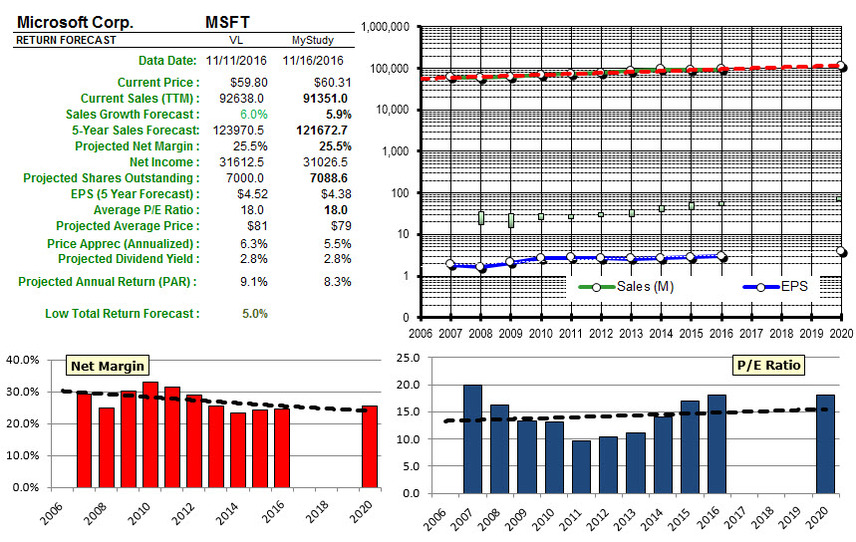
The rhinos (Wall Street analysts and institutions) overreact. Period. In the case of Petroleum (Integrated) companies, I wouldn’t be surprised to see that 2020 actual result more closely match the trend line shown in the accompanying figure. Sometimes, experienced investors simply have to look across the chasm — imagine what it may be like on “on the other side.”

Captain James T. Kirk, as a cadet, was victorious in a No-Win scenario by changing the rules. He reprogrammed the simulation. When faced with a chasm, sometimes you just gotta invest like Captain Kirk.
.

MANIFEST 40 Updates

  • 14. Exxon Mobil (XOM)

Round Table Stocks

  • BP plc (BP)
  • Conoco-Philips (COP)

Best Small Companies

(None)

Results, Remarks & References

Companies of Interest: Value Line (12/2/2016)

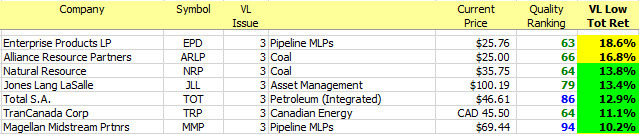
The average Value Line low total return forecast for the companies in this week’s update batch is 4.5% vs. 3.5% for the Value Line 1700 ($VLE).

Attrition (reduction in long term forecasts) seems to have abated a bit for this batch of Value Line updates but remember this is a challenging and cyclical minefield of companies (in general) … shop carefully. There are very few widely-followed or Round Table companies on this week’s menu.
Materially Stronger: Joy Global (JOY) 1, Chemours (CC)

Materially Weaker: Southwestern Energy (SWN), Energy Trans Partners (ETP)

Discontinued: Questar (STR), Infoblox (BLOX), AMN Healthcare (AHS), Rackspace (RAX), Monster Worldwide (MWW)

1 Joy Global (JOY) to be acquired by Komatsu in mid-2017.

Market Barometers
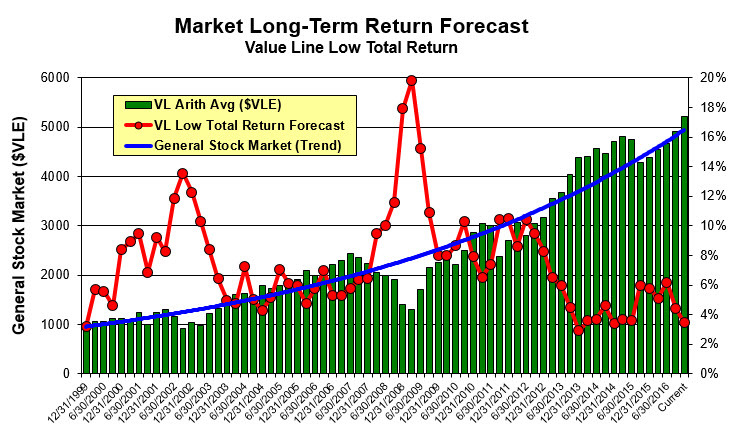
Value Line Low Total Return (VLLTR) Forecast. The long-term low total return forecast for the 1700 companies featured in the Value Line Investment Survey is 3.5%, down from 4.3% last week. For context, this indicator has ranged from low single digits (when stocks are generally overvalued) to approximately 20% when stocks are in the teeth of bear markets like 2008-2009.

Stocks to Study (12/2/2016)

The Long & Short. (December 2, 2016) Projected Annual Return (PAR): Long term return forecast based on fundamental analysis and five year time horizon. Quality Ranking: Percentile ranking of composite that includes financial strength, earnings stability and relative growth & profitability. VL Low Total Return (VLLTR): Low total return forecast based on 3-5 year price targets via Value Line Investment Survey. Morningstar P/FV: Ratio of current price to fundamentally-based fair value via www.morningstar.com S&P P/FV: Current price-to-fair value ratio via Standard & Poor’s. 1-Year ACE Outlook: Total return forecast based on analyst consensus estimates for 1-year target price combined with current yield. The data is ranked (descending order) based on this criterion. 1-Year S&P Outlook: 1-year total return forecast based on S&P 1-year price target. 1-Yr “GS” Outlook: 1-year total return forecast based on most recent price target issued by Goldman Sachs.


We’ve added a Saturday morning Open House session (webcast) to the schedule.

Date: Saturday, December 03 · 10:00 AM – 11:59 AM EST
Location: Online

It’s another Saturday morning as we explore what’s on the mind of our fellow long-term investors. This open house format webcast invites you to participate. We’ll share some thoughts on stocks and topics and issues but mostly we’d like to hear from you.

Register: https://attendee.gotowebinar.com/register/2012622328797380610

Discovery Club

“Dump your hedge funds and explore their small-cap stock picks.”

Small cap is not necessarily small (faster-growing) companies but in general, we like the idea of a nice blend. So yes, we’re interested in hunting down some actionable ideas among the most successful investors on our radar screen — seeking companies that aren’t on too many radar screens, yet. The discovery of smaller, promising and faster-growing companies has always been one of our favorite (and rewarding) activities. In that spirit, we’re expanding our efforts in this realm, seeking smaller, less discovered companies and add them to our coverage. We will continue to scour our Best Small Company Funds with leaders like Brown Small Company.

This Week’s Sources and Suggestions

  • Value Line Investment Survey: Small and Mid-Cap Edition
  • Conestoga Small Cap Investors (CCASX)
  • Goldman Sachs

Coverage Initiated/Restored: Catalent (CTLT), MGP Ingredients (MGPI), Repligen (RGEN), WageWorks (WAGE), Sotheby’s (BID)

Market Barometers (Continued)

As Jeff Traeger pointed out:

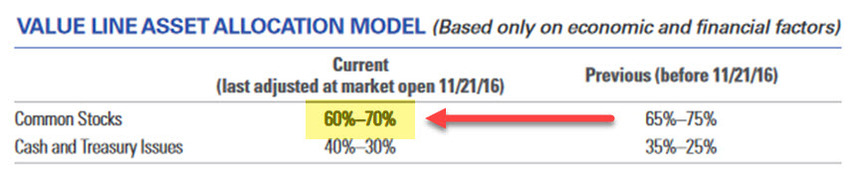
Notable change in Value Line’s asset allocation model as of 11/21/16. Common stock allocation moved down from 65% – 75% to 60% – 70%. This is not an every day occurrence and so is worthy of note. The Value Line commentary indicates that the market is still sound but that the higher price levels signals investor caution. The last change in allocation was an upward move on 2/22/16.
Vl s o 20161121

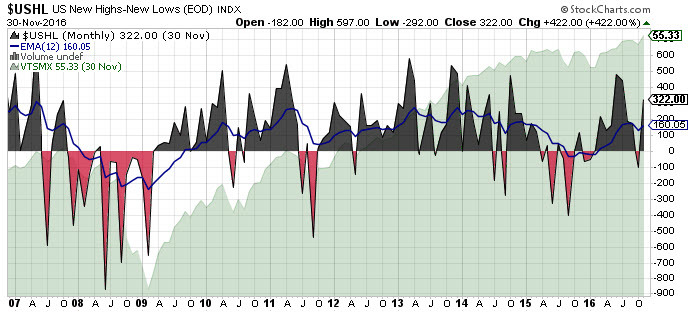
Reminder: We believe elevated safety measures (more emphasis on quality, for some higher percentages of cash equivalents) is merited when the blue long-term trend line crosses through 0.0.
 ushl 20161201


Beyond Cyber Monday … Cyber December

Discover the successful investing approach used by hundreds of thousands of investors over the last several decades. By focusing on company quality, return forecast and growth forecasts — we design and manage portfolios that are built to beat the market.

Create an account at www.manifestinvesting.com for ONLY $79/year — and send an email to manifest@manifestinvesting.com for a 2-for-1 Cyber December SPECIAL. Offer valid  until December 31. You MUST send an email to qualify for the subscription exte

Introductory pricing is only available to households or customers at a business address who have not been subscribers to Manifest Investing within the last 180 days. If you respond to this offer but do not qualify for introductory pricing, we reserve the right to reject your order or prorate your subscription term to reflect current subscriber pricing. This offer may be withdrawn at any time.

Fave Five (12/2/2016)

Fave Five (12/2/2016)

Our Fave Five essentially represents a listing of stocks with favorable short term total return forecasts (1 year, according to Analyst Consensus Estimates, or ACE) combined with strong long-term return forecasts and good/excellent quality rankings. The average 1-year ACE total return forecast is 8.1%.

We’re back after a Turkey hiatus and proceeding with the second year of this weekly feature and resultant tracking portfolio. This week’s stocks represent some leaders with a solid long term outlook, a couple that have clearly found a speed bump … but all of them are generally regarded as “over sold” and many of them have been appearing on screening results.

The Fave Five This Week

  • Allergan (AGN)
  • Cerner (CERN)
  • Steris (STE)
  • Synaptics (SYNA)
  • Teva Pharma (TEVA)

The Long and Short of This Week’s Fave Five

The Long & Short. (December 2, 2016) Projected Annual Return (PAR): Long term return forecast based on fundamental analysis and five year time horizon. Quality Ranking: Percentile ranking of composite that includes financial strength, earnings stability and relative growth & profitability. VL Low Total Return (VLLTR): Low total return forecast based on 3-5 year price targets via Value Line Investment Survey. Morningstar P/FV: Ratio of current price to fundamentally-based fair value via www.morningstar.com S&P P/FV: Current price-to-fair value ratio via Standard & Poor’s. 1-Year ACE Outlook: Total return forecast based on analyst consensus estimates for 1-year target price combined with current yield. The data is ranked (descending order) based on this criterion. 1-Year S&P Outlook: 1-year total return forecast based on S&P 1-year price target. 1-Yr GS: 1-year total return forecast based on most recent price target issued by Goldman Sachs.

Weekend Warriors

The relative/excess return for the Weekend Warrior tracking portfolio is +4.5% since inception. 51.3% of selections have outperformed the Wilshire 5000 since original selection.

Tracking Dashboard: https://www.manifestinvesting.com/dashboards/public/weekend-warriors

Round Table (November 2016)

November Round Table

Our Round Table, a monthly session featuring our favorite stock ideas right now in true round table fashion, was held November 29.

Stocks Discussed

  • CVS Health (CVS)
  • Infosys Tech (INFY)
  • Mercadolibre (MELI)

The stocks selected for this program over the last six years have collectively beaten the Wilshire 5000. The excess return (annualized) has been ranging from 2-3%. We seek actionable opportunities to study and pursue.

The agenda will also include a continuation of our selling decision concept based on relative return.

The round table knights include small company champion and Mid-Michigan Director Ken Kavula; Cy (MythBuster) Lynch; pharmaceutical scientist Hugh McManus; and Manifest Investing’s Mark Robertson who will analyze their favorite stocks. Guest damsels have included Anne Manning, Susan Maciolek and Kim Butcher. Guest knights who have jousted include Nicholas Stratigos, Herb Lemcool and Matt Spielman.

The audience selected CVS Health (CVS).

Positions closed/sold: Knight Transportation (KNX), Landauer (LDR), PRA Group (PRAA), US Physical Therapy (USPH)

The tracking portfolio has been updated at: https://www.manifestinvesting.com/dashboards/public/round-table

Rt poll 20161129

Fave Five (11/18/2016)

Fave Five (11/18/2016)

Our Fave Five essentially represents a listing of stocks with favorable short term total return forecasts (1 year, according to Analyst Consensus Estimates, or ACE) combined with strong long-term return forecasts and good/excellent quality rankings.

This week, we seek the companies with the best return forecasts, highest quality and in a tribute to www.morningstar.com — the companies with the lowest price-to-fair value ratios as being potentially “on sale.” Context: A P/FV = 100% would indicate that a stock is priced at its fair value according to Morningstar.

The Fave Five This Week

  • Cognizant Technology (CTSH)
  • CVS Health (CVS)
  • Novo Nordisk (NVO)
  • Stericycle (SRCL)
  • Synaptics (SYNA)

The Long and Short of This Week’s Fave Five

The Long & Short. (November 18, 2016) Projected Annual Return (PAR): Long term return forecast based on fundamental analysis and five year time horizon. Quality Ranking: Percentile ranking of composite that includes financial strength, earnings stability and relative growth & profitability. VL Low Total Return (VLLTR): Low total return forecast based on 3-5 year price targets via Value Line Investment Survey. Morningstar P/FV: Ratio of current price to fundamentally-based fair value via www.morningstar.com S&P P/FV: Current price-to-fair value ratio via Standard & Poor’s. 1-Year ACE Outlook: Total return forecast based on analyst consensus estimates for 1-year target price combined with current yield. The data is ranked (descending order) based on this criterion. 1-Year S&P Outlook: 1-year total return forecast based on S&P 1-year price target. 1-Yr GS: 1-year total return forecast based on most recent price target issued by Goldman Sachs.

Weekend Warriors

The relative/excess return for the Weekend Warrior tracking portfolio is +5.0% since inception. 50.7% of selections have outperformed the Wilshire 5000 since original selection.

Tracking Dashboard: https://www.manifestinvesting.com/dashboards/public/weekend-warriors

Fave Five (11/11/2016)

Fave Five (11/11/2016)

Our Fave Five essentially represents a listing of stocks with favorable short term total return forecasts (1 year, according to Analyst Consensus Estimates, or ACE) combined with strong long-term return forecasts and good/excellent quality rankings.

The Fave Five This Week

  • FleetCor (FLT)
  • Gildan Activewear (GIL)
  • Rocky Mountain Chocolate Factory (RMCF)
  • Silicon Motion (SIMO)
  • STERIS (STE)

The Long and Short of This Week’s Fave Five

The Long & Short. (November 11, 2016) Projected Annual Return (PAR): Long term return forecast based on fundamental analysis and five year time horizon. Quality Ranking: Percentile ranking of composite that includes financial strength, earnings stability and relative growth & profitability. VL Low Total Return (VLLTR): Low total return forecast based on 3-5 year price targets via Value Line Investment Survey. Morningstar P/FV: Ratio of current price to fundamentally-based fair value via www.morningstar.com S&P P/FV: Current price-to-fair value ratio via Standard & Poor’s. 1-Year ACE Outlook: Total return forecast based on analyst consensus estimates for 1-year target price combined with current yield. The data is ranked (descending order) based on this criterion. 1-Year S&P Outlook: 1-year total return forecast based on S&P 1-year price target. 1-Yr GS: 1-year total return forecast based on most recent price target issued by Goldman Sachs.

Weekend Warriors

The relative/excess return for the Weekend Warrior tracking portfolio is +4.5% since inception. 50.7% of selections have outperformed the Wilshire 5000 since original selection.

Tracking Dashboard: https://www.manifestinvesting.com/dashboards/public/weekend-warriors

Fave Five (11/4/2016)

Fave Five (11/4/2016)

Our Fave Five essentially represents a listing of stocks with favorable short term total return forecasts (1 year, according to Analyst Consensus Estimates, or ACE) combined with strong long-term return forecasts and good/excellent quality rankings.

Every year, we remind investors to focus on small company opportunities in the final quarter of the year. Tax-related selling can often provide outsized opportunities — a condition that is amplified among the faster-growing and promising smaller companies. We used to urge investors to carefully mine the Forbes List of Best Small Companies that was published in late October for 36 years. Unfortunately, Forbes discontinued the feature last year. Fret not. We’ll be out with our own list of 40 Best Small Companies soon (final edits in progress.) The 2016 collection performed very well for the second straight year.

The Fave Five This Week

This week we’re taking a detour to feature the five companies at the top of our 40 Best Small Companies for 2017. As shown here, the 2016 collection outdistanced the Wilshire 5000 by a considerable margin — beating the total stock market for the 8th time in 11 years with an excess/relative return since inception of +4.6%.

  • Forward Air (FWRD)
  • Mercadolibre (MELI)
  • Meridian Bioscience (VIVO)
  • Mesa Labs (MLAB)
  • Neogen (NEOG)

Context: The median S&P price to fair value ratio is 102%.

The Long and Short of This Week’s Fave Five

The Long & Short. (November 4, 2016) Projected Annual Return (PAR): Long term return forecast based on fundamental analysis and five year time horizon. Quality Ranking: Percentile ranking of composite that includes financial strength, earnings stability and relative growth & profitability. VL Low Total Return (VLLTR): Low total return forecast based on 3-5 year price targets via Value Line Investment Survey. Morningstar P/FV: Ratio of current price to fundamentally-based fair value via www.morningstar.com S&P P/FV: Current price-to-fair value ratio via Standard & Poor’s. 1-Year ACE Outlook: Total return forecast based on analyst consensus estimates for 1-year target price combined with current yield. The data is ranked (descending order) based on this criterion. 1-Year S&P Outlook: 1-year total return forecast based on S&P 1-year price target. 1-Yr GS: 1-year total return forecast based on most recent price target issued by Goldman Sachs.

Weekend Warriors

The relative/excess return for the Weekend Warrior tracking portfolio is +4.0% since inception. 52.5% of selections have outperformed the Wilshire 5000 since original selection.

Tracking Dashboard: https://www.manifestinvesting.com/dashboards/public/weekend-warriors

Fave Five (10/28/2016)

Fave Five (10/28/2016)

Our Fave Five essentially represents a listing of stocks with favorable short term total return forecasts (1 year, according to Analyst Consensus Estimates, or ACE) combined with strong long-term return forecasts and good/excellent quality rankings.

So you’re looking at the stocks in the top 1% of all companies according to MANIFEST Rank (Return Forecast and Quality combination) that have the lowest price-to-fair value ratios (P/FV) according to S&P. The P/FV profile for the S&P Platinum Portfolio is shown here:

The Fave Five This Week

  • Abbvie (ABBV)
  • Celgene (CELG)
  • Deckers (DECK)
  • LKQ Corp (LKQ)
  • Stericycle (SRCL)

Context: The median S&P price to fair value ratio is 102%.

The Long and Short of This Week’s Fave Five

The Long & Short. (October 28, 2016) Projected Annual Return (PAR): Long term return forecast based on fundamental analysis and five year time horizon. Quality Ranking: Percentile ranking of composite that includes financial strength, earnings stability and relative growth & profitability. VL Low Total Return (VLLTR): Low total return forecast based on 3-5 year price targets via Value Line Investment Survey. Morningstar P/FV: Ratio of current price to fundamentally-based fair value via www.morningstar.com S&P P/FV: Current price-to-fair value ratio via Standard & Poor’s. 1-Year ACE Outlook: Total return forecast based on analyst consensus estimates for 1-year target price combined with current yield. The data is ranked (descending order) based on this criterion. 1-Year S&P Outlook: 1-year total return forecast based on S&P 1-year price target. 1-Yr GS: 1-year total return forecast based on most recent price target issued by Goldman Sachs.

Weekend Warriors

The relative/excess return for the Weekend Warrior tracking portfolio is +8.7% since inception. 42.6% of selections have outperformed the Wilshire 5000 since original selection.

Tracking Dashboard: https://www.manifestinvesting.com/dashboards/public/weekend-warriors

Relatively Better Selling?


During the October Round Table, we discussed our exploration into the possibility of building an excess/relative return based trigger to limit losses and preserve capital.  We repeat. This is intended to be incremental and additive to the time-honored selling guidelines reviewed here and this is a work-in-progress.  We’re continuing to review whether the trigger point should be variable (a function of inherent characteristics) and whether the 1-year vigilance period is appropriate.  This reprint is a recent cover story from Manifest Investing that provides a thumb nail of the concept/project.

“The ability to select stocks, manage them over time and know when to sell them is incredibly difficult, even for professional fund managers.” — Barry Ritholtz

When to Sell: The Challenge of Reason We don’t want to give the impression that any of the time-honored selling disciplines change with the exploration/concept described here. We still believe that the reasons for selling are short and simple: (1) You need the money, (2) Signs of quality degradation and (3) You can make the portfolio better. That said, we’ll explore this capital preservation and rate of return potential enhancement and decide if it’s a worthy improvement in our arsenal.

During the April Round Table, we struck a community collective nerve. We reminded that we’ve deployed a new selling discipline in a few different places that is based on the notion of an alert, or a flag, based on relative return. Based on the case studies with the embryonic Fave Five Weekend Warriors and Round Table tracking portfolios the concept is compelling. The approach is incremental. Nothing about our traditional selling disciplines is disrupted. This month, we explore the impact of this concept on the Solomon Select monthly features over the last 11-12 years. will be intended to side step excursions and preserve capital.

“The ability to select stocks, manage them over time and know when to sell them is incredibly difficult, even for professional fund managers.” — Barry Ritholtz

I’d go a step further than Barry and say that “especially” might be more acurate (than “even”) for rhinos and average investors. It might even be more challenging when it comes to companies doing share repurchases. But that’s a story for another day.

We’re here for the returns. Anything that offers the potential of an incrementally higher performance is something that grabs our attention. We’ve long been troubled by selections that have underperformed, rapidly losing 60-80% of the purchase price — in some cases within a few months of the original decision. It seems like the damage is often done in 90 days or less. So we decided to subject the monthly decisions made for the Solomon Select feature to this concept. Many stocks have been “sold” when the stock price soared and the return forecast dropped below the market average. Victory laps are always fun. Those stocks have been celebrated and “dismissed” from the tracking portfolio over the years. But what about the other extreme? It’s a question that has haunted many of us — for a long time.


Total Assets vs. “Small” Incremental Returns. The audience at the Better Investing national convention treasured this reminder about small advantages and huge gains in incremental results. We do, too.


Investing $100 each and every month into the Wilshire 5000 since the inception of Manifest Investing would deliver a passive rate of return of 9.6%.

So far, using the original three selling criteria, the tracking portfolio rate of return is 11.1% — a relative rate of return vs. the total stock market of +1.5%.

Implementing at relative return “stop”/alert concept explored here increases the rate of return since inception to 13.3% —2.2% higher!

The accompanying figure courtesy of Walter Schloss and his track record is a powerful reminder about the vast gains possible over the long term from a “percentage point or two.” And yes, Virginia, it’s exponential.

+2.2%?

Yes, +2.2%. Matching the market at 10% over the period shown for Walter Schloss netted $4114 from the original $100. Beating the market by 2%, or 12% absolute, turned that $100 into $8308. Tacking on a mere +2.2%, or an additional two percentage points swells that $8308 to $16,569. It’s the answer to “When is 2% actually worth 100%?”

Think about it. +2% matters.

Iconix Brands (ICON): Time Out! Poster child for a concept. $1000 invested in ICON for the Round Table tracking portfolio had sunk to $800 against a flat total stock market. “Selling” preserved the $800 which would have plummeted to $330 within a few months.

“Time Out” Based on Relative Return

The concept is simple. It’s inspired by one of the steadfast rules on selling stocks made popular by Investor’s Business Daily and William O’Neil. Their discipline is to sell any holding that drops 7-8% from the original selection point. In our view, this would lead to excessive turnover if we attempted to apply the discipline to our style of investing. But the preservation of capital concept has merit and the general approach of “stopping” to check for assumption errors, etc. seems worthy.

But we’d want to avoid selling a stock that drops 8% when the total stock markets drops, for example, 10%. Hence, our focus and emphasis on relative return. We want to single out stocks that have under performed the overall market on an individual, and comparison, basis.

We’ve discussed this at a few Round Table webcasts and most notably during the selection of Iconix Brands (ICON) during April 2009. We now see the ICON case as something of a “poster child” for the concept. The original $1000 invested in ICON as part of the Round Table tracking portfolio on 4/30/2015 had dwindled to $800 by 8/3/2015. The Wilshire 5000 had actually gained 0.1% over the same period. As shown in the accompanying figure, ICON continued its swoon. This finance.yahoo.com chart is constructed by comparing the price of the stock with VTSMX with the selection date as the start date and displayed on the far left. The relative return is the difference between the blue and red lines over time.

As shown, the swoon did not stop at $800 and the original $1000 invested was worth only $256 by 11/6/2015. Was a “time out” clearly in order after dropping the original 20%?

Solomon Select Suggestion

So we asked a question. Actually, a few questions.

(1) Are there any cases of a stock “bottoming” and getting toggled out of the portfolio where the selection had gone on to deliver market-beating returns?

(2) Is 20% the right number?

One of the earliest Solomon Select features was Oracle (ORCL) back in May 2005. As shown, ORCL trailed the overall stock market by approximately 15% in early 2006. Setting the limit closer to 15% would have stopped out this strong performer — +7.2% annualized relative return for 11 years. We were not able to find another case where a “premature” time out would have ultimately prevented a strong long term performance.

(3) Would 20% result in a high turnover rate?

We found that (24) of the 134 transactions made over the last eleven years for the Solomon Select feature actually triggered the 20% condition. The names read like a roll call of disappointment: American Capital Strategies, Atwood Oceanics, Capella Education, Coach, Dolby Labs, Garmin, Landauer, Nokia, Quality Systems, Strayer Education, Urban Outfitters …

(In all fairness, companies like Coach and Urban Outfitters also have SUCCESSFUL close outs within the Solomon Select tracking portfolio — a condition that we’d probably reasonably expect from this relatively volatile sector.)

So we’re generally looking at a couple of instances per year — a notion shared by one Round Table webcast participant who wondered if this wouldn’t simply flag companies on the wrong end of the Rule-of-Five … and reduce losses, pain and suffering? Bottom line: We don’t know if 20% is the number — it may be variable and perhaps a function of quality, for example — but a target setting in this range would not seem to produce excessive turnover.

(4) What is the typical holding period for these triggered transactions?

With one exception (Qualcomm at 3.3 years), the 20% limit triggered in less than 18 months with an average holding period of approximately 9 months. That would be easy to remember! Nearly 50% of the cases triggered in less than six months.

(5) Do the tools exist to do this?

Not exactly. An investor could use spreadsheets but we’re not aware of an existing commercial source for tracking this condition. Would we add it to Manifest Investing? Possibly. If our explorations continue to show this potential, we’ll consider adding this type of performance tracking as a portfolio management tool.

Our Like-Minded Community Heard From

We think the concept is both intriguing and compelling. Our community of investors apparently agrees as we’ve received an unusually large amount of correspondence on the subject. Most of it rhymes with this:

“I think you guys could really be on to something here. In the same way that Stock Selection Guide based studies can be messed up by a plummeting stock price – with Upside-Downside ratios run amok – and a company that is struggling actually can appear ‘more attractive’ on a Guide … I think this concept holds merit for gauging and challenging those stocks with PARs greater than the sweet spot.”

“This could be a game changer. I’ve been looking for a concept like this for a very long time.”

In short, I think the potential is promising. Probably at least as compelling as embedding the analyst estimates in our business model analyses. It’s not a violation of “buy low and sell high” because we’re here for the returns and it’s the bigger picture, the cumulative results that matter. We’ll continue to test other portfolios and implement standing procedures that may become disciplines and best practices over time.

Nordstrom (JWN)

This is a sample stock analysis, the type of feature that we regularly share with subscribers at http://www.manifestinvesting.com  Stocks selected during our FREE/public monthly webcasts known as our Round Table have outperformed the market (Wilshire 5000) for over 5 years.  FREE test drives and trial subscriptions available. If you’d like to be added to a reminder list for future monthly Round Tables, send a request to nkavula1@comcast.net.


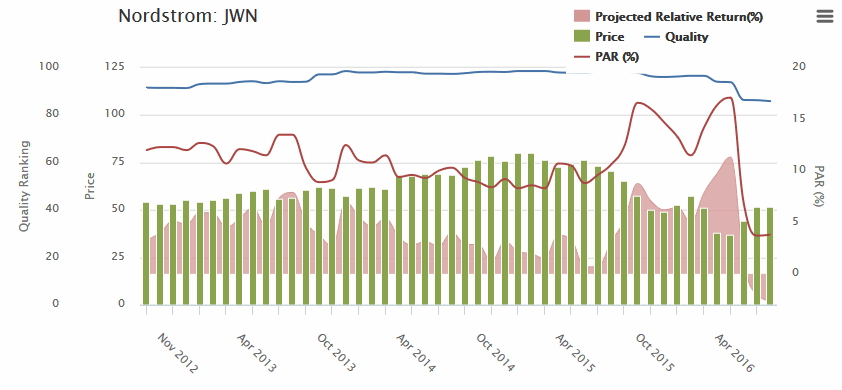
Here’s a quick look at Nordstrom (JWN). It’s a quality company, but the sagging profitability is a concern. These return forecasts should make it clear why it was “sold” from the Round Table tracking portfolio after only five months — but after it had delivered gains greater than 40%.

Note the return forecast (PAR) in the chronicle and the erosion of quality. This is also an example of a company going from forecast excess returns (pink shaded area, projected relative return) to sub-zero where the stock is projected to lag the market over the long term.

Jwn eagle 20161025