Wrong Way To View Investment Risk?

After a cursory review, I’m wondering if this book doesn’t have the potential to parallel (and rhyme with) Nicholson’s 1984 Individual Investor’s Manual and for that reason, I’ve ordered my advance copy for a closer look. As you read this overview, notice how often the things he says, starting with the definition of risk through the eyes of a disciplined long-term investor, the recovery following the Great Recession of portfolios like Tin Cup … and a host of other philosophies that we hold dear, including but not limited to our practice of all-of-the-above investing. (Note his references to the equally-weighted Wilshire 5000) His objective mapping even resembles our +5% mantra. I look forward to a closer look and sharing thoughts with our community of investors during a future book review.

Looking at Investment Risk the Wrong Way

by James B. Cloonan, AAII Founder and Chairman

We have all been looking at investment risk the wrong way. And unfortunately we have been paying dearly for this mistake. Please allow me a moment to explain this statement and to teach you how you can change your day-to-day investment approach to compensate for what has more than likely been years of under performance.

You can easily produce much more investment return if you are willing to embrace what I call Level3 logic and reason when dealing with your investment program. The simple truth is that every long-term investor will hit two, perhaps three, major market downturns in their investment life.

Historically, these major downturns take only 3 to 4 years to recover from (come back to even) if you were to do nothing but simply stay in the market. Remember, markets have historically always risen and that is a great advantage for the individual investor … But the financial press, CNBC and Wall Street has everyone brainwashed to believe that we need to put 40%, 50% or even 60% of our assets into so-called safe investments (bonds and cash). Investing with that level of safety is insane when you realize that since 1871 market downturns have recovered as follows:

  • 33% of market downturns recover within a month
  • 50% of market downturns recover within 2 months
  • 80% of market downturns recover within 1 year
  • 95% of the time, those big “once or twice in a lifetime drops” return back to even in 3 to 4 years with an appropriate portfolio

Collectively, since 1871 the time it takes for the market to recover (top to trough to top again) is a mere 7.9 months. (This context and perspective is urgent to understanding what we do and how we do it.)

Unfortunately, most individual investors watch daily, weekly, monthly and quarterly market moves like their life depends on it. The logical and far more reasonable way to invest is to put only what you will need to withdraw from your portfolio for living expenses over the short term into extremely safe (cash-like) accounts and to invest the rest of your assets in stocks. I define short-term as 3 to 4 years. This is a logical and rational use of funds that serve as a safety net that can be used to ride out any downfall Mr. Market throws our way. It also serves to keep us from having to focus on the near-term performance results of our portfolios. Having a near-term safety net allows investors to be more aggressive in the overall stock portion of their portfolios while being able to simultaneously ignore short-term market swings.

The equal-weighted Wilshire 500 index represents a much broader basket of companies and has a much larger number of small-cap and mid-cap stocks in its holdings. That smaller company skew is what propelled the Wilshire 5000 equal-weighted index up to an annualized return of 17.1% over the past 45 years (the longest data set available for this segment of the market).

Trust me when I say that long term most investors would be jumping up with joy to achieve just the S&P 500’s return. But the fact is, most investors fail to come even close to the overall market return, let alone our favored cousin – the equal-weighted Wilshire 5000. In-the-know researchers and studies from actual brokerage account transactions show that most investors get into and out of the market at the absolute wrong time. That coupled with their fixation on large-cap growth stocks has produced returns that are closer to 7% or 8% on an annualized basis.

Following the Level3 Investing approach that I have developed allows investors the ability to implement 3 investor advantages that can propel portfolio returns and generate huge sums of wealth:

Advantage #1—My Level3 Investment Strategy teaches you how to understand and use risk to your advantage by building a cash cushion that will weather any market downturn. Simultaneously the strategy frees you to put more of your assets into higher returning portions of the investment marketplace – individual stocks and a handful of passive ETFs (I call them forever funds.)

Advantage #2—Level3 Investment Research has tapped into academic and time-tested studies to show beyond a reasonable doubt that investment portfolio growth comes from small and mid-cap stocks not large-cap companies. So if you are a long-term investor, you should be looking closely at building up not only the overall size of your equity portfolio but the percent you equate to small and mid-cap stocks and funds. Remember, these are the types of investments that history shows have outpaced the overall market by more than 4% per year. Average investors produce 8% return, while a Level3 approach should produce 12%. Regardless of the size of your portfolio, that 4% difference will provide you with twice the assets of a regular investor in 18 short years.

Advantage #3—Level3 Investing drives home the use of Time Diversification. My new Level3 approach uses investment research that has proven that no matter how much the equity market collapses it historically has always exceed its previous high.We know that investing can be difficult when markets drop, but as an individual investor you must remember that history shows that all dips all crashes and all drops ultimately lead to higher returns. Market data since 1871 bears this out. And best of all, the kinds of stocks that Level3 investing favors are the kinds of stocks that rebound the fastest! Going forward, if you can keep the concept that time favors the individual investor in the forefront of your mind, you will find that investing becomes much easier.

If you are interested in becoming a Level3 type of investor, I encourage you to do the following …

Accept that true investment risk is not some arbitrary percentage downfall in the market this day, week, month or year, but that investment risk is actually failing to meet your retirement lifestyle goals because the funds we reasonably expect to have are NOT THERE when needed. That’s the Level3 definition of long-term risk, not having the assets needed to live the life you deserve!

Think about what it means to be a true long-term investor and recognize that any funds you need in the next 4 to 5 years should simply not be invested in stocks or bonds. Your near-term spending needs should be placed in money market accounts, CDs or savings. Thus when and if the market drops, near-term you know that you will have the funds needed to live your current lifestyle and not have to worry about selling at a bottom to get cash or fleeing the overall market because you are afraid of losses. This one simple strategy allows you to earmark the bulk of your overall assets into long-term Level3-type stock and fund investments that can generate wealth quicker than any other asset class.

Recognize that greater long-term [appreciation] comes from investing in smaller and mid-cap companies. If these types of holdings are not in your portfolio, consider adding them. You can start by looking into Guggenheim’s RSP or you can use the link below to purchase my new “Investing at Level3” book where I share a handful of ETFs that you could simply hold forever.

“Investing at Level3” is a refreshingly simple and historically proven way to invest that has the power to greatly impact your wealth as well as your retirement lifestyle.

The “Investing at Level3” approach, if followed diligently, could double or triple the value of a portfolio at retirement for the long-term investor when compared to today’s current investment practices. The book provides a research-driven yet easy-to-use approach to help individual investors with overcoming their unease with investment risk, investing while in retirement, investment selection, asset allocation, retirement funding and more.

Fondly,

James B. Cloonan
AAII Founder and Chairman

  • The Wilshire 5000 Equal Weighted index is not generally quoted and has no symbol. There is no fund replicating it because many of the stocks have limited float, but it does serve as a good proxy for the type of investing I outline in my new book “Investing at Level3.” If I have piqued your interest, current and past values can be found at Wilshire.com under the Wilshire Index Calculator. (This is why we use the Value Line Arithmetic Average, $VLE via www.stockcharts.com)


Fave Five (10/14/2016)

Fave Five (10/14/2016)

Our Fave Five essentially represents a listing of stocks with favorable short term total return forecasts (1 year, according to Analyst Consensus Estimates, or ACE) combined with strong long-term return forecasts and good/excellent quality rankings.

So you’re looking at the stocks in the top 1% of all companies according to MANIFEST Rank (Return Forecast and Quality combination) that have the highest 1-year total return forecasts according to the analyst consensus estimates. (ACE)

The Fave Five This Week

  • Aaron’s Rents (AAN)
  • Celgene (CELG)
  • Cognizant Technology (CTSH)
  • Novo Nordisk (NVO)
  • Universal Display (OLED)

Context: The median 1-year return forecast (ACE) is 9.9%.

The Long and Short of This Week’s Fave Five

The Long & Short. (October 14, 2016) Projected Annual Return (PAR): Long term return forecast based on fundamental analysis and five year time horizon. Quality Ranking: Percentile ranking of composite that includes financial strength, earnings stability and relative growth & profitability. VL Low Total Return (VLLTR): Low total return forecast based on 3-5 year price targets via Value Line Investment Survey. Morningstar P/FV: Ratio of current price to fundamentally-based fair value via www.morningstar.com S&P P/FV: Current price-to-fair value ratio via Standard & Poor’s. 1-Year ACE Outlook: Total return forecast based on analyst consensus estimates for 1-year target price combined with current yield. The data is ranked (descending order) based on this criterion. 1-Year S&P Outlook: 1-year total return forecast based on S&P 1-year price target. 1-Yr GS: 1-year total return forecast based on most recent price target issued by Goldman Sachs.

Weekend Warriors

The relative/excess return for the Weekend Warrior tracking portfolio is +9.8% since inception. 44.3% of selections have outperformed the Wilshire 5000 since original selection.

Tracking Dashboard: https://www.manifestinvesting.com/dashboards/public/weekend-warriors

MANIFEST 40 Update (9/30/2016)

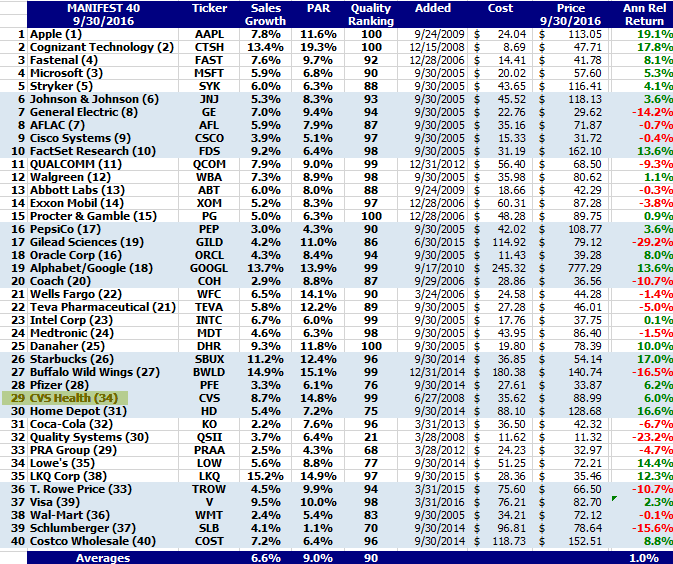
Our MANIFEST 40 is a celebration of collective excellence in stock selection, strategy and disciplined patience.

“We have always believed that the collective decisions made by our community of long-term investors are worth huddling over … a place where ideas are born.”

The 40 stocks are something of a barometer because we know that these community favorites are not simply followed … most of them are also widely owned, with considerable diligence and vigilance.

The rate of return remains at 8.8% since inception (9/30/2005) vs. 5.8% for matching investments in the Wilshire 5000 for an excess/relative return of +3.0%. We believe that this portends success for many of our subscribers and investors.

MANIFEST 40: September 2016. Performance Results. These are the most widely followed stocks by Manifest Investing subscribers. Current leader Apple (AAPL) was added on 9/24/2009 and steadily climbed the ranks while generating a relative return of +19.1% (annualized). Figures in parentheses are the June 2016 rankings. Tracking dashboard: https://www.manifestinvesting.com/dashboards/public/manifest-40

Quality is still solid at 90 and the overall return forecast is 9.0%, pegged to slightly outperform the Wilshire 5000 or S&P 500. The average sales growth forecast is 6.6%. Again, we’d like to see an emphasis on discovering smaller, faster-growing companies — the focus of our Discovery Club efforts. We miss smaller, less discovered, companies poised to make difference, like Bio-Reference Labs (BRLI) did.

The top performers continue to be Apple (AAPL), Cognizant Technology (CTSH), Starbucks (SBUX), and Home Depot (HD). 57.5% of the decisions have outperformed the market.

Capturing Attention: Charger

CVS Health (CVS) advanced from #34 to #29. We’ve noted that CVS has been ubiquitous on screening results for a while and collectively, you’ve noticed. Fastenal and Microsoft swapped positions in the top 5 but there are no new entries to the 40 this quarter.

The results of $100 invested into any of these positions at the time of addition can be viewed at any time at: https://www.manifestinvesting.com/dashboards/public/manifest-40

We’ll continue to hope that a few promising faster growers will penetrate a future roll call.

Novo Nordisk (NVO)

This is a sample stock analysis, the type of feature that we regularly share with subscribers at http://www.manifestinvesting.com  Stocks selected for this monthly feature have outperformed the market (Wilshire 5000) for over 12 years.  FREE test drives and trial subscriptions available.

Solomon Select (October 2016)

Novo Nordisk (NVO)

This month we take a look at another “flavor” of repeat selections. Guest damsel Kim Butcher presented this world class leader in insulin and diabetes care during the August and September Round Table webcasts. The audience was polled and sanctioned the nomination both times.

As detailed in recent Barron’s coverage, Denmark’s Novo Nordisk (NVO), the global leader in diabetes medications, will get a new CEO in January, when company insider Lars Fruergaard Jørgensen takes the reins from his long-serving predecessor. But don’t expect the company’s strategy to change, even though increased competition and turmoil in the U.S. health-care market lately have pressured results.

NVO intends to stay the course, building on its No. 1 status in diabetes management, and expanding its drug pipeline into other lucrative areas, such as medications to fight obesity, hormone regulation and treatment of hemophilia. With a portfolio of new and more efficacious diabetes drugs, and other promising treatments in the wings, the company is likely to win back investors.

Novo Nordisk (NVO): Business Model Analysis. 9-10% top line growth has been the trend for NVO in the face of economic pressures in Europe and the long term market drivers (demographics and obesity macro trends) suggest continuing growth. Profitability has been steadily improving but will likely plateau under competitive pressures and P/E ratios in the realm of 20x seem reasonable going forward.

Growth, Profitability, Valuation

The Manifest Investing sales growth forecast for NVO is 9.2%. Value Line has a 3-5 year sales growth forecast of 10% and Morningstar “dissents” a little with 5% revenue growth expectation through 2020. The company has scaled back top line growth projections for 2016 to 5-7% and the analyst consensus expects a continuation in 2017. Novo Nordisk “should return to double-digit growth when new products reach critical mass,” says ABG Sundal Collier analyst Andrew Carlsen. But that might not happen before the end of 2018. By then, sales of new products could offset the effects of U.S. pricing pressure.

We’re using 31.0% for the projected net margin. The average net margin has been 28.2% for the period 2010-2015. Value Line has a 3-5 year projected net margin of 34.0%. The trend as shown in the accompanying profitability graphic is strong and in the right direction. Morningstar acknowledges pressures on margins but stipulates that manufacturing efficiencies and product mix will alleviate some of this.

The median P/E for the period 2008-2015 is 20.3×. We’re using 21x for the projected average P/E.

At the time of selection (10/4/2016), the stock price is $40.63, the projected annual return is 15-16%. The quality RANKING is 99 (Excellent, Top Shelf) and the financial strength rating is 94 (A+).

Points of View

The Value Line low total return forecast for NVO is approximately 12%. Morningstar has NVO with a fair value of $51 for a price-to-fair value ratio of 82%.

Last week, the company announced it would cut about 1,000 jobs from its 42,300-strong workforce to reduce costs. The move underscores Novo Nordisk’s struggle to maintain strong growth amid the competition in the insulin market, which accounts for more than half its sales. The company has a strong track record when it comes to return on research invested, comparing favorably versus Sanofi and other major pharma players. That said, the departure of the CEO and the apparent intentions to expand efforts in new insulin technologies and other frontiers could possibly mark a directional shift for the company. Value Line continues to look for expansion of the diabetes business … issue took a hit following loss of a contract with Express Scripts and lowered guidance … creating a potentially favorable entry point for patient investors.

Fave Five (10/7/2016)

Fave Five (10/7/2016)

Our Fave Five essentially represents a listing of stocks with favorable short term total return forecasts (1 year, according to Analyst Consensus Estimates, or ACE) combined with strong long-term return forecasts and good/excellent quality rankings.

So you’re looking at the stocks in the top 1% of all companies according to MANIFEST Rank (Return Forecast and Quality combination) that have the highest 1-year total return forecasts according to the analyst consensus estimates. (ACE)

The Fave Five This Week

  • Cognizant Technology (CTSH)
  • CVS Health (CVS)
  • Hain Celestial (HAIN)
  • Novo Nordisk (NVO)
  • Simulations Plus (SLP)

Context: The median 1-year return forecast (ACE) is 9.6%.

The Long and Short of This Week’s Fave Five

The Long & Short. (October 7, 2016) Projected Annual Return (PAR): Long term return forecast based on fundamental analysis and five year time horizon. Quality Ranking: Percentile ranking of composite that includes financial strength, earnings stability and relative growth & profitability. VL Low Total Return (VLLTR): Low total return forecast based on 3-5 year price targets via Value Line Investment Survey. Morningstar P/FV: Ratio of current price to fundamentally-based fair value via www.morningstar.com S&P P/FV: Current price-to-fair value ratio via Standard & Poor’s. 1-Year ACE Outlook: Total return forecast based on analyst consensus estimates for 1-year target price combined with current yield. The data is ranked (descending order) based on this criterion. 1-Year S&P Outlook: 1-year total return forecast based on S&P 1-year price target. 1-Yr GS: 1-year total return forecast based on most recent price target issued by Goldman Sachs.

Weekend Warriors

The relative/excess return for the Weekend Warrior tracking portfolio is +7.3% since inception. 44.1% of selections have outperformed the Wilshire 5000 since original selection.

Tracking Dashboard: https://www.manifestinvesting.com/dashboards/public/weekend-warriors

Wall Street on Water … Ahead

This Week at MANIFEST (9/23/2016)

If you’ve ever wondered what a cruise ship class room looks like, here’s Christi Powell (Oklahoma City) aboard the Holland Cruise Lines Westerdam doling out another one of her exceptional classes on common sense financial matters. This voyage had two side-by-side class rooms, attended pretty much as you see here. As you can see, it’s like any other class room — except for the glaciers, whales, salmon and Alaskan fjords out the window.

Relatively small blocks of time (1 hour each) were carved out during the cruise to present a number of investing-related classes over a span of seven days. It was the first time Manifest Investing had attended and participated in one of these efforts and we came away impressed with the potential. The pace was unhurried and attendees had plenty of opportunities over dinners and while navigating the waters to discuss just about anything. We’ll probably explore collaborating with Better Investing and reaching out to some other communities for a Boston-to-Montreal version of this cruise next year. Stay tuned for more details and please send us a note (manifest@manifestinvesting.com) if you’d be interested in exploring more details about a future cruise… and we’ll add you to the “Maybe” Manifest. (grin)

There were many highlights and we’ll continue the roll out of the handbook chapters we issued to our ship mates in days ahead.

MANIFEST 40 Updates

  • 4. Fastenal (FAST)
  • 15. Procter & Gamble (PG)
  • 31. Home Depot (HD)
  • 35. Lowe’s (LOW)

Round Table Stocks: Chicago Bridge & Iron (CBI), Fastenal (FAST), Tractor Supply (TSCO)

Best Small Companies (None this week)

Results, Remarks & References

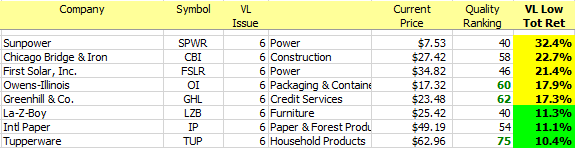
Companies of Interest: Value Line (9/23/2016)

The average Value Line low total return forecast for the companies in this week’s update batch is 5.0% vs. 5.0% for the Value Line 1700 ($VLE).

Materially Stronger: Ethan Allen (ETH), Bemis (BMS)

Materially Weaker: Sunpower (SPWR), Tractor Supply (TSCO), Tile Shop Holdings (TTS)

Discontinued: Cablevision (CVC), Elizabeth Arden (RDEN)

Market Barometers

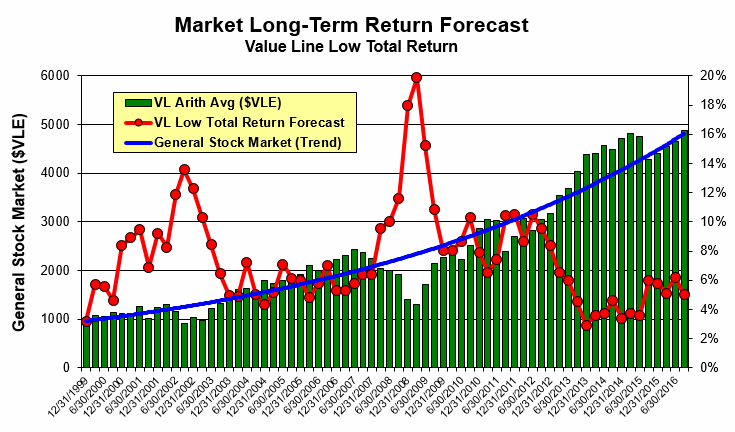
Value Line Low Total Return (VLLTR) Forecast. The long-term low total return forecast for the 1700 companies featured in the Value Line Investment Survey is 5.0%, unchanged from 5.0% last week. For context, this indicator has ranged from low single digits (when stocks are generally overvalued) to approximately 20% when stocks are in the teeth of bear markets like 2008-2009.

Stocks to Study (9/23/2016)

The Long & Short. (September 23, 2016) Projected Annual Return (PAR): Long term return forecast based on fundamental analysis and five year time horizon. Quality Ranking: Percentile ranking of composite that includes financial strength, earnings stability and relative growth & profitability. VL Low Total Return (VLLTR): Low total return forecast based on 3-5 year price targets via Value Line Investment Survey. Morningstar P/FV: Ratio of current price to fundamentally-based fair value viawww.morningstar.com S&P P/FV: Current price-to-fair value ratio via Standard & Poor’s. 1-Year ACE Outlook: Total return forecast based on analyst consensus estimates for 1-year target price combined with current yield. The data is ranked (descending order) based on this criterion. 1-Year S&P Outlook: 1-year total return forecast based on S&P 1-year price target. 1-Yr “GS” Outlook: 1-year total return forecast based on most recent price target issued by Goldman Sachs.

Stock Selection & Portfolio Management September 24, 2016 at 9:00 AM ET Indianapolis, Indiana

Ken Kavula & Mark Robertson will be the featured presenters at this all-day educational workshop for long-term investors. Overview of Analysis (We’ll actually do a case study — walking through the analysis with exposure to our favorite resources and research.) Common Ground – How investment clubs take care of a portfolio. We’ll review portfolio design and discuss management considerations. What is effective stock “watching?” How can we best be vigilant for opportunities and threats to our holdings? Discovery – A demonstration of various screening resources with a look at some of our favorite resources. An Industry Study – Taking a discovery and putting it through its paces to ensure that we’re considering (or accumulating and retaining the best of the best) Let’s Talk Stocks – An interactive, audience-driven discussion of specific study ideas and case studies.

For more information: Go here.

September Round Table September 27, 2016 at 8:30 PM ET ONLINE

Stocks Featured: TBD

The Round Table tracking portfolio has beaten the market by 3-4 percentage points over the last five years. Consider joining Kim Butcher, Ken Kavula, Hugh McManus and Mark Robertson as they share their current favorite stock study ideas.

We will be continuing the discussion of the relative return-based selling guideline for portfolio management.

Registration: https://www.manifestinvesting.com/events/199-round-table-september-2016

Discovery Club

“Dump your hedge funds and explore their small-cap stock picks.”

Small cap is not necessarily small (faster-growing) companies but in general, we like the idea of a nice blend. So yes, we’re interested in hunting down some actionable ideas among the most successful investors on our radar screen — seeking companies that aren’t on too many radar screens, yet.

The discovery of smaller, promising and faster-growing companies has always been one of our favorite (and rewarding) activities. In that spirit, we’re expanding our efforts in this realm. This week, we redouble our efforts to discover some smaller, less discovered companies and add them to our coverage. The EXTENDED EDITION of the Value Line Investment Survey will be the first resource scanned and we’ll also take a look at some new positions or significant accumulations among our Best Small Company Funds starting with Brown Small Company.

But it doesn’t end with only the smaller companies, we’ll also be vigilant for opportunities flagged by reviewing the quarterly filings of idea generation resources like the Renaissance Technologies hedge fund.

This Week’s Sources and Suggestions

  • ITC Holdings (ITC) — Thanks, Marty Eckerle (Temporary Reinstatement)
  • Value Line Investment Survey

Coverage Initiated/Restored: CalAtlantic (CAA), Fonar Corp (FONR), ITC Holdings (ITC), State National (SNC)

Market Barometers (Continued)

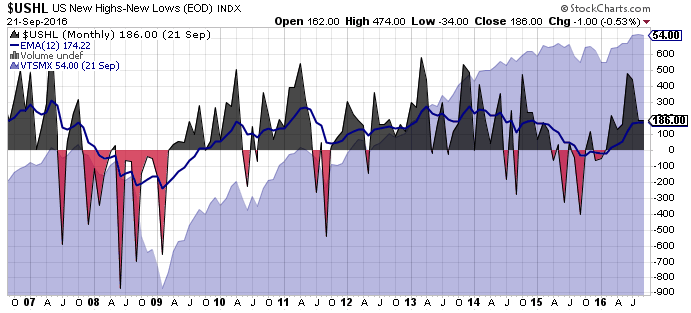
By popular demand, it’s probably time to check in on our of favorite, albeit obscure, market barometers.

US New Highs-New Lows ($USHL)

The long-term trailing average for $USHL actually dipped below zero within the past year — and trepidation was a little more rampant. But as shown here, the storm seems to have passed.

 ushl 20160921

Fave Five (9/23/2016)

Fave Five (9/23/2016)

Our Fave Five essentially represents a listing of stocks with favorable short term total return forecasts (1 year, according to Analyst Consensus Estimates, or ACE) combined with strong long-term return forecasts and good/excellent quality rankings.

So you’re looking at the stocks in the top 1% of all companies according to MANIFEST Rank (Return Forecast and Quality combination) that have the highest 1-year total return forecasts according to the analyst consensus estimates. (ACE)

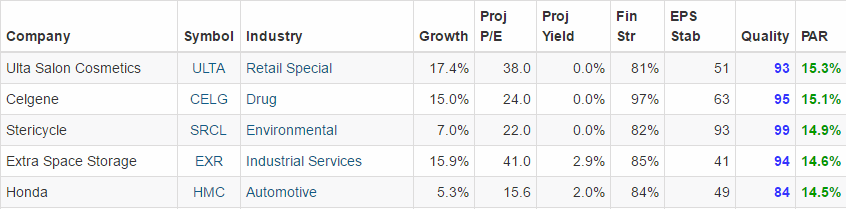
The Fave Five This Week

  • Celgene (CELG)
  • Extra Space Storage (EXR)
  • Honda (HMC)
  • Stericycle (SRCL)
  • Ulta Salons (ULTA)

Context: The average 1-year total return forecast for the Value Line 1700 is 14.7%. The average 5-year return forecast for $VLE is 5.0% (annualized).

This Week’s Fave Five In The Sweet Spot

Sweet Spot Five. (September 23, 2016) Projected Annual Return (PAR): Long term return forecast based on fundamental analysis and five year time horizon. Quality Ranking: Percentile ranking of composite that includes financial strength, earnings stability and relative growth & profitability.

Weekend Warriors

The relative/excess return for the Weekend Warrior tracking portfolio is +6.3% since inception. 54.1% of selections have outperformed the Wilshire 5000 since original selection.

Tracking Dashboard: https://www.manifestinvesting.com/dashboards/public/weekend-warriors

Fave Five (9/16/2016)

Fave Five (9/16/2016)

Our Fave Five essentially represents a listing of stocks with favorable short term total return forecasts (1 year, according to Analyst Consensus Estimates, or ACE) combined with strong long-term return forecasts and good/excellent quality rankings.

So you’re looking at the stocks in the top 1% of all companies according to MANIFEST Rank (Return Forecast and Quality combination) that have the highest 1-year total return forecasts according to the analyst consensus estimates. (ACE)

The Fave Five This Week

  • Aaron’s (AAN)
  • Celgene (CELG)
  • Cognizant Tech (CTSH)
  • CVS Health (CVS)
  • Jazz Pharma (JAZZ)
  • Spirit Airlines (SAVE)

Context: The average 1-year total return forecast for the Value Line 1700 is 14.7%. The average 5-year return forecast for $VLE is 5.0% (annualized).

The Long and Short of This Week’s Fave Five

The Long & Short. (September 16, 2016) Projected Annual Return (PAR): Long term return forecast based on fundamental analysis and five year time horizon. Quality Ranking: Percentile ranking of composite that includes financial strength, earnings stability and relative growth & profitability. VL Low Total Return (VLLTR): Low total return forecast based on 3-5 year price targets via Value Line Investment Survey. Morningstar P/FV: Ratio of current price to fundamentally-based fair value viawww.morningstar.com S&P P/FV: Current price-to-fair value ratio via Standard & Poor’s. 1-Year ACE Outlook: Total return forecast based on analyst consensus estimates for 1-year target price combined with current yield. The data is ranked (descending order) based on this criterion. 1-Year S&P Outlook: 1-year total return forecast based on S&P 1-year price target. 1-Yr GS: 1-year total return forecast based on most recent price target issued by Goldman Sachs.

Weekend Warriors

The relative/excess return for the Weekend Warrior tracking portfolio is +5.8% since inception. 53.4% of selections have outperformed the Wilshire 5000 since original selection.

Tracking Dashboard: https://www.manifestinvesting.com/dashboards/public/weekend-warriors

Fave Five (9/9/2016)

Fave Five (9/9/2016)

We took another slight detour this week to focus on some high-quality stocks with superior long term return forecasts that are near the top of our Sweet Spot. It was a great week for the Weekend Warriors highlighted over the last year as the tracking portfolio now has a rate of return of 16.9% versus 11.2% for the Wilshire 5000 since inception.

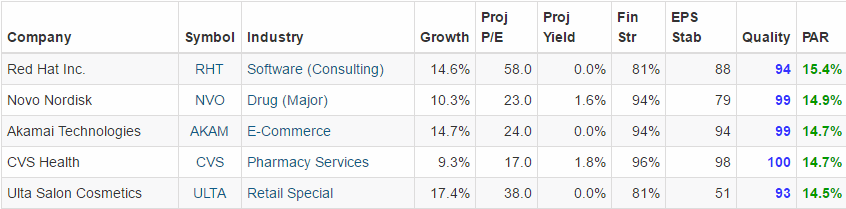
The Fave Five This Week

  • Akamai (AKAM)
  • CVS Health (CVS)
  • Novo Nordisk (NVO)
  • Redhat (RHT)
  • Ulta Salon (ULTA)

Context: The average 1-year total return forecast for the Value Line 1700 is 14.7%. The average 5-year return forecast for $VLE is 5.5% (annualized).

This Week’s Fave Five: Top Of The Sweet Spot

Top Of The Sweet Spot. (September 9, 2016) Projected Annual Return (PAR): Long term return forecast based on fundamental analysis and five year time horizon. Quality Ranking: Percentile ranking of composite that includes financial strength, earnings stability and relative growth & profitability.

Weekend Warriors

The return for the Weekend Warrior tracking portfolio is 16.9% since inception. (Wilshire 5000 is at 11.2%) 48.3% of selections have outperformed the Wilshire 5000 since original selection.

Tracking Dashboard: https://www.manifestinvesting.com/dashboards/public/weekend-warriors

Fave Five (9/2/2016)

Fave Five (9/2/2016)

Our Fave Five essentially represents a listing of stocks with favorable short term total return forecasts (1 year, according to Analyst Consensus Estimates, or ACE) combined with strong long-term return forecasts and good/excellent quality rankings.

These are all repeat selections this week. Under Armour (UA) has gained 10.4% since selection on 1/14/2016.

The Fave Five This Week

  • Air Lease (AL)
  • Celgene (CELG)
  • Jazz Pharma (JAZZ)
  • Spirit Airlines (SAVE)
  • Under Armour (UA)

Context: The average 1-year total return forecast for the Value Line 1700 is 14.7%. The average 5-year return forecast for $VLE is 5.5% (annualized).

The Long and Short of This Week’s Fave Five

The Long & Short. (September 2, 2016) Projected Annual Return (PAR): Long term return forecast based on fundamental analysis and five year time horizon. Quality Ranking: Percentile ranking of composite that includes financial strength, earnings stability and relative growth & profitability. VL Low Total Return (VLLTR): Low total return forecast based on 3-5 year price targets via Value Line Investment Survey. Morningstar P/FV: Ratio of current price to fundamentally-based fair value viawww.morningstar.com S&P P/FV: Current price-to-fair value ratio via Standard & Poor’s. 1-Year ACE Outlook: Total return forecast based on analyst consensus estimates for 1-year target price combined with current yield. The data is ranked (descending order) based on this criterion. 1-Year S&P Outlook: 1-year total return forecast based on S&P 1-year price target. 1-Yr GS: 1-year total return forecast based on most recent price target issued by Goldman Sachs.

Weekend Warriors

The return for the Weekend Warrior tracking portfolio is 15.9% since inception. 43.6% of selections have outperformed the Wilshire 5000 since original selection.

Tracking Dashboard: https://www.manifestinvesting.com/dashboards/public/weekend-warriors