This Week: Stocks to Study

This Week at MANIFEST (5/20/2016)

“If you are not willing to learn, no one can help you. If you are determined to learn, no one can stop you.”

We gather. The convention serves a unique purpose. Because connecting investors can prove to be the most valuable resource imaginable for individual investors. In that context, the national convention becomes a true investment club — centered on sharing and discovering actionable ideas and pursuing successful investing, together.

During the current Book Club review of Peter Lynch’s Beating The Street, Hugh McManus mentioned the special session with Peter Lynch at the 1998 NAIC national convention in San Jose. Lynch reviewed many of the key points covered in the book during his speech. This reference inspired me to track down a copy of Smart Money from January 1999 where Emily Harrison Ginsburg provided a story on the heritage of NAIC via Thomas O’Hara. I thought Emily mentioned Peter Lynch in the article, but on further review, I found that she hadn’t. If you’re new to the investment club movement or simply want to go on a nostalgic binge, the Smart Money feature can be found here.

MANIFEST 40 Updates

Round Table Stocks: Caterpillar (CAT), Deere (DE), Illumina (ILMN), Landauer (LDR), Masimo (MASI), Stryker

Results, Remarks & References

Companies of Interest: Value Line (5/20/2016)

The average Value Line low total return forecast for the companies in this week’s update batch is 4.2% vs. 5.6% for the Value Line 1700 ($VLE).

Materially Stronger: Honda Motors (HMC), Nissan Motor (NSANY.PK), II-VI (IIVI), Edwards Lifesciences (EW), Baxter (BAX), Bruker (BRKR)

Materially Weaker: Manitowoc (MTW), OSI Systems (OSIS), Navistar (NAV), Fiat Chrysler (FCAU), Haemonetics (HAE), Douglas Dynamics (PLOW), Terex (TEX), Actuant (ATU)

Discontinued: Newport (NEWP), Affymetrix (AFFX), Sirona Dental (SIRO)

Coverage Initiated/Restored:

Market Barometers

Value Line Low Total Return (VLLTR) Forecast. The long-term low total return forecast for the 1700 companies featured in the Value Line Investment Survey is 5.6%, up from 5.4% last week. For context, this indicator has ranged from low single digits (when stocks are generally overvalued) to approximately 20% when stocks are in the teeth of bear markets like 2008-2009.

Stocks to Study (5/20/2016)

  • Illumina (ILMN) — Highest MANIFEST Rank
  • Honda Motor (HMC) — Highest Low Return Forecast (VL)
  • Fiat Chrysler (FCAU) — Lowest P/FV (Morningstar)
  • Honda Motor (HMC) —Lowest P/FV (S&P)
  • Cutera (CUTR) — Best 1-Yr Outlook (ACE)
  • General Motors (GM) — Best 1-Yr Outlook (S&P)
  • Alere (ALR) — Best 1-Yr Outlook (GS)

The Long & Short of This Week’s Update Batch

The Long & Short. (May 20, 2016) Projected Annual Return (PAR): Long term return forecast based on fundamental analysis and five year time horizon. Quality Ranking: Percentile ranking of composite that includes financial strength, earnings stability and relative growth & profitability. VL Low Total Return (VLLTR): Low total return forecast based on 3-5 year price targets via Value Line Investment Survey. Morningstar P/FV: Ratio of current price to fundamentally-based fair value via www.morningstar.com S&P P/FV: Current price-to-fair value ratio via Standard & Poor’s. 1-Year ACE Outlook: Total return forecast based on analyst consensus estimates for 1-year target price combined with current yield. The data is ranked (descending order) based on this criterion. 1-Year S&P Outlook: 1-year total return forecast based on S&P 1-year price target. 1-Yr “GS” Outlook: 1-year total return forecast based on most recent price target issued by Goldman Sachs.

May Round Table May 22, 2016 at 11 AM ET ONLINE

Stocks Featured: TBD

The Round Table tracking portfolio has beaten the market by 3-4 percentage points over the last five years. Consider joining Ken Kavula, Cy Lynch and Mark Robertson as they share their current favorite stock study ideas.

The May session will be simulcast from the NAIC Better Investing national convention near Washington D.C.

Round Table Online Registration: https://attendee.gotowebinar.com/register/8401811825391796481

Various attendance options — including single day passes — are available if you’re interested in attending the BI National Convention and the Round Table “live”: 2016 BI National Convention
Market Barometers (Continued)

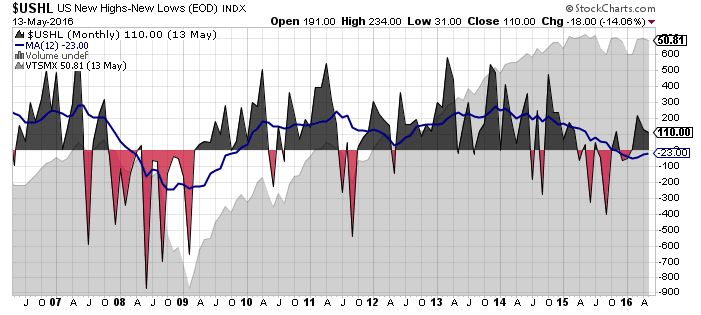
Watching Rhino Walk, Not Rhino Talk. If you believe supply-and-demand matters (and you should) then the collective actions of the herd have bearing. By monitoring the relationship of new highs vs. new lows, we get an early warning clarion that signaled as Halloween 2007 approached. Current $USHL has recovered somewhat from the “test” a few months ago.
Context Among Chaos

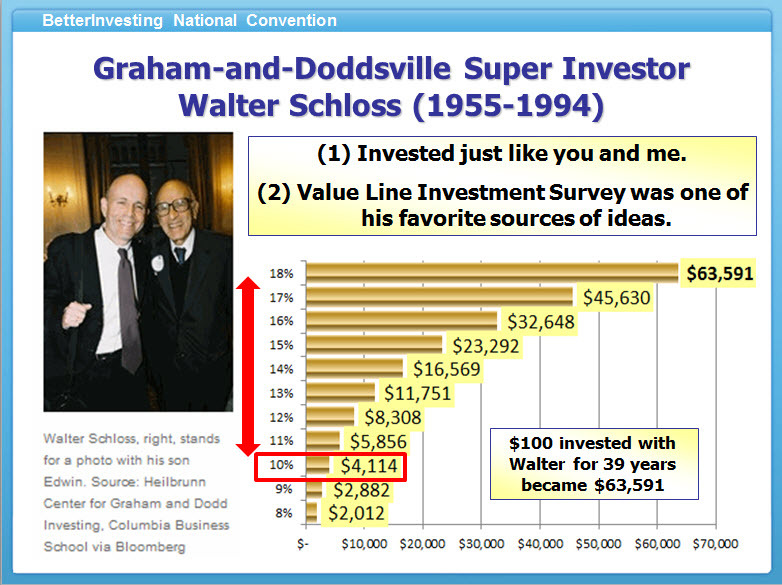
Achieving and documenting incrementally higher returns.  It matters.  The power and potential are significant.  In a brief discussion with an investment industry colleague yesterday, we lamented the charlatans and carnival barkers in the investment arena who soap box about spectacular returns.  All the while, a skeptical investing nation yawns when somebody like David Gardner beats the market by 710 basis points (+7.1%) over 14 years of investing.  The challenge is (1) capturing the attention of seekers with numbers like 15% when the barkers are howling things like “81% guaranteed” and (2) educating the masses about the impact of years and a few extra percentage points vividly on display in the Schlossian graphic below.

We’ll be looking at a few of our demonstration portfolios as we did for David Gardner’s RuleBreakers, but for now, we’ll simply observe that the MANIFEST 40 has 10.6 years under its belt with an annualized total return of 9.0% and a relative (excess) return of +3.6%

Feel free to participate in a collective pat on the back in consideration of the performance of your most widely-followed stocks.

This slide from this weekend’s Super Investor presentation underscores and hammers home the powerful potential behind achieving a an extra percentage point advantage or two … and why — as a community of investors — we aim for +5%.

Schloss 39 years

the Sage of Madison Heights

In honor of this week’s BI National Convention, here’s a lengthy (but representative) Smart Money article about NAIC, investment clubs and Tom O’Hara. Smart Money is “extinct” and reprints of the January 1999 issue are scarce. The article is presented here, largely in its entirety, with a few edits for accuracy. I collaborated with the author, Emily Harrison Ginsburg, and was influential in the development of the story as she explored the organization and the investment club movement. First and foremost, Tom thought the article focused too much on him. Some of the achievements and contributions of the likes of George Nicholson, Ken Janke and a nation of volunteers were less obvious. But the facts are facts. O’Hara was chairman of the organization for more than 50 years. How many people — ever — have been able to say that? It’s also a fact that Tom paid his $20 monthly dues to the Mutual Club of Detroit every single month since February 1948. I watched him withdraw several hundred thousand dollars and still have a balance greater than $1,000,000 in the club. His account had an annualized total return of 13.4% from 1948-2004, beating the stock market by more than three percentage points. The San Jose convention was huge and featured the Motley Fools and a keynote by Fidelity Magellan’s Peter Lynch among other noted investors. Nicholson referred to the modern investment club movement as a “Grand Experiment.” O’Hara thought of his massive community as the world’s largest and most successful investment club. — Mark Robertson

It’s a full house in the main exhibit hall at the San Jose Convention Center, with several thousand people brandishing large name tags and carrying white Lucent Technologies tote bags, each of them here for what looks like four days of nonstop talk about the stock market. “Did you see what small caps did this week?” asks one attendee. “Those Internet stocks are perking up again,” says another.

Amid the crowd roams am 82-year-old man dressed in pants that are a bit too short and accompanied by an attractive red-haired woman who hovers solicitously at his side, steering him gently by the elbow as he makes his way through the crowd. She occasionally whispers some comment into his ear and even slips him a mint at one point. As the elderly gentleman progresses on his trek, he says hello to many of his fellow conventioneers, his raspy voice barely audible above the din of the crowd, and stops to collect some of the giveaways being handed out by the investor relations people who are here in San Jose to pitch their companies’ stock to potential investors.

There is nothing particularly remarkable about this scene. In fact, this man, his wife of 47 years by his side, seems barely distinguishable from the thousands of others in the room. But then, suddenly, you notice that this elderly personage is being interviewed by a TV camera crew, that someone else is asking to have her picture taken with him (“This will be my keepsake,” she gushes), and that a large number of onlookers seem to be gazing adoringly as Thomas O’Hara makes his way past.

That’s right. Thomas O’Hara.

The name didn’t mean anything to you? Didn’t think so. But this gray-haired, soft-spoken man is a key reason there is nearly an overflow crowd at this California confab — the annual gathering of the National Association of Investors Corp, the umbrella organization for investment clubs throughout the country. That’s because in 1951, along with the same old Army buddies who lived near his suburban Detroit home, O’Hara formed the basis of the NAIC, an investing movement that over the years has transformed the country’s investing landscape, spawned the bestselling book, The Beardstown Ladies’ Common-Sense Investment Guide, grown into an organization of roughly 37,000 investment clubs and a total of [478,000 active participants] and turned O’Hara himself into one of the most influential people in the stock market.

Whether it’s through conventions like this one — which increasingly draw investor relations executives from public companies well aware that a favorable nod from the NAIC can attract plenty of new shareholders — or whether it’s through the NAIC’s monthly magazine, Better Investing which points out stocks for clubs to consider, or through the so-called I-Club-List, an Internet-based mailing list that generates some 100 emails/day, the NAIC’s reach is broad and powerful. Members invest about $1.3 billion in the stock market each year and now represent a cumulative stake of $175 billion. That chunk of assets would place the NAIC 21st in Institutional Investor magazine’s annual ranking of the country’s largest institutional investors, just above such meganames as American Express and Chase Manhattan. The NAIC’s key tenets are:

  • Invest on a regular basis.
  • Reinvest your earnings.
  • Buy growth stocks.
  • Diversify [prudently].

The guidelines are basic which members have embraced with an evangelical fervor. “Our only religion is that of the NAIC,” says Candis King, a 46-year-old mother of two from Chicago. And Thomas O’Hara is their touchstone, their messiah — the one who has shown them the promised land of double-digit annual returns.

Thomas O’Hara may be the messiah, but the drab one-story NAIC headquarters in Madison Heights, Michigan, is no mecca. An unrenovated elementary school is more like it. Inside, beyond the brown wood paneling and sea of cubicles are the unadorned, circa 1960s offices of O’Hara and Ken Janke, the 64-year-old president, who handles the day-to-day operations now that O’Hara has officially retired from the NAIC. (Unofficially, he’s still as involved as ever.)

Unassuming as it may seem, however, NAIC headquarters serves as Ground Zero for the investment club movement. For one thing, this is a clearinghouse for the 2 million brochures, books and magazines that the association sells every year. It’s also from here that the group’s flagship manual, Starting and Running a Profitable Investment Club, written by O’Hara and Janke, is distributed. The 250-page paperback has sold half a million copies since the team penned it three years ago, and it has been published in French. [And subsequently in Portuguese and Japanese also.]

The O’Hara Building, as it is called, is also the home of the NAIC stock-picking tools that thousands of members use to build their club portfolios. Take, for example, the Stock Selection Guide, or SSG, or “The Guide” — the very backbone of the organization. O’Hara, inspired by George Nicholson Jr. CFA, his club’s original broker, [embraced the two-page worksheet developed by Nicholson] that forces users to review all of a stock’s fundamentals, from price-to-earnings ratios to profit margins. Members then use the results of the studies to calculate whether or not a stock has the potential to double over the next five years — a most important NAIC general criterion. [In short, the “Guide” determines quality by peer/competitor comparisons and uses the return forecast to determine whether a given stock is “on sale.”]

NAIC advocates are so devoted to this system that the notion of a “hot” stock is anathema. In San Jose, one conference registrant could be overheard asking the woman at the registration desk, “You can’t give me any investment tips? That’s OK. We’re not allowed to take them anyway. It’s against the religion.” One club in Illinois earmarks only 10 percent of its assets to invest in non-NAIC sanctioned stocks, calling the stash its “Lunacy Fund.” Explains club founder Mark Robertson, a former engineer, local volunteer and now, senior contributing editor for Better Investing … “Anything outside of the organization’s principles [for core holdings] we regard as lunacy.”

If members are loyal to the SSG, they are obsessed with Better Investing magazine. The title has become a mantra. (A Better Investing banner flies alongside the American flag outside the headquarters.) “Best Wishes and Better Investing’ is the favorite email/correspondence signature of Mark Robertson.

At first glance it’s hard to see what all the fuss is about. A recent issue looks more like an accounting trade magazine than a stock picker’s bible. But NAIC members clamor every month for one feature in particular: “A Stock To Study.” The story — recently on men’s apparel maker Nautica Enterprises — is a five page treatise complete with charts, tables and a partially-completed SSG explaining why that particular stock is poised to grow.

But don’t call this a stock pick. Despite the fact that NAIC officers know that members end up not just studying but actually buying these stocks, they are adamant that nothing in Better Investing — or any NAIC publication or educational event for that matter — should be construed as a recommendation. “We are in the investment education business,” says Robert O’Hara, one of Thomas’ three children and an NAIC vice president. “Our goal is to try and teach people to do things for themselves.”

Whether or not the NAIC calls them picks, members are buying these stocks. Etana Finkler, for instance, a Rockville, Maryland computer-graphic artist, bought shares of Clayton Homes earlier this year at $16.50. What did she use to persuade her club to go along with the buy?

“When I presented the stock, I mentioned Better Investing has done three features on Clayton in the last three years,” says Finkler. (Clayton was down $1 at the end of November.) Eric Delph, who started a club four years ago in Huntington Beach, California, must have read those same articles. “I never would have heard of Clayton Homes if not for Better Investing magazine,” he says.

Janke himself provides what is perhaps the most telling evidence that a “Stock to Study” should really be called a “Stock to Buy.” Years ago [back in the 1950s], the NAIC ran a story on a bad stock. Plenty of clubs bought the stock anyway. “I guess people read the headline and didn’t really read on,” says Janke. As a result, every new stock featured in the magazine must now [meet the organization’s quality and buying metrics.]

Just who is setting those criteria and choosing those stocks? It’s not exactly a group of Wall Street-trained money managers, but it’s not a bunch of market neophytes either. O’Hara, Janke, Better Investing editor Donald Danko and seven other investment professionals (mostly chartered financial analysts) whom O’Hara and Janke have gotten to know over the years through various Detroit-based financial-industry functions make up what the NAIC calls the Securities Review and Editorial Advisory Committee.

The group meets over lunch each month to discuss stocks — not unlike an investment club. Each person comes prepared with a name or two and makes the case for nomination as a “Stock to Study” or “An Undervalued Stock.” When everyone has had their say, the company that will be featured is selected by voting.

As for performance, the stocks to study have done about as well as you would expect an investment club to do — some good periods, some bad. In the 42 rolling 5-year periods since 1952, Stocks to Study beat the Dow Jones Industrial Average 26 times. In the past five years, the raging bull market has run past the NAIC. Stocks that were picked in 1993 are up an average of 17.8% annually compared with 20.3% for the Dow. Plenty of clubs do better. Nancy Isaacs, a Toms River, New Jersey, member and NAIC volunteer, has watched her personal portfolio return 24% annually over the past five years. Through the NAIC, she says, “I feel empowered.”

Better Investing has another highlight members have learned to rely on: “The Top 100.” This annual list names the stocks most widely held by NAIC investment club members. Of course, just because clubs are buying a stock doesn’t necessarily mean it’s a good pick. But that doesn’t stop members from treating the list like a tip sheet. If other members are buying a stock, members figure, then it must have passed the NAIC criteria and therefore, [may] make sense for them. Don Heyrich, a 32-year-old attorney in Seattle, admits that his club uses the Top 100 as a source of new ideas, figuring other members have already applied the NAIC analysis and concluded that these were good stocks to own.

It’s no coincidence, then, that three of the top 10 names on the 1998 list — Intel, Lucent and Merck — are also among the 10 stocks most widely-held in Merrill Lynch brokerage accounts, a common gauge of how popular a stock is among individuals.

O’Hara has been preaching the gospel of individual investing ever since 1940, when he plunked down his first $20 monthly installment to join the Mutual Investment Club of Detroit. When World War II broke out, O’Hara started corresponding with members who had been drafted — first from his post in Iceland, then in London during the blitz. Military censors, who as a matter of course intercepted and read the group’s letters, started writing back asking how they could join the club. Within a year the Mutual Investment Club of Detroit had doubled in size. After the war, with three other clubs on board, the NAIC was born and Tom O’Hara was in charge.

By 1958, O’Hara quit his job as the director of the payroll department at the Detroit Board of Education to run the NAIC full time. A graduate of Wayne State University’s business school, with a degree in accounting, O’Hara has no other formal financial training — no chartered financial analyst designation after his name, no brokerage house experience, not even a stint as a financial planner. Nevertheless, his years of devotion to the individual investor have earned him a directorship at the Financial Analysts Society of Detroit and an advisory role on Securities and Exchange Commission committees.

O’Hara has spent the better part of the last two decades devising ways to bring more clubs into the fold. In 1979, for example, he started up the NAIC version of seed money for investment clubs, buying one share of a company’s stock, then selling that share to a member without a commission. That way a club could start small, access dividend reinvestment programs, and minimize expenses early in the life of the club.

It was about this time also that O’Hara made a shift in strategy that would fundamentally shape the future of the organization. With the stock market going nowhere, the phones weren’t exactly ringing off the hook. The modest club membership fees and publication sales couldn’t cover everything, so O’Hara and Janke began soliciting corporate sponsorship. Advertising discounts in Better Investing and the chance to tell their stories to investors through NAIC conventions were compelling to investor relations charged with reaching retail investors.

Throughout the 1980s, the NAIC slowly grew as clubs continued to catch on with investors. Then, starting in 1995, O’Hara’s homespun organization exploded with the publication of the Beardstown Ladies guide. The Beardstown Ladies were NAIC members and said so, loudly, in their book and appearances. Membership doubled from 1995 through 1998, thanks in part to the well-placed plug. Even when it became clear that the Ladies’ 23.4% annual returns were a mistake on the book’s cover — the impact did not spread to the NAIC. “There was no fallout,” says Janke. “We already had so much growth because of the booming market.”

O’Hara has obviously benefited from the investment club craze and bull market. Aside from his residence in Bloomfield Hills, the toney Detroit suburb close to Madison Heights, he owns homes in northern Michigan and Florida. A water buff, O’Hara owns a total of seven boats. As far as he’s concerned, the good times will go on. O’Hara remains relentlessly optimistic about the market despite the recent volatility. “The fundamentals of the market are better now than they have been for 20 years.” Of course, as the lead cheerleader for individual investors, you’d expect such a positive outlook.

Back at the San Jose convention, Andrew Backman knows how to work the NAIC crowd. The director of investor relations at Lucent is at a coffee shop down the street with a bunch of members whose clubs all own Lucent stock. The group is probably in their 50s with occupations ranging from housewife to lawyer, to engineer. And these investors aren’t playing with Monopoly money. The average member has a portfolio worth $223,000. [O’Hara also liked to remind that 14-of-15 investment club members would establish their own personal brokerage accounts for their “real money.”]

Lucent’s share price has recently dipped, and Backman is braced for the group’s reaction. “Are you concerned?” he asks. He’s pleasantly surprised by what he learns is a classic NAIC response. “No. We’re invested for the long haul,” one person pipes up. Some investors even volunteer that they have accumulated more shares at the lower prices.

What is Andrew Backman, a savvy corporate executive who is far more connected to Wall Street than he is to Main Street, doing at a coffee klatch of investment club groupies? Getting together with members, Backman says, is the best way to keep up with Lucent’s shareholders. “We can find out what their perspective is on the market, our sector and our stock,” he explains.

Backman isn’t the only corporate executive who has discovered the power of the NAIC. Don Eagon, head of investor relations at Diebold, has been currying favor with the organization and its members for years. Back in 1990, when Eagon first started with Diebold, he was alarmed at the large number of institutional owners — then as much as 86% — was causing unnecessary volatility in the company’s stock price. Eagon was concerned that two-thirds of the stock held by institutions was in the hands of only five firms. He set a goal to reduce institutional ownership to 75% of shares outstanding.

One of the first steps Eagon took towards achieving that goal? He joined the NAIC as a corporate member. “If you really want to build a strong base of individual shareholders, that is the way you do it,” Eagon says. He used his discounts to run at least six ads in Better Investing. And Eagon, or someone on his staff, began mingling with club members at several of the 75 regional investment education events, or fairs, that the organization sponsors every year.

All that was preparation for what he knew would really lure individuals — a spot on Better Investing’s Top 100 list. Once he hit that, Eagon must have known that Diebold would pull in even more individual shareholders. But what most corporate members really aspire to is being chosen as a BI Stock to Study. While joining the NAIC is no guarantee to a company that the securities review committee will feature it in the magazine, it does seem to help. 16 out of 36 stories highlighted once of the 280 member companies. [Only to the point of visibility and awareness, I can personally attest as a committee member that — if anything — corporate membership could actually inhibit the potential for a magazine appearance. — Mark Robertson]

Corporate membership paid off for Diebold with a place in the 1995 BI Top 100 and a [deserved] feature as a stock to study. Institutional ownership dropped to 73% that year and by 1999 was down to 54%.

But does corporate membership really serve NAIC members? While Diebold’s stock is certainly no dog — it has risen 19.4% annually over the last five years — it has lagged the S&P 500. Strict as the NAIC is about its stock selection criteria, the organization is far looser when it comes to screening corporate members. If a company is publicly traded, has been in business five years and is willing to pay the sponsorship dues, it’s in. “Our people are not stupid. We tell them to make up their own minds,” says Janke in defense of the program.

And, of course, devout members see no problem with the arrangement. “I have seen the NAIC principles work for me and my club,” says Cy Lynch, a 39-year-old Atlanta attorney. Anyone who is willing to spend the time can pick stocks as well as a professional money manager. I do better than my own mutual funds,” he says proudly.

One fall day, sitting in his office in Madison Heights, O’Hara was waxing sentimental about the displays of gratitude that members show him whenever he travels. “There is hardly a place we go that somebody doesn’t come up and thank us,” he says, the “we” meaning himself and his wife. “Three weeks ago in Chicago, a man came up and thanked me because he had saved and invested, and had a million dollars for retirement,” he says, slowly taking off his glasses to dab his eyes. A visitor, not noticing that the old man is actually wiping away tears, asks what it is like to have such an impact. O’Hara responds simply, “It’s a thrill.” And then, “Oh, look what you’ve done. You have gone and made me cry.”

  • Smart Money was the Wall Street Journal’s magazine of personal business. The finance magazine launched in 1992 by Hearst Corporation and Dow Jones & Company. In 2010, Hearst sold its stake to Dow Jones. The September 2012 edition was the last paper edition. Its content was merged into MarketWatch in 2013.
  • The institutional stake for Diebold (DBD) as a percent of float is now 96%.
  • Those 11 Best Stocks for 1999 from this issue were: Wells Fargo (WFC), Compaq, Kohl’s (KSS), DR Horton (DHI), Guidant, Warner-Lambert, Bank One, Apple (AAPL), Dollar General (DG), Toll Brothers (TOL) and Pfizer (PFE).
  • Warren Buffett and Berkshire Hathaway agreed regarding Clayton Homes, purchasing the company in 2003. One of our favorite — and most memorable — I-Club-List moments happened when Jim Clayton (Chairman and CEO) “showed up” to field some questions. We only asked him if he was really the Easter Bunny twice before realizing he was really Jim Clayton.

Stocks to Study (5/13/2016)

This Week at MANIFEST (5/13/2016)

“Science and technology revolutionize our lives, but memory, tradition and myth frame our response.” – Arthur Schlesinger

“The real danger is not that computers will begin to think like men, but that men will begin to think like computers.” – Sydney Harris

This week’s update batch has a number of community favorites in the mix. The following companies are all members of the MANIFEST 40 — the most widely-followed companies by our subscribers:

  • Cognizant Technology (2)
  • Microsoft (3)
  • Oracle Corp. (16)
  • Alphabet/Google (19)
  • Wells Fargo (22)
  • Price T. Rowe (36)

Amazon (AMZN) has been an important contributor to Hugh McManus and his superior returns as a participant in the Round Table. AMZN ranks as the all-time leading selection despite that lonely selection in Chicago a few years ago. Other companies that have been featured in Round Table sessions include: Alphabet/Google (GOOG), Bank of America (BAC), Bank of New York Mellon (BK), Cognizant Technology (CTSH), eBay (EBAY), Global Payments (GPN), Infosys Tech (INFY), Microsoft (MSFT), Oracle (ORCL), PayPal (PYPL), Priceline (PCLN), SEI Investments (SEIC), T. Rowe Price (TROW) and Western Union (WU).

Results, Remarks & References

Companies of Interest: Value Line (5/13/2016)

The average Value Line low total return forecast for the companies in this week’s update batch is 6.9% vs. 5.4% for the Value Line 1700 ($VLE).

Materially Stronger: SLM (SLM), Priceline.com (PCLN), Western Union (WU), BlackRock (BLK), Earthlink (ELNK), Adobe Systems (ADBE), Facebook (FB), Overstock.com (OSTK), Amazon (AMZN)

Materially Weaker: Invesco (IVZ), EZCorp (EZPW)

Discontinued:

Coverage Initiated/Restored:

Market Barometers

Value Line Low Total Return (VLLTR) Forecast. The long-term low total return forecast for the 1700 companies featured in the Value Line Investment Survey is 5.4%, unchanged from 5.4% last week. For context, this indicator has ranged from low single digits (when stocks are generally overvalued) to approximately 20% when stocks are in the teeth of bear markets like 2008-2009.

Stocks to Study (5/13/2016)

  • RedHat (RHT) — Highest MANIFEST Rank
  • Citigroup ( C ) — Highest Low Return Forecast (VL)
  • Priceline (PCLN) — Lowest P/FV (Morningstar)
  • Priceline (PCLN) —Lowest P/FV (S&P)
  • H&R Block (HRB) — Best 1-Yr Outlook (ACE)
  • Symantec (SYMC) — Best 1-Yr Outlook (S&P)
  • Netflix (NFLX) — Best 1-Yr Outlook (GS)

The Long & Short of This Week’s Update Batch

The Long & Short. (May 13, 2016) Projected Annual Return (PAR): Long term return forecast based on fundamental analysis and five year time horizon. Quality Ranking: Percentile ranking of composite that includes financial strength, earnings stability and relative growth & profitability. VL Low Total Return (VLLTR): Low total return forecast based on 3-5 year price targets via Value Line Investment Survey. Morningstar P/FV: Ratio of current price to fundamentally-based fair value via www.morningstar.com S&P P/FV: Current price-to-fair value ratio via Standard & Poor’s. 1-Year ACE Outlook: Total return forecast based on analyst consensus estimates for 1-year target price combined with current yield. The data is ranked (descending order) based on this criterion. 1-Year S&P Outlook: 1-year total return forecast based on S&P 1-year price target. 1-Yr “GS” Outlook: 1-year total return forecast based on most recent price target issued by Goldman Sachs.

May Round Table May 22, 2016 at 11 AM ET ONLINE

Stocks Featured: TBD

The Round Table tracking portfolio has beaten the market by 3-4 percentage points over the last five years. Consider joining Ken Kavula, Cy Lynch and Mark Robertson as they share their current favorite stock study ideas.

The May session will be simulcast from the NAIC Better Investing national convention near Washington D.C.

Registration: https://attendee.gotowebinar.com/register/8401811825391796481

Fave Five (5/13/2016)

Fave Five (5/13/2016)

Our Fave Five essentially represents a listing of stocks with favorable short term total return forecasts (1 year, according to Analyst Consensus Estimates, or ACE) combined with strong long-term return forecasts and good/excellent quality rankings.

The Fave Five This Week

  • Apple (AAPL)
  • Gentherm (THRM)
  • Mellanox Technologies (MLNX)
  • Skyworks Solutions (SWKS)
  • Under Armor (UA)

Context: The median 1-year total return forecast (via ACE) for the Value Line 1700 is 9.5%. The median 5-year return forecast (MIPAR) is 6.7% (annualized).

The Long and Short of This Week’s Fave Five

The Long & Short.(May 13, 2016)Projected Annual Return (PAR): Long term return forecast based on fundamental analysis and five year time horizon. Quality Ranking: Percentile ranking of composite that includes financial strength, earnings stability and relative growth & profitability. VL Low Total Return (VLLTR): Low total return forecast based on 3-5 year price targets via Value Line Investment Survey.Morningstar P/FV: Ratio of current price to fundamentally-based fair value via www.morningstar.comS&P P/FV: Current price-to-fair value ratio via Standard & Poor’s. 1-Year ACE Outlook: Total return forecast based on analyst consensus estimates for 1-year target price combined with current yield. The data is ranked (descending order) based on this criterion. 1-Year S&P Outlook: 1-year total return forecast based on S&P 1-year price target. 1-Yr GS: 1-year total return forecast based on most recent price target issued by Goldman Sachs.

Weekend Warriors

The relative return for the Weekend Warrior tracking portfolio is +0.8% since inception. 54.3% of selections have outperformed the Wilshire 5000 since original selection.

Tracking Dashboard: https://www.manifestinvesting.com/dashboards/public/weekend-warriors

Hain Celestial (HAIN) was “sold” from the tracking portfolio.

HAIN had been added on 12/28/2015 at $41.23.

The sale on 5/12/2016 at $48.06 represents a total return of 16.6% and a relative return of +16.3%.

Fave Five (5/6/2016)

Fave Five (5/6/2016)

Our Fave Five essentially represents a listing of stocks with favorable short term total return forecasts (1 year, according to Analyst Consensus Estimates, or ACE) combined with strong long-term return forecasts and good/excellent quality rankings.

The Fave Five This Week

  • Allergan (AGN)
  • Apple (AAPL)
  • Gentherm (THRM)
  • Under Armor (UA)
  • Simulations Plus* (SLP)

Context: The median 1-year total return forecast (via ACE) for the Value Line 1700 is 9.3%. The median 5-year return forecast (MIPAR) is 6.9% (annualized).

The Long and Short of This Week’s Fave Five

The Long & Short. (May 6, 2016) Projected Annual Return (PAR): Long term return forecast based on fundamental analysis and five year time horizon. Quality Ranking: Percentile ranking of composite that includes financial strength, earnings stability and relative growth & profitability. VL Low Total Return (VLLTR): Low total return forecast based on 3-5 year price targets via Value Line Investment Survey. Morningstar P/FV: Ratio of current price to fundamentally-based fair value via www.morningstar.com S&P P/FV: Current price-to-fair value ratio via Standard & Poor’s. 1-Year ACE Outlook: Total return forecast based on analyst consensus estimates for 1-year target price combined with current yield. The data is ranked (descending order) based on this criterion. 1-Year S&P Outlook: 1-year total return forecast based on S&P 1-year price target. *1-Yr GS: 1-year total return forecast based on most recent price target issued by Goldman Sachs.

Weekend Warriors

The relative return for the Weekend Warrior tracking portfolio is +22.9% since inception. 55.6% of selections have outperformed the Wilshire 5000 since original selection.

Tracking Dashboard: https://www.manifestinvesting.com/dashboards/public/weekend-warriors

Fave Five (4/29/2016)

Fave Five (4/29/2016)

Our Fave Five essentially represents a listing of stocks with favorable short term total return forecasts (1 year, according to Analyst Consensus Estimates, or ACE) combined with strong long-term return forecasts and good/excellent quality rankings.

The Fave Five This Week

  • Air Methods (AIRM)
  • Aaron’s (AAN)
  • Alphabet/Google (GOOG)
  • Apple (AAPL)
  • Skyworks Solutions (SWKS)

Context: The median 1-year total return forecast (via ACE) for the Value Line 1700 is 9.3%. The median 5-year return forecast (MIPAR) is 6.4% (annualized).

The Long and Short of This Week’s Fave Five

The Long & Short. (April 29, 2016) Projected Annual Return (PAR): Long term return forecast based on fundamental analysis and five year time horizon. Quality Ranking: Percentile ranking of composite that includes financial strength, earnings stability and relative growth & profitability. VL Low Total Return (VLLTR): Low total return forecast based on 3-5 year price targets via Value Line Investment Survey. Morningstar P/FV: Ratio of current price to fundamentally-based fair value via www.morningstar.com S&P P/FV: Current price-to-fair value ratio via Standard & Poor’s. 1-Year ACE Outlook: Total return forecast based on analyst consensus estimates for 1-year target price combined with current yield. The data is ranked (descending order) based on this criterion. 1-Year S&P Outlook: 1-year total return forecast based on S&P 1-year price target. *1-Yr GS: 1-year total return forecast based on most recent price target issued by Goldman Sachs.

Weekend Warriors

The relative return for the Weekend Warrior tracking portfolio is +15.2% since inception. 59.5% of selections have outperformed the Wilshire 5000 since original selection.

Tracking Dashboard: https://www.manifestinvesting.com/dashboards/public/weekend-warriors

Fave Five (4/15/2016)

Fave Five (4/15/2016)

Our Fave Five essentially represents a listing of stocks with favorable short term total return forecasts (1 year, according to Analyst Consensus Estimates, or ACE) combined with strong long-term return forecasts and good/excellent quality rankings.

The Fave Five This Week

  • Air Methods (AIRM)
  • Inteliquent (IQNT)
  • Maximus (MMS)
  • Perrigo (PRGO)
  • Steris (STE)

Context: The median 1-year total return forecast (via ACE) for the Value Line 1700 is 9.2%. The median 5-year return forecast (MIPAR) is 6.6% (annualized).

The Long and Short of This Week’s Fave Five

The Long & Short. (April 15, 2016) Projected Annual Return (PAR): Long term return forecast based on fundamental analysis and five year time horizon. Quality Ranking: Percentile ranking of composite that includes financial strength, earnings stability and relative growth & profitability. VL Low Total Return (VLLTR): Low total return forecast based on 3-5 year price targets via Value Line Investment Survey. Morningstar P/FV: Ratio of current price to fundamentally-based fair value via www.morningstar.com S&P P/FV: Current price-to-fair value ratio via Standard & Poor’s. 1-Year ACE Outlook: Total return forecast based on analyst consensus estimates for 1-year target price combined with current yield. The data is ranked (descending order) based on this criterion. 1-Year S&P Outlook: 1-year total return forecast based on S&P 1-year price target. 1-Yr Rhino Outlook: 1-year total return forecast based on most recent price target issued by Goldman Sachs, Merrill Lynch, JP Morgan Chase or Morgan Stanley.

Weekend Warriors

The relative return for the Weekend Warrior tracking portfolio is +20.2% since inception. 53.7% of selections have outperformed the Wilshire 5000 since original selection.

Here are some links to fairly recent monthly stock features, Round Table discussions and/or analysis updates for companies in the tracking portfolio:

  • Aaron’s (AAN)
  • Apple (AAPL)
  • Biogen (YouTube video: BIIB discussion starts at 21:45 of the session)
  • Forward Air (FWRD)
  • Stericycle (SRCL) Feb-2014 Round Table nomination by Nick Stratigos (starts at 18:33 of session)

Tracking Dashboard: https://www.manifestinvesting.com/dashboards/public/weekend-warriors

Gone Gold: PRIMECAP Growth (POAGX)

It’s been nearly five years since Morningstar launched the medalist designations for mutual funds. This month, we cull the gold medal funds that also have a 5-star rating seeking long-term leaders.

It’s been nearly five years since Morningstar launched the medalist designations for mutual funds. The intent is to maintain a long term perspective and identify top tier investment opportunities. Morningstar Medalists are funds that have been assigned a Morningstar Analyst Rating of Bronze, Silver, or Gold, meaning that those are the funds that we think are likely to outperform their category peer groups and appropriate benchmarks on a risk-adjusted basis over market cycles of at least five years. This month, we cull the gold medal funds that also have a 5-star rating seeking long-term leaders, candidates for fund investors and as always, potential sources of actionable and investable stock opportunities.

PRIMECAP Odyssey Aggressive Growth (POAGX): Long-Term Performance. This actively managed fund has beaten the market by 4.5% (percentage points) over the trailing 10 years. The fund has achieved an absolute total return (annualized) of 11.4% during a period when the Wilshire 5000 advanced 6.9%. Although closed to new investors, as always, this type of outperformance may provide some study candidates. The fund appears to select carefully and has very low turnover.

Winner: PRIMECAP Agg Growth (POAGX)

The PRIMECAP Odyssey Aggressive Growth Fund has beaten the total stock market benchmark (Wilshire 5000) by +4.5% annualized over the trailing ten years. The absolute return has been 11.4% — clearly top tier performance as the fund has beaten the benchmark in 9-of-the-last-11 years.

Portfolio turnover is 15%. It doesn’t get much lower than that for an equity fund specializing in smaller companies and deeper value situations. The fund managers act with conviction after considerable diligence that attempts to identify companies with differentiated potential that exceeds Wall Street expectations.

The expense ratio is 0.62%, also an attractively low burden for fund investors and compares well to similar funds. But the fund is closed to new investors at the present — so it becomes a proving ground and source of stock study ideas because the fund managers are excruciatingly selective and any recent additions (or sales) from the portfolio is probably worth a closer look and further study.

$100 invested on 12/31/2004 had blossomed to $360.40 on 12/31/2015. For comparison, $100 invested in a Total Stock Market Index (VTSMX) was worth $217.10 on 12/31/2015. This is a rather dramatic reminder of the power of a 3-5% relative return over a period as short as ten years.

The fund’s largest holdings include: Abiomed (ABMD), Qiagen (QGEN), Sony (SNE), Seattle Genetics (SGEN), Royal Caribbean Cruiselines (RCL) and Nektar Therapeutics (NKTR). But more importantly, added during the 12/31/2015 update were new positions in Ruckus Wireless (RKUS), Hewlett Packard Enterprise (HPE) and Alphabet/Google (GOOG). Ruckus and HPE have advanced fairly dramatically but GOOG is still relatively near the 4Q2015 price levels. We’ll watch the 3Q 2016 update for potential ideas.

MANIFEST 40 (3/31/2016)

Your Most Widely-Followed Stocks: An Update

Our MANIFEST 40 is a celebration of collective excellence in stock selection, strategy and disciplined patience.

The 40 stocks are something of a barometer because we know that these community favorites are not simply followed … most of them are also widely owned, with considerable diligence and vigilance.

MANIFEST 40 (March 2016). Performance Results. These are the most widely followed stocks by Manifest Investing subscribers. Current leader Apple (AAPL) was added on 9/24/2009 and steadily climbed the ranks while generating a relative return of +20.3% (annualized) since then. Figures in parentheses are the ranking back in December 2015.

The rate of return is 9.0% since inception (9/30/2005). Bottom line? On an annualized basis, your community favorites have beaten the Wilshire 5000 by +3.6 percentage points — a relative, or excess, return that probably portends outsized success with our actual portfolios.

Quality (90) is solid and the overall return forecast (8.9%) is positioned to outperform the Wilshire 5000. At an average sales growth forecast of 6.8%, we’d to see some faster-growing companies adopted by our community.

Capturing Attention: Chargers

Gilead Sciences (GILD) moved from #25 to #22 as most of the list remained rather steady. Visa (V) is a new addition at #40. The results of $100 positions investing in any of the Top 40 companies can be viewed at any time via the public dashboard on the home page.

“We have always believed that the collective decisions made by our community of long-term investors are worth huddling over … a place where ideas are born.”