Goldman Sachs: Buy and Avoid

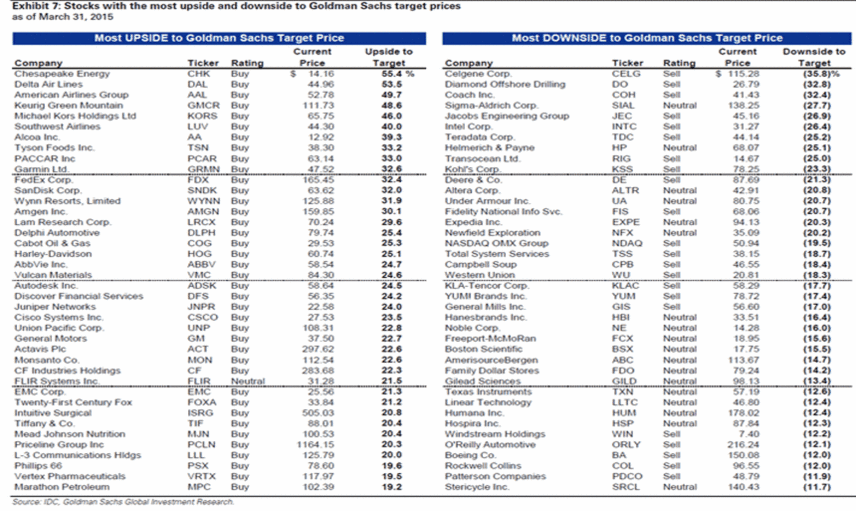
This was a tangential subject of discussion during the March Round Table. We’ve added Goldman Sachs price targets and will be monitoring them versus ACE and S&P.

Nutshell: Might this be a way to gauge sentiment? In this case, these differentials could deliver influence or impact, providing a potentially meaningful sentiment indicator.

http://www.bloomberg.com/news/articles/2015-04-02/goldman-here-s-where-u-s-investors-should-put-their-money-for-the-rest-of-the-year

Gs buy avoid list 20150331

As a quick reminder to be careful out there, this is what this morning held for Garmin (GRMN).

That’s a reduction from $63 to $54.

Source: Benzinga.com

Grmn gs opinion 20150402

More Fun With Goldman Sachs

When they’re not doing “God’s work” or referring to retail investors as Muppets, Goldman Sachs (GS) makes some calls — long and short — that can be influential in the market. In some Wall Street circles, the legions of Goldman Sachs are playfully known as Masters of the Universe.

In addition to the two lists shared above, here’s a list of nineteen stocks that Goldman Sachs believes are headed for price swoons — a list of stocks to sell short.

Goldman Sachs offers three criteria on how to pick stocks to short:

  • Look for individual stocks with high valuations that have a tendency to underperform;
  • take hints from mutual funds as they do a good job of selecting shorts;
  • and look for stocks that are likely to move on company-specific factors and are less prone to moving with general market and sector trends.

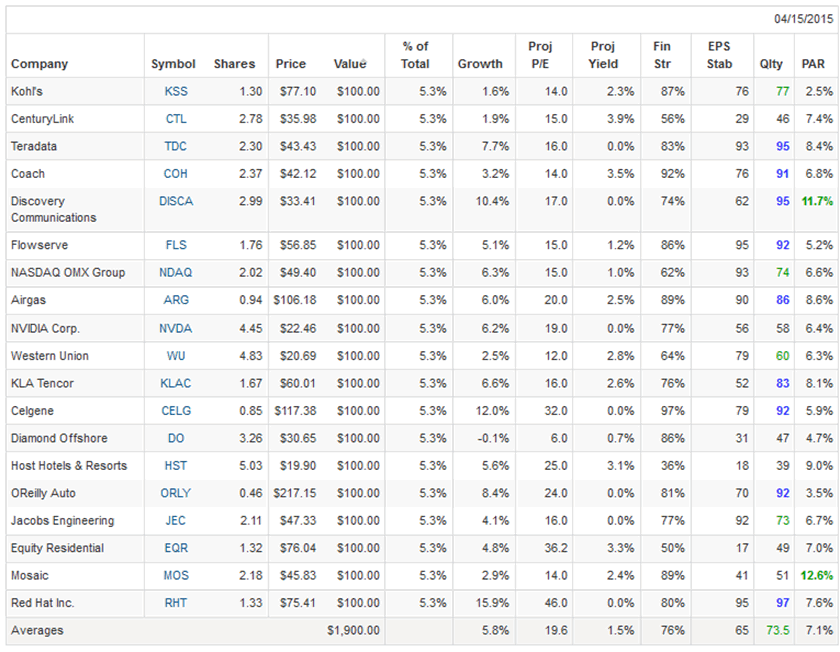
Among the overvalued stocks Goldman thinks could drop are Celgene (CELG), OReilly Automotive (ORLY) and Red Hat (RHT). Stocks underweight by mutual funds that could fall are HST, CTL and EQR; and likely to deviate from the broad market and their sectors are KLAC, JEC and COH.

Rounding out Goldman’s 19 stock recommendations that could reward short sellers: ARG, DO, DISCA, FLS, KSS, MOS, NDAQ, NVDA, TDC, WU.

Tracking Dashboard: http://www.manifestinvesting.com/dashboards/public/goldman-shorts-20140414

Here are the tracking dashboards for the Goldman MOST UPSIDE and MOST DOWNSIDE stocks as of 3/31/2015:

Celgene (CELG)

Celgene (CELG)

Celgene seeks to deliver truly innovative and life-changing drugs for patients. This major pharmaceutical company focuses on the discovery, development and commercialization of products for the treatment of cancer and other severe immune inflammatory conditions.

This one is worth a closer look. Celgene (CELG) ranks at the top of the list for this week’s update batch based on the combination of return forecast (PAR) and quality rating.

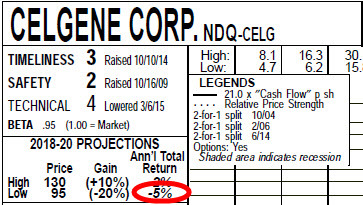
But the long-term low total return forecast via Value Line is -5%! What gives?

This provides an opportunity for a closer look at the consensus aspect of what we do.

Weekly Update Summary (Stocks to Study). This listing accompanies every batch update on Monday morning. It represents the consensus-based forecast based on a number of favorite sources.

Thanks for the question. I was really hoping that someone would ask.

With any forecast, it really does come down to the three judgment milestones and your question can basically be framed by seeking differences between Value Line, your own personal study and perhaps the analyst consensus.

The three most influential factors are:

  • Sales Growth Forecast (%)
  • Expected Net Margin (%)
  • Projected Average P/E Ratio

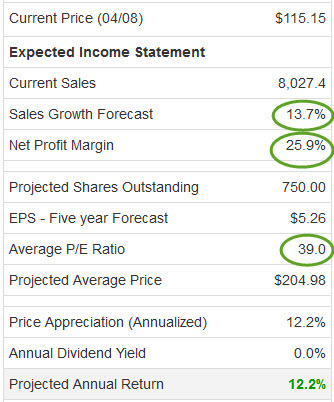
The first place you can turn for these comparisons after the batch update is the Company Report page (excerpt/snapshot shown here).

Remember, these are the consensus estimates based on a number of sources.

The influences include: Value Line, Standard & Poor’s, Morningstar, the Analyst Consensus Estimates and to some degree, Goldman Sachs (although this is a work in progress, more on that in a minute).

The next step is to check them versus the Value Line assumptions to see if we can determine where the differences/variances are — because there’s a world of difference between a -5% forecast and a double-digit forecast.

The date on the Value Line company report and our batch update will say April 10, 2015. But the Value Line analysis was performed on 3/30/2015 — something we can determine by finding the date that corresponds with $120.02 here Keep in mind that the Value Line-based low total return forecast is adjusted for (1) change in price and (2) change in time horizon when published at MANIFEST.

Sales Growth Forecast: Although Value Line displays 13.5% in the Annual Rates box … the growth rate for the 3-5 year time horizon is (13000/9000)^(1/4)-1 = 9.6%. (Keep in mind that the Annual Rates box data can be greatly distorted by mergers, acquisitions and/or divestitures.) The growth rate displayed in the Business Model (visual analysis) is 13.7%. I think most of us would be comfortable with expectations of 10-12% for Celgene.

Profitability: These are identical. Nothing to see here.

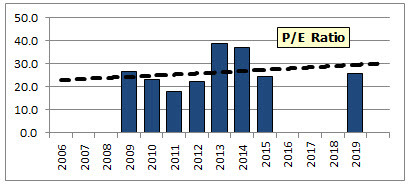
Projected Average P/E Ratio: Here’s where the disparate opinions kick in. Value Line is using 26×. Morningstar sees the stock as currently relatively fairly valued at a P/E of 39.5x or 47.9x … and Standard & Poor’s actually sees CELG with a price-to-fair value of 78%.

This is the crux. And it’s probably the basis for Celgene (CELG) being massacred and being the stock with the worst (avoid like the plague) rating over at Goldman Sachs. Goldman probably has a lower projected P/E ratio than Value Line for their long-term forecast. It’s clear by their 1-year outlook that they think P/E decay could even come “home to roost” during the next year.

I realize that most of us are loathe to go above 30x … perhaps 35x … for a long-term P/E expectation — and this is good policy. For my own study, I’d avoid using 39x — but, for now, that does represent the consensus. Who’s right? Time will tell, but this company is successfully navigating and delivering in a challenging but promising and desperately needed environment.

The Stocks We Follow (MANIFEST 40)

Perspectives

MANIFEST 40 Update

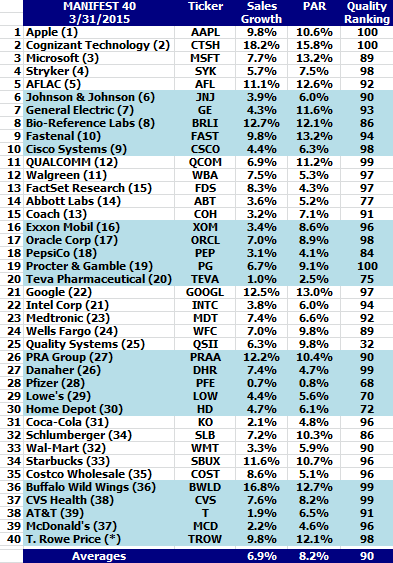
Our MANIFEST 40 is a celebration of collective excellence in stock selection, strategy and disciplined patience. We continuously monitor the 40 most-widely followed stocks by our community of subscribers at Manifest Investing.

“We have always believed that the collective decisions made by our community of like-minded, long-term investors are worth huddling over … a place where ideas are born.”

This managed “tracking portfolio” of your collective favorites has outperformed the Wilshire 5000 by +3.3%. The absolute rate of return for the trailing 9.5 years is 9.6%.

Capturing Attention: Chargers

QUALCOMM (QCOM) continues to ascend, moving from #12 to #11. CVS Health (CVS) has been bolstered of late and moves from #38 to #37.

The results of $100 positions investing in any of the Top 40 companies can be viewed at any time at: http://www.manifestinvesting.com/dashboards/public/manifest-40

Newcomer

T. Rowe Price (TROW) is a newcomer to the MANIFEST 40. The company was featured in Solomon Select in the July 2014 issue and has been discussed during a number of Round Tables and during other events. The asset manager is highly regarded in this long-term investing community and has been a favorite for decades.

Strongest Performers

The three top performers in the MANIFEST 40 since inception, based on annualized relative rate of return, are Cognizant Technology (+30.7%!), Apple (27.5%), PRA Group (20.2%).

The charter members of the MANIFEST 40: Microsoft (3), Stryker (4), AFLAC (5), Johnson & Johnson (6), General Electric (7), Cisco Systems (10), Walgreen (12), FactSet Research (13), Oracle Corp (17), PepsiCo (18), Teva Pharmaceutical (20), Intel Corp (22), Medtronic (23), Danaher (27) and Wal-Mart (33).

We’ll continue to pay the most attention to these community favorites. Keep up the good hunting!

More Fun With The MANIFEST 40

Here’s the listing (ranked from Most Widely Held, Descending) with a display of Opinions on Parade courtesy of Manifest Investing (consensus-based), Value Line, Morningstar, Standard & Poor’s, Analyst Consensus Estimates and Goldman Sachs.

Mi 40 opinions 20150410

$100/bbl On The Wall, $100/Barrel

Take one down, pass it around …

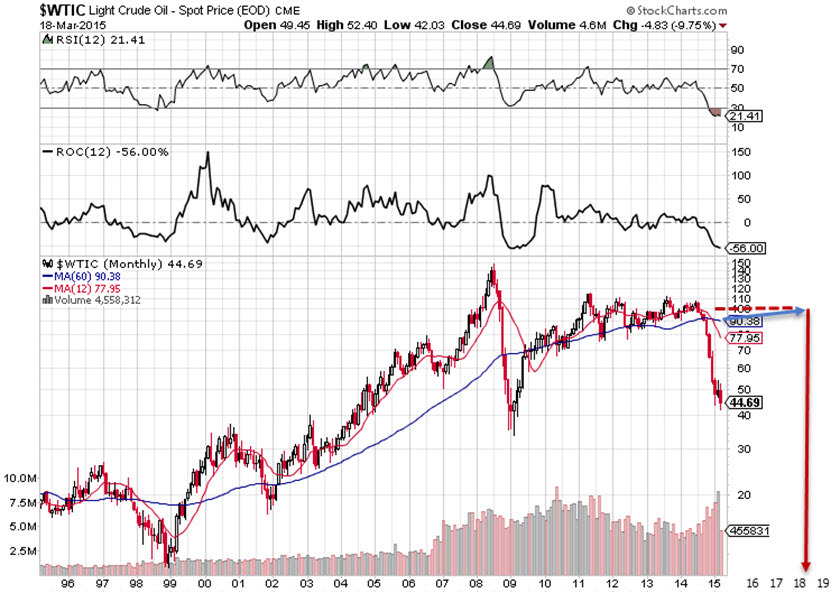
Here’s a 20-year look at the price of crude oil ($WTIC).

$100/barrel will be back before most people expect — perhaps in the 2018-2020 range. Unless somebody propagates a successful and sustained fusion reaction in their garage.

It is interesting that the slope of the long-term trend following the Great Recession resembles what we’re seeing for top-line growth from all companies, collectively.

 wtic  100 2019 2020

A Stroll Thru The Junkyard ($LKQ)

This report is offered as an example of the analysis performed during a stock study that you might experience with investment club partners.  The champion and grandfather of the modern investment club movement, George Nicholson Jr. CFA focused attention on the overall quality of companies and suggested laser type emphasis on sales growth, profitability and valuation trends while building a return forecast for companies that we study or own.  At Manifest Investing (www.manifestinvesting.com) we feature several companies each week — generally triggered by (1) positive or negative shifts in fundamentals or (2) stocks that are widely followed by our community of long-term investors.  If you’d like to explore the resources for long-term investors at Manifest Investing, send a request for a test drive to manifest@manifestinvesting.com and we’d be glad to give you some time to kick the tires.

LKQ (LKQ) provides replacement systems, components and parts needed to repair cars and light trucks, primarily in North America and Europe.

Think fender bender. That’s LKQ’s cue to spring into action.

LKQ buys wrecked cars at auction and distributes the reusable parts to collision repair shops. It also provides aftermarket parts services. Customers include repair facilities and insurance companies.

The industry is hugely fragmented. LKQ deploys an aggressive acquisition strategy.

Equity Analysis (Business Model)

It’s easy to see why this company captures the attention of many investors in our community. The up, straight and parallel images suggest a great deal of consistency in an industry that is fairly challenging and very competitive.

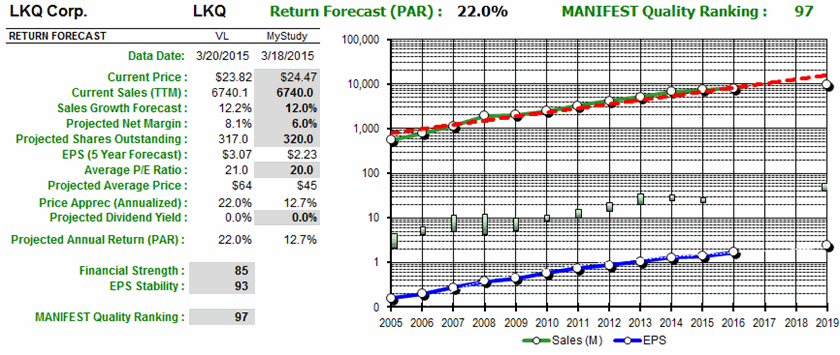
The Value Line low total return forecast is 14%.

Focusing on recent history and expectations for our 5-year time horizon, a sales growth forecast of 12% seems feasible. This could be vulnerable to an industry shift from repair to replace. We’ll probably take a closer look at the Retail Automotive industry — and its massive recent performance — and check that against some longer term history from trade/industry data to condition and build growth and profitability forecasts.

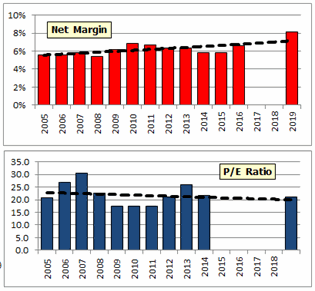
The projected net margin is more likely at 6% but Value Line is using 8.1% for their 3-5 year forecast. Shareholders hope that the Value Line analyst (Iason Dalavagas) is right.

A projected average P/E ratio of approximately 20x seems to be in order for this consistent performer that is still a medium-sized workhorse slogging away quite well in an extremely fragmented industry. But they’re becoming the 800-lb gorilla or at least they’re on the way to the jungle.

The Morningstar price-to-fair value (P/FV) ratio is 98% making them a little less optimistic. The S&P P/FV is 78%. The analyst consensus estimate (ACE) for 52-week total return is 33.9%. It’d be interesting to see how that would be impacted by any shift in industry repair/replace trends.

LKQ has a 40% debt-to-capital ratio and the effective interest rate is 6.39% (lowest quartile) so it’s not a leisurely walk through the junkyard. There are some junkyard dogs lurking that bite. Morningstar reduced the financial health to “B” and this will lower our financial strength composite to 72%. The overall quality ranking will still be 95 (Excellent).

Our projected annual return (PAR) is 15% based on 12.2% growth, 6.3% net margins and a projected P/E of 20×.

When Irish Cows Are Smiling

This Week at MANIFEST (3/20/2015)

“There is little value in the single cow.” — Irish Proverb

“Any man who owns a cow can always find a woman to milk her.” — Irish Saying

Happy St. Patrick’s Day, Daniella!

After spending last weekend in Chicago with some Badgers, Spartans, Buckeyes and various other varmints, I was reminded that Chicago starts St. Patrick’s Day early with a parade on Saturday. The streets were packed with throngs of green-clad celebrants and we watched as the Chicago River was dyed green in compliance. I’m not sure I understand the difference between an Irish proverb and an Irish saying … or what is the meaning behind the bovine suggestions here. But given a choice, I think every portfolio needs more than one cow to avoid the adverse effects of cow tipping.

Chicago also honors a famous cow with a play every March, “When Irish Cows Are Smiling.” Set in March 1872, five months since the Great Chicago Fire, the MOO-morial service, held at the Diggum, Deepe & Dye Funeral Parlour, pays tribute to Mrs. O’Leary’s cow, Daniella Joy, the infamous firebug.

Companies of Interest: Value Line

The average Value Line low total return forecast for the companies in this week’s update batch is 3.9% — slightly higher than the 3.7% for the Value Line 1700.

Materially Stronger: Gentex (GNTX), Synaptics (SYNA), Drew Industries (DW)

Materially Weaker: Avon Products (AVP), Windstream (WIN), Titan International (TWI), Cincinnati Bell (CBB)

Standard Coverage Initiated: Balchem (BCPC)

Discontinued:

Market Barometer

Value Line Low Total Return (VLLTR) Forecast. The long-term low total return forecast for the 1700 companies featured in the Value Line Investment Survey is 3.7%, up slightly from 3.6% last week. For context, this indicator has ranged from low single digits (when stocks are generally overvalued) to approximately 20% when stocks are in the teeth of bear markets like 2008-2009.

Stocks to Study (3/20/2015)

  • LKQ Corp (LKQ) – Highest MANIFEST Rank (100)
  • Neustar (NSR) – Highest Low Return Forecast (VL)
  • Express Scripts (ESRX) – Lowest P/FV (Morningstar)
  • Neustar (NSR) – Lowest P/FV (S&P)
  • Bioscrip (BIOS) – Best 1-Yr Outlook (ACE)
  • Neustar (NSR) – Best 1-Yr Outlook (S&P)

Breaking News: Rite-Aid (RAD) actually has a financial strength rating (2%). While Value Line maintains its “C” (0%) rating on Rite-Aid, Morningstar checks in with a “C” … and the effective interest rate is still steep at 6.8% but it is better than it was!

Tin Cup Update

“I would be a bum on the street corner with a tin cup if markets were efficient.” — Warren Buffett

This demonstration portfolio invests the maximum allowable 401(k) in stocks. Total assets reached $1,000,000 in 17 years. Tin Cup has outperformed the S&P 500 since inception (1995) and the annualized total return is now 18.6% vs. 9.9% for the S&P 500.

The total return for the trailing year for Tin Cup is 20.1% versus 13.9% for the Wilshire 5000 (VTSMX).

Tin cup vs vtsmx 20150301

And not to “jinx” the free throw shooter during March Madness … but we can probably start thinking $2,000,000 count down fairly soon.  The second million won’t take nearly as long as the first.

Tracking portfolio for Tin Cup: https://www.manifestinvesting.com/dashboards/public/tin-cup

Stocks to Study (3/9/2015)

The most “green lights” are on Chart Industries (GTLS) with a nod to Precision Castparts (PCP) a long-time community favorite.

We also note that — despite a solid 2014 (+26.6%) — Berkshire Hathaway (BRK-B) is still a pretty good idea. And a far, far better idea than reading what Berkshire Hathaway has bought and chasing those purchases. It’s a recipe for disaster … or at least erosion of several percentage points of total return.

Stocks to study 20150313

March Madness

This Week at MANIFEST (3/13/2015)

March. “Madness … takes its toll.” — Riff Raff

The name “Hebron” traces back to a range of meanings from “colleague”, “unite” or “friend”. In the proper name Hebron, the original sense may have been alliance. Invest With Your Friends.

From 1908-1971, the Illinois boys high school basketball championship was a single tournament contested by nearly all high schools in Illinois. The Illinois High School Basketball Championship was the first tournament to be called ‘March Madness’. The term was first used about the Illinois tournament in 1939, decades before it was used about NCAA basketball tournament.

The movie Hoosiers was preceded by these real events from across the state line in Illinois. In 1952, the Hebron Green Giants (from a high school with a total enrollment of 98) defeated Quincy in a real David and Goliath story.

But that doesn’t stop us from fondly remembering the scene where Gene Hackman and his high school boys arrive at Butler Field House for the state championship game. Hackman has players measure the distance from the basket to the free throw line and the height of the basket, demonstrating to the players that everything is “the same as our gym back in Hickory.”

Our methodology is based on measuring and monitoring the sales growth forecast, profitability expectations and projections for a reasonable, considered average P/E ratio in the future for all companies that we analyze. This is how we do.

Equally important is to make sure that we’re prudent. This requires diversification across sectors and industries like everybody else out there building portfolios in the investing world. But we emphasize — on a higher level — the urgency of diversifying such that our blend of companies will produce an average sales growth forecast (plus or minus a percent or two) of 11-12%. So in our investing world, the “Hebrons” are as important as the Quincy entries.

And in the spirit of Gene Hackman’s Coach Norman Dale, measuring what matters is what really matters.

Our Periodic Reminder About “All-Of-The-Above” Investing

While the rest of the world hyperventilates over NASDAQ 5000, we’ll be watching for a different 5000 — that being the 5000 level for the Value Line Arithmetic Average. We think the overall performance of the Value Line 1700 stocks over time is a powerful reminder of the common sense wisdom to achieve and maintain diversification by average overall portfolio growth rate (company size).

The 10-year rate of return on the Value Line 1700 (Arithmetic Average) is (4806.57/1771.3) = 10.5%

The 10- year rate of return on the S&P 500 (VFINX) is (191.73/91.60)^(0.1)-1 = 7.7%

Companies of Interest: Value Line

The average Value Line low total return forecast for the companies in this week’s update batch is 4.0% — slightly higher than the 3.6% for the Value Line 1700.
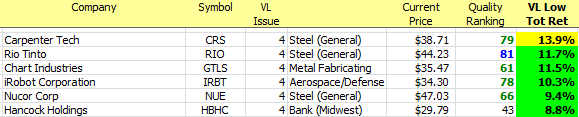
Materially Stronger: Seattle Genetics (SGEN), TCF Financial (TCB), U.S. Steel (X), Fifth Third Bancorp (FITB), ACE (ACE), Private Bancorp (PVTB), Biomarin Pharma (BMRN), Cerner (CERN)

Materially Weaker: Arcelor Mittal (MT), Schnitzer Steel (SCHN), Kennametal (KMT), Brookdale Senior (BKD)

Standard Coverage Initiated:

Discontinued: Alliant Techsystems (ATK), Orbital Sciences (ORB)

Market Barometer

Value Line Low Total Return (VLLTR) Forecast. The long-term low total return forecast for the 1700 companies featured in the Value Line Investment Survey is 3.6%, up slightly from 3.5% last week. For context, this indicator has ranged from low single digits (when stocks are generally overvalued) to approximately 20% when stocks are in the teeth of bear markets like 2008-2009.