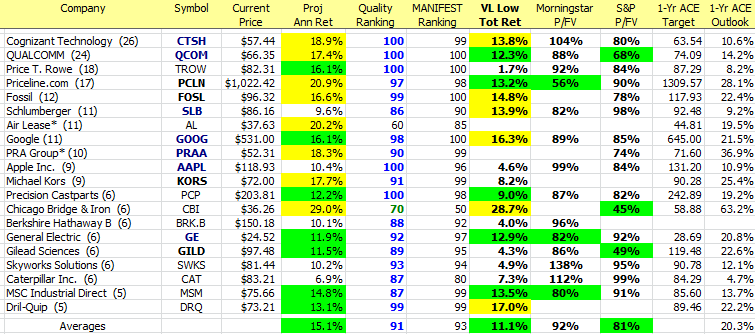
Here are the consensus favorites from the entries in Groundhog Challenge IX (2015).
It was a dead heat between QUALCOMM (QCOM) and Cognizant Technology (CTSH). The figures in parentheses are the number of times a stock appeared among the 2015 entries.
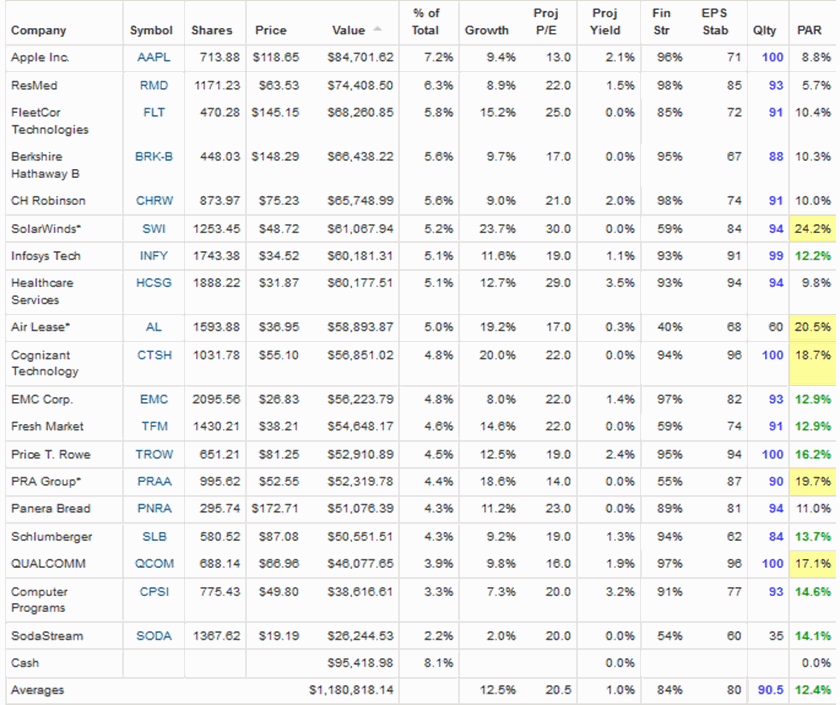
It’s a solid list across the board with an overall PAR of 15.1% and an average quality rating of 91. Collectively, these selections rank in the top 7th percentile of all stocks based on return forecast and quality ranking. The average Value Line low total return forecast is 11.1% (vs. 3-4% for the Value Line 1700). The price-to-fair value ratios according to Morningstar and S&P are also quite favorable … as well as the 1-year total return forecast (+20.3%) based on consensus 1-year price targets (and current yields).
The tracking dashboard for the 2015 consensus selections (Heavy Hogs) is available at:
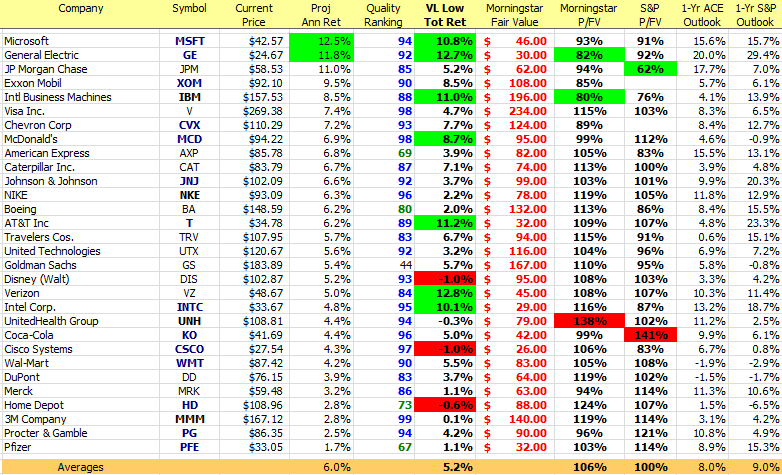
The last few years have been pretty good to the Dow 30 stocks — after spending the first ten years of this century in the dog house. The trailing 5-year annualized return is 15.0% versus the Wilshire 5000 at 16.8%. So the other 4970 stocks have actually continued to outshine the Dow 30.
One of the things we’ve noticed is that the renaissance of many of these stocks has persisted — with continuing improvement in profitability, etc. — while many companies are under more margin pressure and “deceleration.”
Here’s a quick look at our 5-year forecasts for the Dow 30 as well as the Value Line low total return 3-5 year forecast. We’ve also included a quick look at Morningstar and S&P price-to-fair value (P/FV) metrics. (100% = fairly valued … <100% is potentially attractive)
In keeping with some of the Groundhog shopping, we also display the 1-year outlooks based on analyst consensus and S&P target prices.
Nutshell: Microsoft (MSFT) and General Electric (GE) are consensus favorites. S&P thinks JP Morgan (JPM) is a steal. There’s an IBM (IBM) bandwagon at Morningstar. Value Line is skeptical about the long-term forecast for Disney (DIS), Cisco Systems (CSCO) and Home Depot (HD). S&P doesn’t want Coca-Cola (KO) … not even with a 10-foot pole. Morningstar thinks United Health (UNH) is overvalued, too. S&P is scratching their heads over Exxon Mobil (XOM) and Chevron (CVX) … and we’ll stay tuned to see what conclusions are reached by Team Stovall.
We have to love a newsletter update that starts out quoting all things Schlossian.
“When it comes to investing, my suggestion is to first understand your strengths and weaknesses, and then devise a simple strategy so that you can sleep at night.” – Walter Schloss
A number of you have written me about the massive adjustments made to several of the energy stocks this week. No, you’re not imagining things. Expectations have been transformed — very notably for 2015 as year-end projections plummet. This week’s EXTENSIVE roll call of stocks that are “Materially Weaker” is not a hoax, either. We’re elated (and a little bit proud) about our energy sector message a few months ago when we suggested things seemed a little too good to be true and urged caution.
During the update, I was reminded of days when Ken Kavula and I would wince while crunching updates. Eddy captures that moment here:
The surging U.S. dollar and collapsing oil prices have dramatically changed the outlook for corporate earnings growth. Guidance from companies hasn’t been this poor since the depths of the Financial Crisis. At the end of the Q3, Wall Street had been expecting Q4 earnings of $32.24 (that’s the index-adjusted number). Now it looks like it will be about $27.64. That’s a big cut. At the end of Q3, the Street was expecting full-year earnings for 2015 of $136.07. That’s now down to $119.76. That’s a 12% cut in four months. Stock prices haven’t responded nearly as much. — CWS Market Review: February 6, 2015
Stock prices follow earnings. Rinse. Repeat.
Cycles are massively challenging. Memories are short. Trend trajectories are temptation embodied because collectively, we’re a bunch of optimists.
Cy Lynch has cautioned us many times in the past about cyclical hyperventilation and vulnerability from the likes of Value Line, Morningstar and NAIC/BetterInvesting. (Sam Stovall and his S&P minions seem to have a better handle on peak and trough chasing.) Step through a case study of Carbo Ceramics (CRR) and it comes clear. While soaring on wings of bubbles, it’s hard to remember the last trough and hard to believe in inevitable future troughs.
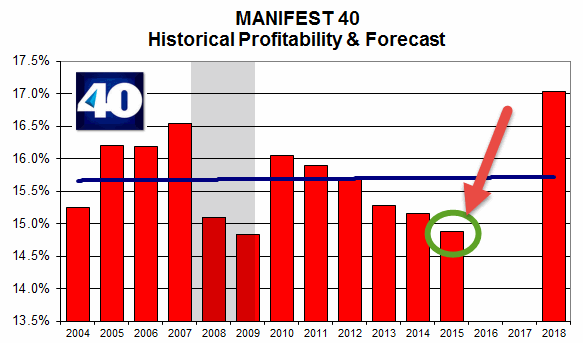
MANIFEST 40 Profitability Expectations
The condition that Eddy is talking about is pretty vivid when looking at the average net margin forecast for the MANIFEST 40. Keep in mind that this is a collection of relatively higher and more stable stocks … your favorites. But as we’ve shared from Barry Ritholtz (http://www.ritholtz.com) in the past, this time of year is historically packed with EXUBERANCE. Profit margin forecasts are elevated during the first quarter and generally erode as we tear calendar pages down.
It’s not easy to refer to the 2015 forecast as exuberant … as the collective forecast is starting the year close to recessionary levels last seen in 2008-2009.
Stock prices follow earnings.
Of course, the thrust of this is reduced expectations for stocks in 2015. As we’ve said many times lately, we don’t believe in 1-year crystal balls for individual stocks (or broader markets or baskets) but there can be an element of self-fulfilling prophecy to some of this. For the MANIFEST 40, the 1-year analyst consensus price targets and the average 2.1% current yield combine to produce a 1-year total return forecast of 10.9%. Using S&P 52-week target prices, the total return forecast is 9.7%. Nothing to “panic” about, particularly with our core stocks … but these forecasts are generally much more optimistic as the year starts … until the reliable Ritholtz earnings erosion removes a suitable amount of exuberance.
The Groundhog Challenge is our 9-year running stock picking contest that runs from Groundhog Day to Groundhog Day. The results over the years have been pretty special and we’ll be back soon with the 2014 finish line results. The “Heavy Hogs” is the annual tracking portfolio for the consensus favorites.
The overall results for Groundhog VIII (2014) were … for lack of a better word, a little stinky. (I have high expectations and you’ll see why when we report the comprehensive results)
Collectively, we stumbled to multi-year lows for relative return and accuracy.
Not all of us were blessed with the luck of the Irish like Mr. McManus, so it probably makes sense to remind ourselves that there seems to be better performance in “numbers.”
As of 2/1/2015, 10-of-the-20 (50%) most frequently chosen stocks by 2014 Groundhoggers had outperformed the general stock market over the annual contest – racking up an average return of 18.1% (+3.9% RR) led by Apple (69.4%)
When nobody else is selecting that hidden gem you’ve identified, be careful. Confirm your assumptions. And when legions of our your friends hold their nose at your selection (think BODY) — you might be right, but ignore them at your peril. It’s also worth noting that there’s no escape hatch in this contest version. You’re stuck with the selections made in early February for 52 weeks until Punxsy Phil stirs again.
Don’t get me wrong. This lack of an escape hatch is often a virtue. We generally believe that hyperactivity in “investing” is erosive and history rhymes with us.
But when the consensus selections outperform the vast majority of hundreds of participants, it’s probably worth heeding the group. Investing with your friends can be a very good idea.
For the January Round Table, we spent some time with a few screening resources in the quest for some good ideas for further study. We’ll collect them here and tabulate the overall results, using a version of the coach’s poll for collegiate sports (20-16-12-8-6-4-2-1 for votes) and see what percolates to the top of the charts.
This screen is based on a recognition that the two most important characteristics of any investment are (1) the return forecast and (2) the quality of the company. The MANIFEST Rank is an index that combines the two characteristics with essentially equal weighting. Here are the top eight results of a current screen based solely on MANIFEST Rank > 99.44
Triple Play Screen
This is one of the more popular screens that we’ve covered over the years. It generally works best after a bear market has raged for a while.
It focuses on some of the primary drivers for higher long-term return forecasts. The three things we’re looking for are:
Elevated return forecast … generally because of a (hopefully) temporarily hammered stock price.
Potential for P/E Expansion … a higher P/E in the future than the current P/E.
Margin Enhancement … projected profitability in the long-term forecast that is higher than current levels.
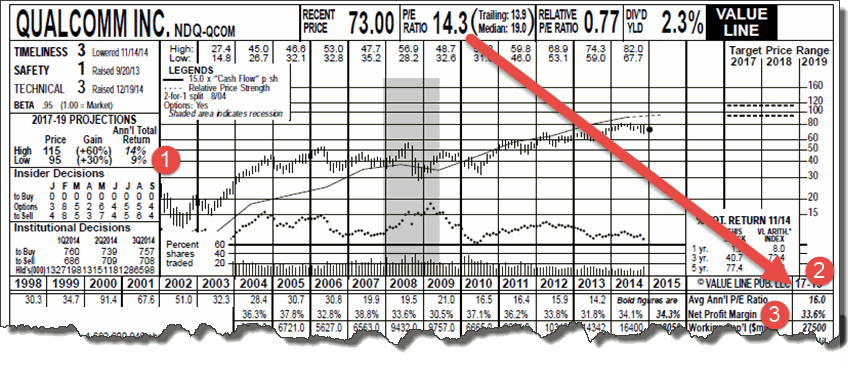
Using one of the current leaders for this screen, we note that Qualcomm (QCOM) has a low return forecast of 9-10% according to Value. Keep in mind that the average low return forecast for the Value Line universe is 3-4%.
We also see a future P/E of 16.0x versus current levels of 13-14×.
Value Line expects “flat” net margins in the 33-34%. The reason this triggered in our database is that the analyst consensus is more optimistic than Value Line when it comes to future profitability for Qualcomm.
This screen is inspired by our repeat group champions, the Broad Assets investment club of St. Louis. Broad Assets repeated as champion last year and is running 2nd this year as Groundhog VIII comes to a close in a few days. We featured the concept behind this screen in our Victory By Escape Velocity? cover story from May 2014.
Nutshell: If you really believe that stock price follows earnings, it makes all the sense in the world to look for those conditions.
In this case, we focus on year-over-year (2015 over 2014) earnings estimates and focus on the companies with the strongest upside. We also limit the field to companies that have shown increasing earnings for each of the 4-5 years displayed. (All year-over-year figures > 0%)
Lannett (LCI) continues to have strong expectations, but it will be interesting to see what Broad Assets does with LCI in the future as 2016 EPS estimates are finally plateauing. We also note the presence of Balchem (BCPC), a long time favorite of another St. Louis club — Mutual of St. Louis and our friends Jay and Ray.
Schloss Screen
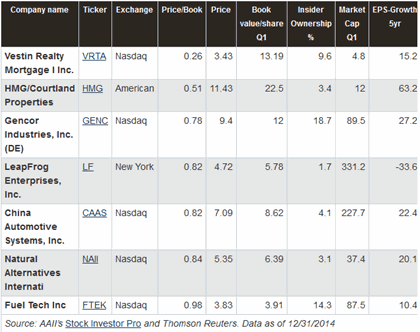
The American Association of Individual Investors (AAII) features a number of screens based on famous investors and methods including one of our time-honored all-time favorites, Walter Schloss.
Screening Criteria
Companies that trade on the over-the-counter market are excluded
ADR stocks are excluded
Companies in the financial sector are excluded
Stock has been traded for at least seven years
Current share price is less than the latest quarterly book value per share
Current share price is within 10% of its 52-week low (Hugh McManus has to like that one)
Percentage of insiders owning shares is higher than the median insider ownership percentage for the entire database
Long-term debt from the most recent quarter and fiscal year equals zero
Piotroski Screen
Joseph Piotroski, associate professor of accounting at Stanford University’s Graduate School of Business, undertook a study of low price-to-book value stocks to see if its possible to establish some basic financial criteria to help separate the winners from the losers.
The result, a favorite screening method among AAII members, is the top-performing screen since inception nearly 20 years ago.
Low Price-to-Book-Value
Piotroski’s work starts with low-price-to-book-value stocks. Price-to-book value was a favorite measure of Benjamin Graham and his disciples who sought companies with a share price below their book value per share. While the market does a good job of valuing securities in the long-run, in the short-run it can overreact to information and push prices away from their true value.
Measures such as price-to-book-value ratio help to identify which stocks may be truly undervalued and neglected.
Motley Fool CAPS
Most frequently chosen Outperform Ratings by the CAPS All-Stars (successful stock pickers) that have 5-Star ratings on 1/29/2015.
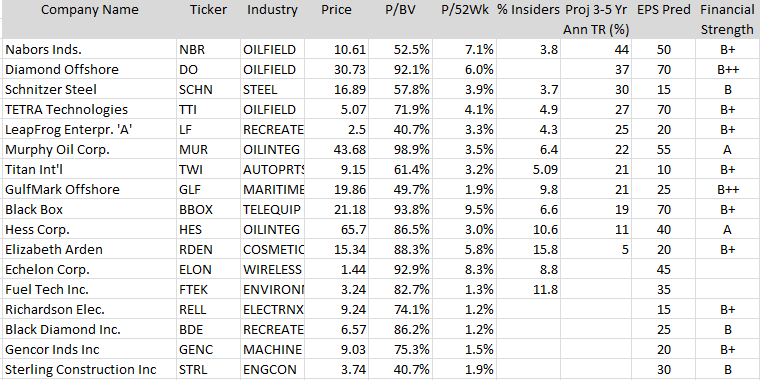
Modified McManus
Hugh likes to shop for high-quality companies when they are trading near their 52-week lows. He keeps a fairly short list of qualified accumulation targets for his personal portfolio. We covered this screening concept here: Gone Fishing … Patiently
What makes this version of the list “modified” is that we’ve applied his shopping methods to the 6000+ companies in the Value Line database, limiting qualifiers to Financial Strength ratings of B+ (or better) and a return forecast (VL 3-5 Yr Proj Ann Tot Return or PAR) to double digits, in general, or better. (Data Source: Value Line Investing Analyzer)
Great Buffalo
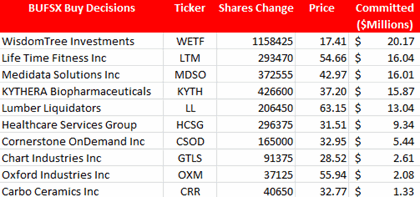
One of our favorite sources of ideas are successful/active fund managers. One of our favorite small company mutual funds is Buffalo Growth (BUFSX) shepherded by Kent Gasaway and his team.
The accompanying table (exported from Morningstar/Premium Version) provides a summary of buy/accumulate decisions made over the last quarter by the Buffalo team.
KYTHERA Biopharmaceuticals (KYTH) is a clinical-stage biopharmaceutical company focused on the discovery, development and commercialization of novel prescription products for the aesthetic medicine market.
Case Studies and Analysis Demonstrations
The stocks featured during the January Round Table:
Caterpillar (CAT)
Google (GOOG)
MSC Industrial (MSM)
QUALCOMM (QCOM)
The audience selected QUALCOMM (QCOM) from the candidates.
Sell Transaction
MWI Veterinary Supply (MWIV) was “sold” from the tracking portfolio during the session. MWIV is being acquired by Amerisource (ABC) for $190. Ken Kavula selected MWIV back on 11/29/2011 for $64.79, so $1000 became $2969 — an annualized return of 40.5% and a relative return of +22.9% versus the Wilshire 5000.
Archived Recording of January Round Table
The recording of this event is now available on the event page:
The stocks featured during the January Round Table:
Caterpillar (CAT)
Google (GOOG)
MSC Industrial (MSM)
QUALCOMM (QCOM)
The audience selected QUALCOMM (QCOM) from the candidates.
Sell Transaction
MWI Veterinary Supply (MWIV) was “sold” from the tracking portfolio during the session. MWIV is being acquired by Amerisource (ABC) for $190. Ken Kavula selected MWIV back on 11/29/2011 for $64.79, so $1000 became $2969 — an annualized return of 40.5% and a relative return of +22.9% versus the Wilshire 5000.
Once again, there’s not a clear “old NFL” team again this year. But Marshawn Lynch likes Skittles and all of those Super Bowl pigskins will be inflated with laser precision accuracy to the right pressure. A victory by the surging National Conference champions would be “most like” an OLDNFL victory … so investors across this nation probably ought to be in the Seattle camp. The Patriots are clearly on old AFL team and the stock market is vulnerable to a Super correction at some point.
The defending champion Seattle Seahawks are led by QB Russell Wilson. Wilson has a streak of 83 straight games — dating back to high school (I think) — where his team has led in the scoring column in each game. That’s quite a streak and it was seriously in jeopardy last week versus the Packers, but an improbable miracle kept Wilson’s run intact. Many people will expect the Seahawks to lead Tom Brady’s Patriots on Sunday — some even at the end of the game.
It’s time to get out there and BUYSOMESTOCKS. 🙂
We’re 6-for-9 having mistakenly selected the Broncos (62%) over the Seahawks (38%) last year.
Our Selections
XLVIII: Denver Broncos (Super Bowl won by Seattle Seahawks) XLVII: San Francisco 49ers (Super Bowl won by Baltimore Ravens) XLVI: New York Giants (defeated the New England Patriots) XLV: Green Bay Packers (defeated the Pittsburgh Steelers) XLIV: New Orleans Saints (defeated the Indianapolis Colts) XLIII: Pittsburgh Steelers (defeated the Arizona Cardinals) XLII: New England Patriots (Super Bowl won by New York Giants) XLI: Indianapolis Colts (defeated the Chicago Bears)
XL: Pittsburgh Steelers (defeated the Seattle Seahawks)
“We have always believed that the collective decisions made by our community of like-minded, long-term investors are worth huddling over … a place where ideas are born.”
This managed “tracking portfolio” of your collective favorites has outperformed the Wilshire 5000 by +3.3%. The absolute rate of return for the trailing 9 1/4 years is 9.6%.
Our MANIFEST 40 is a celebration of collective excellence in stock selection, strategy and disciplined patience. We continuously monitor the 40 most-widely followed stocks by our community of subscribers at Manifest Investing. We think it’s more than a fair assumption that many of these are in your real money portfolios … and for that, we’re optimistic and grateful. This managed “tracking portfolio” of your collective favorites has outperformed the Wilshire 5000 by +3.3% (relative rate of return, percentage points). The aggregate absolute rate of return has been 9.6% during a period when the annualized rate of return for the general stock market has been 6.3%.
Capturing Attention: Chargers
Schlumberger (SLB) moved from #39 to #34 and continues to attract interest despite the current challenges in the energy sector. Buffalo Wild Wings (BWLD) returns to the MANIFEST 40 at #36 as chicken wings, beer and sporting events continue to deliver for investors.
The results of $100 positions investing in any of the Top 40 companies can be viewed at any time at:
The three top performers in the MANIFEST 40 since inception, based on annualized relative rate of return, are Cognizant Technology (+27.4%!), PRA Group (25.8%) and Apple (24.8%).
The charter members of the MANIFEST 40: Microsoft (3), Stryker (4), AFLAC (5), Johnson & Johnson (6), General Electric (7), Cisco Systems (8), Walgreen (11), FactSet Research (14), Oracle Corp (18), PepsiCo (17), Teva Pharmaceutical (16), Intel Corp (21), Medtronic (22), Danaher (26) and Wal-Mart (31).
We’ll continue to pay the most attention to these community favorites. Keep up the good hunting!
A favorite from March 2012, celebrating the usefulness of Value Line and honoring a couple of legends — Chuck Allmon and Walter Schloss.
My responsibilities at Better Investing included the opportunity and privilege to correspond and spend time with some of the most exceptional investors in stock market history. From Peter Lynch to John Bogle and the likes of John Neff, the moments were treasured and the mission was a continuous focus/emphasis on deriving lessons that could be applied to our long-term perspective. The objective is simple. Discover wisdom and lean on experience in an effort to maximize the relative returns of everybody all around us.
Current day favorites include many of you, Jeremy Grantham, Brad Perry and until a few days ago … one of the denizens of Graham-and-Doddsville, Walter Schloss. More on Mr. Schloss in a minute. Another long-time is a favorite for many of you, Charles Allmon…














 A favorite from March 2012, celebrating the usefulness of Value Line and honoring a couple of legends — Chuck Allmon and Walter Schloss.
 Expecting Alpha