Chicago: Successful Investing

  Chicago banner 20160130


Experience Successful Investing based on decades of time-honored methods and philosophy — brought to life by the modern investment club movement …

You’re invited to a complimentary workshop where you’ll learn how to discover and study the best companies, how to determine if/when they are “on sale,” and prudent portfolio design & management principles using Manifest Investing web-based resources for long-term investors.

Registration: https://www.manifestinvesting.com/events/184-chicago-successful-investing

Note: This will be an on-location Simulcast event. If you’re attending in person in Chicago, please also RSVP to: manifest@manifestinvesting.com

WHAT WE’LL COVER

What are some of the most powerful lessons learned from multiple decades of successful long-term investing? We’ll explore best practices and examine key success factors based on working with the most successful investment clubs and individual investors.

  • The most important factors for selecting long term investments
  • The most important components of fundamental analysis: Defining Quality, Building A Return Forecast
  • Building and Maintaining Effective Portfolios: Dashboard Diagnostics & Sandboxes
  • Discovery: Some of our Favorite Sources of Information & The Manifest Investing/Forbes 50 Best Small Companies

TIME AND PLACE

January 30, 2016

9:00 AM: Registration starts … Green Room & Open Discussion
10:00 AM to 11:30 AM: Education Session
11:30 AM to 12:30 PM: Lunch

12:30 PM to 2:00 PM: Education Session continues, Questions & Answers

ITT Technical Institute
11551 184th Place
Orland Park, IL 60467

Black Friday at the Forum

Black Friday: LIVE at the Forum

Avoid the Madness of Crowds and the arm bar take downs while jostling for those three dirt cheap (and soon to be out-of-stock) LCD displays and share some time with your investing friends instead.

We’ll “man” this folder continuously through the day — with a break for a Murder Mystery with the family at 1 PM ET — starting at 8 AM ET. It’ll be like “Open Microphone, Open Keyboard” but at a slower pace.

  • What’s On Your Mind?
  • What topic would you like to explore? Need some link references?
  • Is there a stock that we should we studying collectively?
  • Did you find the 50 Best Small Companies helpful? Did you study/buy any of them?

The format will be “almost live.” You may either post your questions in this folder or email topics/questions to manifest@manifestinvesting.com and we’ll post answers, links, follow up questions right here on the Forum.

Forum access is a benefit of subscribing to http://www.manifestinvesting.com.  You may create a trial account and a 30-day FREE test drive to participate in this session.

You may also tweet questions and topic requests to: @manifestinvest “Follow me!”

Hot Links & Fractured Fairy Tales

Hot Links & Fractured Fairy Tales

I’m often asked about the utility of Twitter and similar “newsfeed” type services. I have to admit that I was extremely skeptical about 140 character blasts and an endless stream back when I first started exploring but I rapidly discovered that Twitter can be a path to discovering and sharing information.

Favorite “Follows” by @ManifestInvest

At Twitter you “follow” people that you’d like to hear from. For me, this includes a number of friends, and it also includes investing-related thought leaders and information providers. I also subscribe to (follow) sources like the various Fed research departments (Minneapolis & St. Louis rock) and companies that I follow. Some of my favorites:

  • @ritholtz — http://www.ritholtz.com/blog/
  • @eddyelfenbein — http://www.crossingwallstreet.com
  • @StovallSPCAPIQ — Sam Stovall (Standard & Poor’s)
  • @BobBrinker
  • @SelenaMaranjian — writer for www.fool.com (also Brothers Gardner via @TomGardnerFool & @DavidGFool)
  • @lecreative — Amy Buttell, colleague and Better Investing alum, writes on “all things financial.”
  • @TMFHousel — not just another Fool
  • @NateSilver538
  • @ReformedBroker — Joshua Brown

As an example, let’s take a look at a recent reading list shared by Josh. I generally find 2-3 things to scan whether it’s Eddy, Barry or Josh laying out the smorgasbord.

Here’s the link: http://thereformedbroker.com/2015/11/17/hot-links-fairy-tales/

What I’m reading this morning:

  • US dollar screams to a 7 year high (Bloomberg)
  • Stocks: Top 10 High-Conviction and New-Money Purchases (Morningstar)
  • Soros lightens up his bet against the S&P 500 (MoneyBeat)
    …and he joins Icahn in a bet on PayPal (Business Insider) — [… one for Kim Butcher and Round Table followers]
  • Alphabet, Amazon Lead A.I. Charge as Machines Take Over, Says UBS (Barron’s)
  • CEO of Alerian Index admits that MLPs are sensitive to oil prices. So much for the “toll collector” fairy tale (ETF.com)
  • Investment banks’ revenue set to decline again in 2015 (Reuters) — probably explains down draft in stock prices of asset managers
  • Home Depot continues to crush it. Another flawless quarter. (Business Insider)
  • Cliff Asness: Good investing is not about genius, it’s about fortitude (Business Insider)
  • Retailers hate those new credit card chips (New York Times)
  • Children born today will most likely live on average to their late 80’s (Upshot) — … one of our favorite themes

Cicadas and the Stock Market

This Week at MANIFEST (9/18/2015)

“The cicadas pierce the air with their searing one-note calls; dust eddies across the roads; from the weedy patches at the verges, grasshoppers whir. The leaves of the maples hang from their branches like limp gloves; on the sidewalk my shadow crackles.” — Margaret Atwood

“Nothing in the cry of cicadas suggests they are about to die” — Matsuo Bashō

“There was an electric buzzing sound that was constantly on, acting as background music like a million cicadas in the forest. A constant white noise.” — Missy Lyons

Cicadas have been used as money, in folk medicine, to forecast the weather, to provide song (in China), and in folklore and myths around the world.

The cicada has represented insouciance since classical antiquity. Jean de La Fontaine began his collection of fables Les fables de La Fontaine with the story La Cigale et la Fourmi (The Cicada and the Ant) based on one of Aesop’s fables: in it the cicada spends the summer singing while the ant stores away food, and finds herself without food when the weather turns bitter.

In China, the phrase “to shed the golden cicada skin” is the poetic name of the tactic of using deception to escape danger. It became one of the 36 classic Chinese stratagems. In the Chinese classic novel Journey to the West (16th century), the protagonist Priest of Tang was named the Golden Cicada; in this context the multiple shedding of shell of the cicada symbolizes the many stages of transformation required of a person before all illusions have been broken and one reaches enlightenment. This is also referred to in Japanese mythical ninja lore, as the technique of utsusemi (i.e., literally cicada), where ninjas would trick opponents into attacking a decoy. More generally, the cicada symbolizes rebirth and immortality in Chinese tradition.

In Japan, the cicada is associated with the summer season. According to Lafcadio Hearn, the song of Meimuna opalifera, called “tsuku-tsuku boshi”, is said to indicate the end of summer, and it is called so because of its particular call.

In an Ancient Greek myth, Tithonus eventually turns into a cicada after being granted immortality, but not eternal youth, by Zeus. The Greeks also used a cicada sitting on a harp as emblematic of music. [Sources: https://en.wikipedia.org/wiki/Cicada]

15-17 Year Cycles In The Markets

From the dusty eddies of end-of-summer (or early autumn) corrections to the notions of noise and the reality of 13-17 year cycles, we find elements of investing in all things cicada. And we wish/hope that the flash crash cicadas will experience similar life cycles.

A number of academic studies have pegged market cycles at approximately 15-17 years. We’re not talking about economic cycles, but those secular trends that seem to last about that long. The bull market of 1982 through 2000 is one example. We just might be living through a cicada cycle from 2000-2002 to 2015-2017 until a real bull market returns. How can we say that? Haven’t we been in a bull market for several years?

Perhaps. Stock prices have recovered in recent years, staggering and muddling along to new highs — but there’s an uneasy feeling among many investors that much of it is artificial, bolstered by things like low interest rates, government seizure and ownership of equities and the quantitative easing of the last several years. As this has propagated, general profitability has been flat and hovering near recessionary levels for the better part of the last ten years. Demand has been quenched and productivity maximized.

We updated the VLLTR forecast chart to cover a period of approximately 16 years. This means that the blue trend line just might cover a full cycle and be “representative.” As we counsel, the blue trend is the real long term path and the spikes and troughs in the green bars (Wilshire 5000) spend time above and below the trend line — much like rising and falling tides in the turbulent oceans.

Investors should not be surprised by a migration back to that blue trend — most likely with some pendulum-like overshoot along the way — because regression to the trend is a little (maybe a lot) like gravity and it’s been historically fairly reliable.

If this is true, we’re likely to be presented with some outstanding long-term opportunities over the next few years as the opportunity cicadas awaken and sing.

Companies of Interest: Value Line

The average Value Line low total return forecast for the companies in this week’s update batch is 5.8% — in line with the 5.9% for the Value Line 1700.

Materially Stronger: CVS Health (CVS), Dycom Industries (DY), T-Mobile (TMUS)

Materially Weaker: Bioscrip (BIOS), Dana Holding (DAN), America Movil (AMX), Arris Group (ARRS), Cablevision (CVC), Dish Network (DISH) … “Dishonorable Mention”: Qualcomm (QCOM)

Standard Coverage Initiated: Shake Shack (SHAK)

Discontinued: DirecTV (DTV), Catamaran (CTRX), Integrys Energy (TEG)

Chicago Investor Expo 2015

Chicago Investor Expo 2015

8:00 a.m. to 4:30 p.m.
Saturday, September 12, 2015
College of DuPage
425 Fawell Blvd.
Glen Ellyn, IL

More than 25 educational sessions, along with corporate presentations, beginner track and meals. Wide range of investment education topics to appeal to investors at all experience levels.

Instructors include Mark Robertson and Ken Kavula with Dan Boyle, Doug Gerlach, Ray Giese, and Jim Crabill.

Cost: $65.00

Sponsored by Chicagoland and Chicago West Chapters of BetterInvesting

For more information and Registration: see http://www.chicagoinvestorexpo.org.

Of Lost Decades …

This Week at MANIFEST (8/7/2015)

“Stock market corrections, although painful at the time, are actually a very healthy part of the whole mechanism, because there are always speculative excesses that develop, particularly during the long bull market.” — Ron Chernow

“You get recessions, you have stock market declines. If you don’t understand that’s going to happen, then you’re not ready, you won’t do well in the markets.” — Peter Lynch

“After 1929, so many people had been traumatized by the stock market crash that there was a lost generation.” — Ron Chernow

The first ten years of this century are referred to as a Lost Decade.

For those who were concentrated in investments in the S&P 500, it clearly was a “lost decade” as the combined stock prices of the S&P 500 actually ended the 10-year period in nearly the same place they started. There were exceptions, but the carnage was deep. We’ve reminisced before about the October 2001 warnings from Ralph Acampora that index fund investors were “about to get killed.”

There are days when I wonder if we aren’t on the verge of another “lost generation.” Interest in common stock investing has waned to long-term lows and the long-term damage/cost/lost opportunity is likely to be palpable.

I like William Devane. A lot. But as a paid spokesperson for one of those gold companies he’s a disservice. “How many of you were compensated or bailed out by the government after the last crash?”

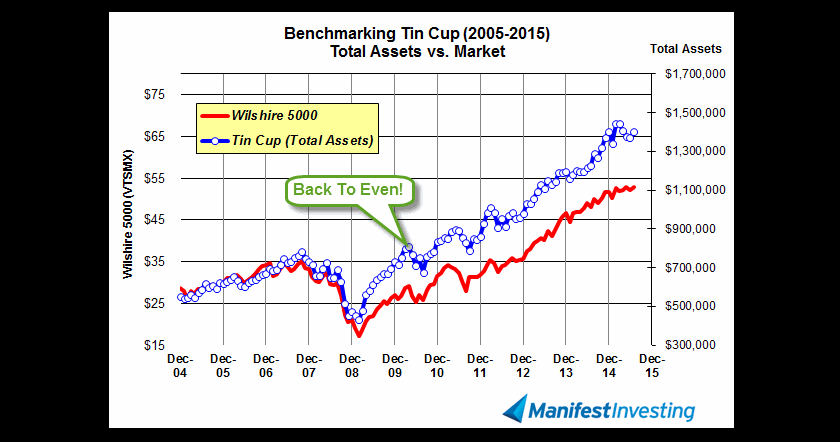
Answer: None. (1) We didn’t expect to be. No one should. (2) We didn’t need it. Check out the image of Tin Cup and the getting-back-to-even moment that happened for many of us before Jim Cramer started talking and writing about it.

Lost Generation? Think about 1941 and the 12 years of aftermath. It was into this void of investing and the schrapnel of rampant speculation that George Nicholson helped to launch the modern investment club movement in Detroit. Because it’s about EDUCATION … and deployed understanding as a real key to the stock market — as suggested by Peter Lynch — is discovered patience and discipline.

Diligence (Weekly)

Diligence. This week’s update provides an up-close-and-personal look at our weekly process for seeking actionable investing opportunities to study.  Our subscribers benefit from this information starting every Monday morning with the roll call, the fundamental updates and the targeted opportunities for further study.  For more on Manifest Investing, go here.

“Diligence is the Mother of good luck.” — Benjamin Franklin

“The expectations of life depend upon diligence; the mechanic that would perfect his work must first sharpen his tools” — Confucius

This week we take a closer look at our weekly report — and specifically — how we think this information is best used by long-term investors.

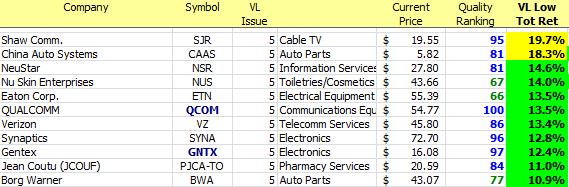
In a nutshell, we’re checking in on a few key areas. If you’re a shareholder or stockwatcher, we provide a synopsis of the best opportunities in the current (this week’s) update batch from Value Line. We update 1/13th of all companies every week and the best return forecasts for the week are on display in the Companies of Interest: Value Line section.

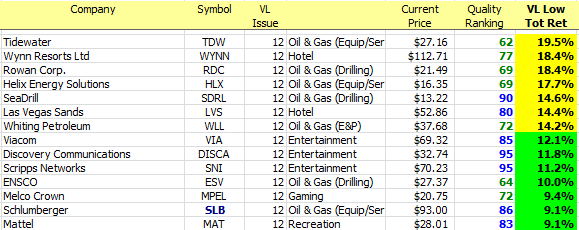
In the case of Tidewater (TDW), the Value Line low total return forecast (annualized for the next 3-5 years) is 25%.

This was based on the stock price shown ($25.57) on the date of analysis (4/28/2015).

The price is now $29.25 — part of the explanation for the 19.5% on our weekly report. The other source of a difference is that we’re constantly (every day) adjusting the time horizon in addition to the price. That $60 long term low price forecast is a fixed date. In any event, every Monday morning brings a roll call of best opportunities according to Value Line.

Why the Value Line Low Total Return (VLLTR) forecast? Because our research has found this to be the most reliable (actual results vs. forecasts) for the collective of companies covered by Value Line.

And about that $60 entry. This is where we flag opportunities and threats. Any material change (~20-25%) in this long term low price forecast (up or down) is flagged as Materially Stronger (up) or Materially Weaker (down) as we do our Monday morning roll call. If you’re a shareholder or stock watcher for a company that shows up in either roll call, consider it a nudge to see why Value Line seems to have adjusted their expectations — UP or DOWN.

We’ve begun to include direct links to snapshots or thumbnails for some of the flagged companies during these weekly updates. This week, we’ve started with Transocean (RIG) and recent Round Table selection Dril-Quip (DRQ).

When You’re Sailing … Do You Really Care About The Wind?

I think the answer is yes, but it depends. It depends on WHO you are and things like risk tolerance, life expectancy time horizons, opportunistic return maximizing, etc.

For a capital preservationist, we’d like to avoid turbulence like we saw during the Great Recession. This is the reason we track primary market barometers like the overall average return forecast. This characteristic doesn’t tell us when corrections, recessions or bear markets will happen — but it does help to gauge “vulnerability.” Higher quality stocks with higher return forecasts are more recession resistant. Period. On the opposite end, following a recession and significant correction, we “dial up” our interest in more speculative opportunities and increase our dosage of emerging, faster-growing companies.

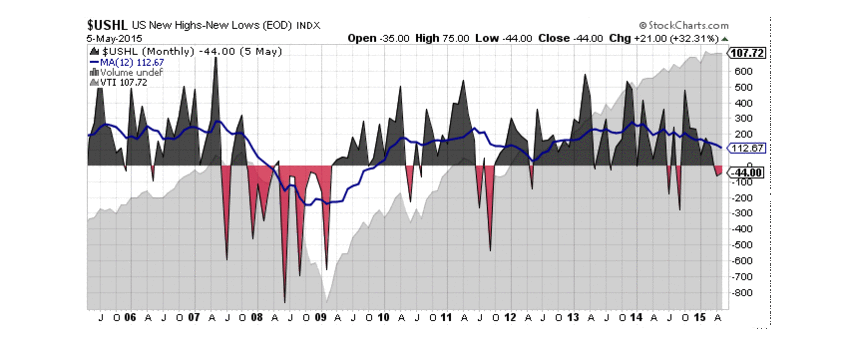
Our barometers on parade are intended to give a few perspectives on “vulnerability.” The $USHL indicator that we display occasionally is a very broad — and seemingly fairly reliable indicator of rhino behavior. This was inspired by The Big Picture and Barry Ritholtz. You can dig a little deeper on this one at An Attempt to Identify Market Tops ($USHL).

Most of us do very, very little asset allocation — and frankly, it ain’t easy and it’s what most of the investors and asset managers foul up, contributing to overall negative relative returns on average for the average rhino.

That said, Nicholson counseled that when it gets extremely challenging to find stocks to buy or accumulate, it is acceptable (and potentially incrementally rewarding) to build a war chest of cash equivalents to go shopping after the recession and stock price correction has blasted stocks back to elevated return forecasts.

Our Consensus Perspective

While the Monday morning roll call is limited to the Value Line update batch and our efforts to flag threats and opportunities, we reach out and check forecasts and judgments at places like Morningstar, Standard & Poor’s, Analyst Consensus Estimates (finance.yahoo.com) and Goldman Sachs. We audit and update these various resources to generate the Stocks to Study. This list is always sorted by MANIFEST Rank, our combination ranking of return forecast and quality … and we generally limit the field to the top decile or top 5 percentiles of the stocks in the 1/13th update batch.

Polaris Industries (PII) provides this week’s example of deeper digging in the snow … and beyond the snowmobiles for the company. Did you know that snowmobiles account for less than 10% of annual revenues?


Companies of Interest: Value Line

The average Value Line low total return forecast for the companies in this week’s update batch is 5.6%.

Materially Stronger: Transocean (RIG), Air Products (APD), Hilton Worldwide (HLT), Penn Gaming (PENN), Scientific Games (SGMS), Cambrex (CMB)

Materially Weaker: Wynn Resorts (WYNN), Input Output (IO), National Oilwell Varco (NOV), Melco Crown (MPEL), Oasis Petroleum (OAS), Dril-Quip (DRQ), Oceaneering International (OII), FMC Techologies (FTI), Interpublic Group (IPG), Carbo Ceramics (CRR)

Standard Coverage Initiated: [G-III Apparel (GIII)]

Discontinued: Konami (KNM)

Market Barometers

Value Line Low Total Return (VLLTR) Forecast. The long-term low total return forecast for the 1700 companies featured in the Value Line Investment Survey is 3.6%, unchanged from 3.6% last week. For context, this indicator has ranged from low single digits (when stocks are generally overvalued) to approximately 20% when stocks are in the teeth of bear markets like 2008-2009.

$USHL: Watching Rhino Walk, Not Rhino Talk. If you believe supply-and-demand matters (and you should) then the collective actions of the herd have bearing. By monitoring the relationship of new highs vs. new lows, we get an early warning clarion that signaled as Halloween 2007 approached. Current $USHL is weakening as the Sell-In-May-And-Go-Away herd begins to hold sway. We’ll be vigilant for this broad sentiment indicator to break 100 on the long-term moving average and/or break into negative territory.

Stocks to Study (5/8/2015)

Seeing fairly significant increases in the 1-year analyst consensus estimate for companies like Baker Hughes (BHI) and Schlumberger (SLB).

  • Polaris (PII) — Highest MANIFEST Rank
  • Wynn Resorts (WYNN) — Highest Low Return Forecast (VL) with Quality Rank > 60
  • Wynn Resorts (WYNN) — Lowest P/FV (Morningstar)
  • SeaDrill (SDRL) — Lowest P/FV (S&P)
  • Harte Hanks (HHS) — Best 1-Yr Outlook (ACE)
  • FMC Technologies (FTI) — Best 1-Yr Outlook (S&P)
  • Wynn Resorts (WYNN) — Best 1-Yr Outlook (GS)

Stocks to study 20150508

Undervalued Stocks: Dirty Dozen

Many of you are familiar with the Stock to Study / Undervalued feature in every monthly issue of Better Investing.

During the years I served on the stock selection committee, there were times when we wondered about the basis for the undervalued selection — in some cases, it seemed like the runner up to the Stock to Study selection.

But the intent was to identify a stock with either (1) a near-term, 12-18 … perhaps even 24 month catalyst that could lead to outsized returns, or (2) a stock that had been beaten down so badly that the return forecast was elevated. In some cases, stocks that would struggle to qualify for the core constituents of our portfolio were included.

The Dirty Dozen will be a version of this. In this case, the field is limited to stocks with quality rankings above 50 (above average) and with the highest return potential based on the difference between current price and the analyst consensus target price. It should be obvious that the 1-year horizon is pretty squishy so we won’t be doing any calculations out to four decimal places. [Grin]

In this case, for this week, it’s fascinating and coincidental that a stock mentioned by the Manifest Investing door prize subscription at last weekend’s StockFest 2015 in Grand Blanc would be the featured stock, Rockwell Medical(RMTI). This promising and potentially emerging Wixom, Michigan company is possibly worthy of a spot on our speculative radars. Our prize winning investor holds a significant number of shares and is hoping the company emerges and makes like a roman candle — at least for a while.

The other important aspect of our Dirty Dozen is that it extends outside the update batch for the week. The universe is all companies (~2400) covered by Manifest Investing.

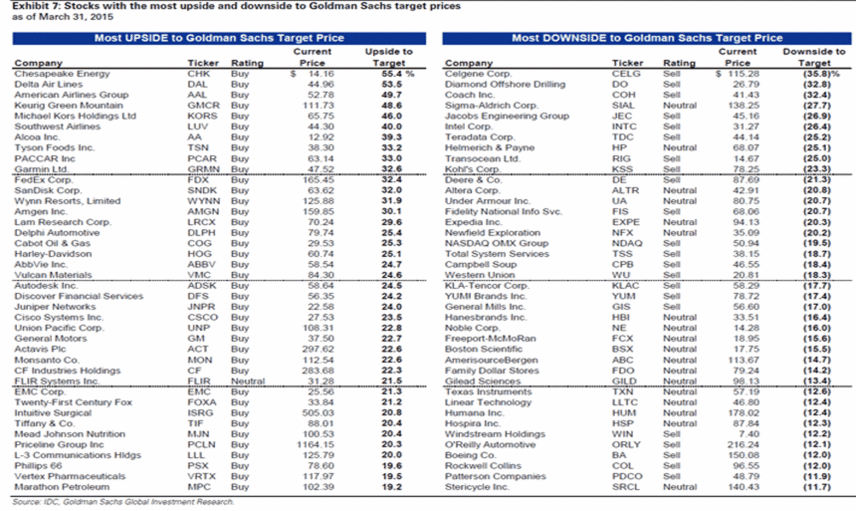
Goldman Sachs: Buy and Avoid

This was a tangential subject of discussion during the March Round Table. We’ve added Goldman Sachs price targets and will be monitoring them versus ACE and S&P.

Nutshell: Might this be a way to gauge sentiment? In this case, these differentials could deliver influence or impact, providing a potentially meaningful sentiment indicator.

http://www.bloomberg.com/news/articles/2015-04-02/goldman-here-s-where-u-s-investors-should-put-their-money-for-the-rest-of-the-year

Gs buy avoid list 20150331

As a quick reminder to be careful out there, this is what this morning held for Garmin (GRMN).

That’s a reduction from $63 to $54.

Source: Benzinga.com

Grmn gs opinion 20150402

More Fun With Goldman Sachs

When they’re not doing “God’s work” or referring to retail investors as Muppets, Goldman Sachs (GS) makes some calls — long and short — that can be influential in the market. In some Wall Street circles, the legions of Goldman Sachs are playfully known as Masters of the Universe.

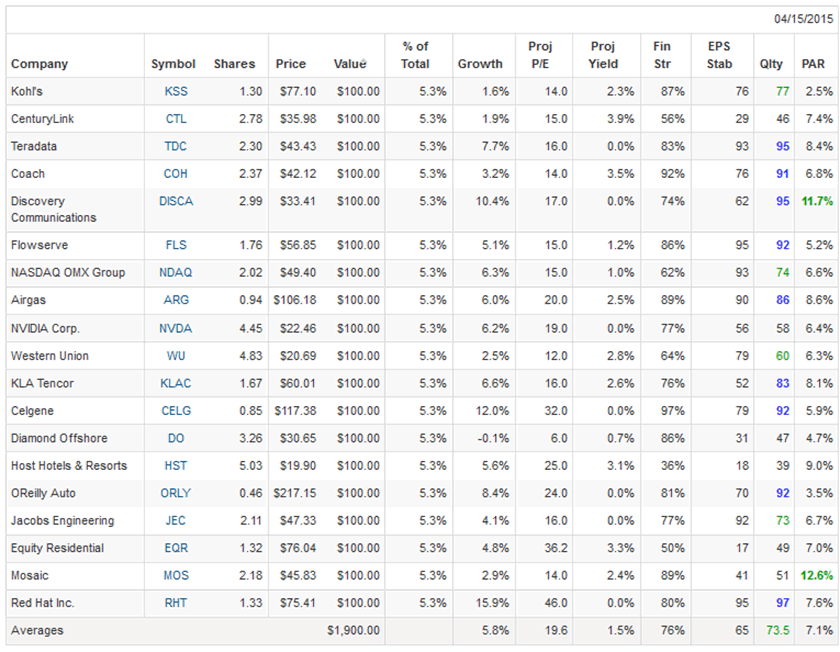
In addition to the two lists shared above, here’s a list of nineteen stocks that Goldman Sachs believes are headed for price swoons — a list of stocks to sell short.

Goldman Sachs offers three criteria on how to pick stocks to short:

  • Look for individual stocks with high valuations that have a tendency to underperform;
  • take hints from mutual funds as they do a good job of selecting shorts;
  • and look for stocks that are likely to move on company-specific factors and are less prone to moving with general market and sector trends.

Among the overvalued stocks Goldman thinks could drop are Celgene (CELG), OReilly Automotive (ORLY) and Red Hat (RHT). Stocks underweight by mutual funds that could fall are HST, CTL and EQR; and likely to deviate from the broad market and their sectors are KLAC, JEC and COH.

Rounding out Goldman’s 19 stock recommendations that could reward short sellers: ARG, DO, DISCA, FLS, KSS, MOS, NDAQ, NVDA, TDC, WU.

Tracking Dashboard: http://www.manifestinvesting.com/dashboards/public/goldman-shorts-20140414

Here are the tracking dashboards for the Goldman MOST UPSIDE and MOST DOWNSIDE stocks as of 3/31/2015:

The Stocks We Follow (MANIFEST 40)

Perspectives

MANIFEST 40 Update

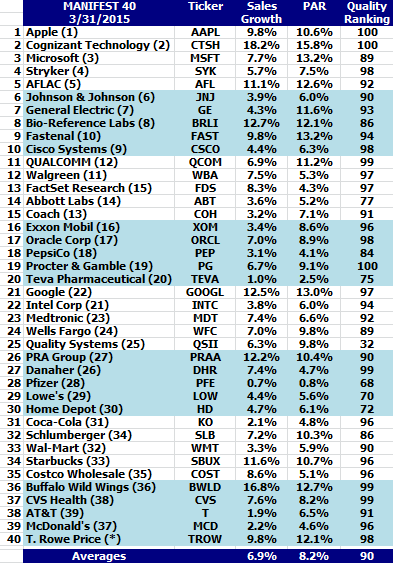
Our MANIFEST 40 is a celebration of collective excellence in stock selection, strategy and disciplined patience. We continuously monitor the 40 most-widely followed stocks by our community of subscribers at Manifest Investing.

“We have always believed that the collective decisions made by our community of like-minded, long-term investors are worth huddling over … a place where ideas are born.”

This managed “tracking portfolio” of your collective favorites has outperformed the Wilshire 5000 by +3.3%. The absolute rate of return for the trailing 9.5 years is 9.6%.

Capturing Attention: Chargers

QUALCOMM (QCOM) continues to ascend, moving from #12 to #11. CVS Health (CVS) has been bolstered of late and moves from #38 to #37.

The results of $100 positions investing in any of the Top 40 companies can be viewed at any time at: http://www.manifestinvesting.com/dashboards/public/manifest-40

Newcomer

T. Rowe Price (TROW) is a newcomer to the MANIFEST 40. The company was featured in Solomon Select in the July 2014 issue and has been discussed during a number of Round Tables and during other events. The asset manager is highly regarded in this long-term investing community and has been a favorite for decades.

Strongest Performers

The three top performers in the MANIFEST 40 since inception, based on annualized relative rate of return, are Cognizant Technology (+30.7%!), Apple (27.5%), PRA Group (20.2%).

The charter members of the MANIFEST 40: Microsoft (3), Stryker (4), AFLAC (5), Johnson & Johnson (6), General Electric (7), Cisco Systems (10), Walgreen (12), FactSet Research (13), Oracle Corp (17), PepsiCo (18), Teva Pharmaceutical (20), Intel Corp (22), Medtronic (23), Danaher (27) and Wal-Mart (33).

We’ll continue to pay the most attention to these community favorites. Keep up the good hunting!

More Fun With The MANIFEST 40

Here’s the listing (ranked from Most Widely Held, Descending) with a display of Opinions on Parade courtesy of Manifest Investing (consensus-based), Value Line, Morningstar, Standard & Poor’s, Analyst Consensus Estimates and Goldman Sachs.

Mi 40 opinions 20150410