Hot Links & Fractured Fairy Tales

Hot Links & Fractured Fairy Tales

I’m often asked about the utility of Twitter and similar “newsfeed” type services. I have to admit that I was extremely skeptical about 140 character blasts and an endless stream back when I first started exploring but I rapidly discovered that Twitter can be a path to discovering and sharing information.

Favorite “Follows” by @ManifestInvest

At Twitter you “follow” people that you’d like to hear from. For me, this includes a number of friends, and it also includes investing-related thought leaders and information providers. I also subscribe to (follow) sources like the various Fed research departments (Minneapolis & St. Louis rock) and companies that I follow. Some of my favorites:

  • @ritholtz — http://www.ritholtz.com/blog/
  • @eddyelfenbein — http://www.crossingwallstreet.com
  • @StovallSPCAPIQ — Sam Stovall (Standard & Poor’s)
  • @BobBrinker
  • @SelenaMaranjian — writer for www.fool.com (also Brothers Gardner via @TomGardnerFool & @DavidGFool)
  • @lecreative — Amy Buttell, colleague and Better Investing alum, writes on “all things financial.”
  • @TMFHousel — not just another Fool
  • @NateSilver538
  • @ReformedBroker — Joshua Brown

As an example, let’s take a look at a recent reading list shared by Josh. I generally find 2-3 things to scan whether it’s Eddy, Barry or Josh laying out the smorgasbord.

Here’s the link: http://thereformedbroker.com/2015/11/17/hot-links-fairy-tales/

What I’m reading this morning:

  • US dollar screams to a 7 year high (Bloomberg)
  • Stocks: Top 10 High-Conviction and New-Money Purchases (Morningstar)
  • Soros lightens up his bet against the S&P 500 (MoneyBeat)
    …and he joins Icahn in a bet on PayPal (Business Insider) — [… one for Kim Butcher and Round Table followers]
  • Alphabet, Amazon Lead A.I. Charge as Machines Take Over, Says UBS (Barron’s)
  • CEO of Alerian Index admits that MLPs are sensitive to oil prices. So much for the “toll collector” fairy tale (ETF.com)
  • Investment banks’ revenue set to decline again in 2015 (Reuters) — probably explains down draft in stock prices of asset managers
  • Home Depot continues to crush it. Another flawless quarter. (Business Insider)
  • Cliff Asness: Good investing is not about genius, it’s about fortitude (Business Insider)
  • Retailers hate those new credit card chips (New York Times)
  • Children born today will most likely live on average to their late 80’s (Upshot) — … one of our favorite themes
Fun With Dashboards: M&A (Walgreens)

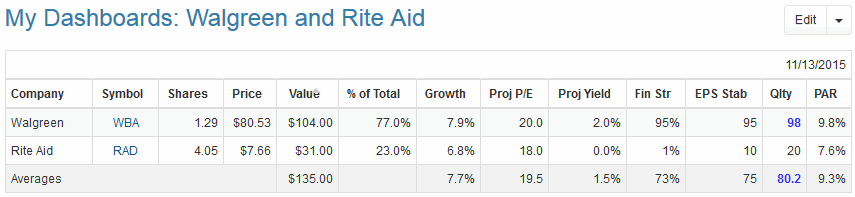
Does Walgreen (WBA) Acquisition of Rite-Aid (RAD) Justify The Stock Price?

Merger & Acquisition Dashboard Analysis. The dollar values entered (104 and 31) reflect the annual revenues (2015E) for the two companies. Walgreen is three times the size of Rite-Aid. The key figures are (1) the return forecast (PAR) for Rite-Aid which suggests that WBA is not over paying for RAD. (2) It is normal and customary for a company to pay a price that delivers a sub-zero return forecast, or PAR (Projected Annual Return). In this case, 7-8% is a pretty good deal for WBA. (They’ll have considerable restructuring and store portfolio management to do in the wake of the deal) (3) The other consideration is the relatively weak quality ranking, financial strength and EPS stability of the long-suffering RAD. The combination here is simple weighted-average math. The more elusive answer is whether Walgreen can transfer culture and operating performance to the new assets.

We often are asked about merger & acquisition analysis. It really does boil down to the return forecast (at the offered price) as to whether the price is too high. Many, many transactions feature situations where the PAR for the acquired company is -10% or -5% and this is particularly true for technology sector mergers. And yes, Virginia, this overpaying in the guise of “synergies” is the root of the good will that ends on company financial statements.

Is Walgreen overvalued? At a PAR of 9-10%, “They” don’t think so. (Remember our return forecast is based on analyst consensus and sources like Value Line, Morningstar, S&P, etc.)

When you pick up the morning newspaper and read that the Rite-Aid stock price is trading at a 50% premium to yesterday’s close and that “the deal is clearly a favorable transaction” — ignore that. The only thing that matters is the long-term return forecast based on the new stock price. A comparison to yesterday’s stock price for anything is uninformative.

The management team at Walgreen is experienced and effective. It will be interesting to watch them make decisions, shedding stores and optimizing the portfolio — and preventing the combined company from falling to the average quality, financial strength and avoiding EPS disruptions as they tackle the challenge. We’ll check back in a couple of years from now to see how they’re doing.

50 Best Small Companies (2015)

This Week at MANIFEST

It’s a busy week — starting with closing out our selections for the Manifest Investing Best Small Company list … to the rescheduled Round Table on Tuesday night … to spending some quality time with friends in Seattle at their annual conference for long-term investors.

A couple of weeks ago, we were advised by Forbes that there would be no 37th Annual List of Best Small Companies. So, after 36 years and the reality that this list has provided a number of actionable and rewarding situations over the last 20 years or so, we’re left to hope that it’s a one year hiatus. The Forbes list has always been a favorite and we’ve reminded investors to “trick or treat” around Halloween every year. “It was a sad day in the Kavula household.” — Ken Kavula.

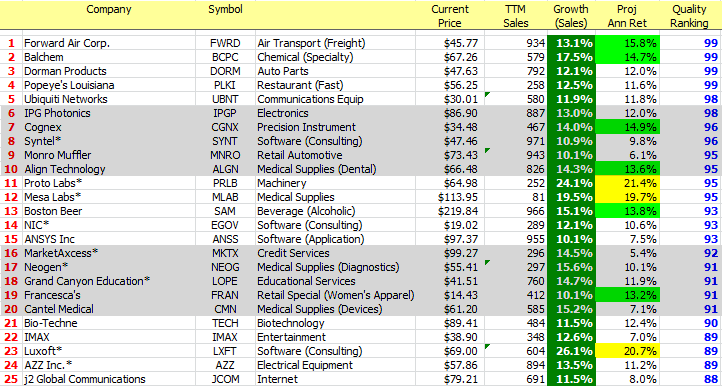
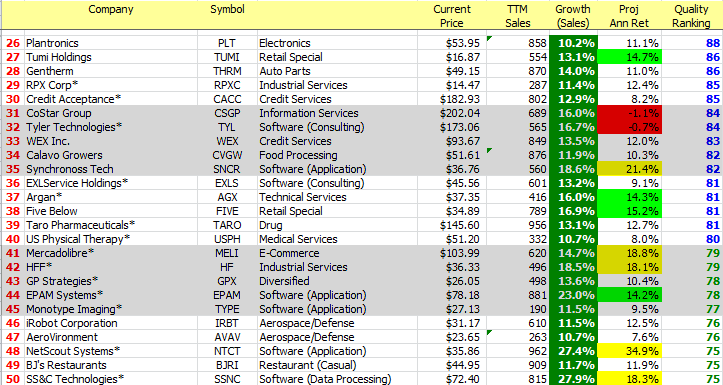
So — while remaining relatively faithful to the Forbes methodology — we decided to generate our own. We’ll do a full narrative and feature this as our cover story for November, but for now, here are the highlights and the 50 Best Small Companies by Manifest Investing.

Methodology

Criteria:

  • SMALL Annual Revenues less than ONE BILLION
  • Sales growth >= 10%
  • Annual Revenues > $50 million
  • Stock Price > $5
  • BEST Ranked by Highest Quality (Percentile ranked composite of Financial Strength, EPS Stability and relative Sales Growth Forecast and Profitability)
  • No Asset-Based Business from Financial Sector

Published Dashboard for 50 Companies: https://www.manifestinvesting.com/dashboards/public/best-small-companies-2015

Manifest Investing 50 Best Small Companies (As Inspired by Forbes)

MANIFEST – Best Small Company Preview

Screening Results (October 2015)

Best Small Company Preview

by Mark Robertson

One of the most powerful lessons we’ve learned from tracking the Forbes Best Small Company list every October is that QUALITY MATTERS. Over the long term, we want out-sized returns from our smaller, more speculative, and faster-growing companies and the best protection against the brutal downside of smaller companies is … quality.

Manifest Investing — Best Small Companies (2015)

Best Small Companies (10/8/2015). Screening results as we search for high-quality faster-growing small companies. The Forbes list will be out during October. Sorted by MANIFEST Rank (PAR & Quality) with minimum growth forecast of 12%. * – not covered in Value Line Investment Survey standard edition.

It will be interesting to see how many of the featured companies end up on the Forbes list. This is certainly a list of candidates that can bolster the overall average growth forecast of our portfolios with an average sales growth forecast of 16.3%. The average return forecast is 18.2%.

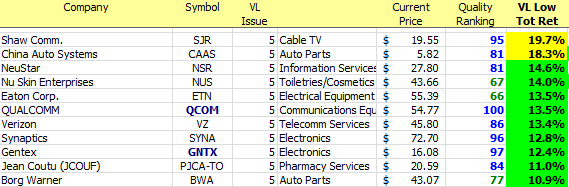
Value Line is quite a bit less exuberant with an average low total return forecast of 8.5%. Morningstar is a little more enthusiastic with an average price-to-fair value ratio (P/FV) of 85%. We take lower expectations for early stage companies with a grain of salt whenever Value Line or Morningstar are providing the analysis. S&P has an average P/FV of 82%.

The outlook for the year ahead from this group is optimistic with the ACE forecast at 24.2%, S&P at 25.3% and our Goldman Sachs benchmarking checking in at 17.6%. It’s all good.

Several of these companies have appeared on the Forbes and/or Fortune lists in the past — some actually discovered by us using those resources.

Which ones have you studied? Which ones do you own? Are any of the names new to you? Welcome to October and small company discovery. Oktoberfest is for good hunting.

This Weekend’s Dirty Dozen (10/9/2015)

Some potential studies for this weekend …

Dirty Dozen

I’ve been looking back over some previous “Dirty Dozens” and the anecdotal results we’ve seen over the last several months and it appears to be compelling — at least anecdotally. The recent price bump in Copa Holdings (CPA) is a case in point among many as I was updating the various “cases.”

It probably makes sense to shop among the stocks with the most perception of upside (think rhino sentiment) while continuing to shop among the higher-quality companies.

In that spirit, here is a current Dirty Dozen that is formed by ranking the highest total return expectation based on analyst consensus expectations (ACE, Source:finance.yahoo.com).

September 2015 Round Table

What: Round Table Discussion of Favorite Stock Study Ideas

When: Tuesday, September 29 at 8:30 PM ET

Where: Online. Register via https://www.manifestinvesting.com/events/178-round-table-september-2015

Who: Kim Butcher, Ken Kavula, Herb Lemcool, Hugh McManus and Mark Robertson

Why: Because we like to share ideas for successful investing. The selections made by Round Table participants have beaten the market over the last five years with a relative return of approximately +3.0%

Stocks Likely To Be Covered: Apple (AAPL), Illumina (ILMN), McGraw Hill Financial (MHFI)

The session (webcast) is FREE. Please invite your friends and family to attend.

If you’d like to be added to an email reminder list for this and all future (monthly) Round Tables, send a request to nkavula1@comcast.net

Cicadas and the Stock Market

This Week at MANIFEST (9/18/2015)

“The cicadas pierce the air with their searing one-note calls; dust eddies across the roads; from the weedy patches at the verges, grasshoppers whir. The leaves of the maples hang from their branches like limp gloves; on the sidewalk my shadow crackles.” — Margaret Atwood

“Nothing in the cry of cicadas suggests they are about to die” — Matsuo Bashō

“There was an electric buzzing sound that was constantly on, acting as background music like a million cicadas in the forest. A constant white noise.” — Missy Lyons

Cicadas have been used as money, in folk medicine, to forecast the weather, to provide song (in China), and in folklore and myths around the world.

The cicada has represented insouciance since classical antiquity. Jean de La Fontaine began his collection of fables Les fables de La Fontaine with the story La Cigale et la Fourmi (The Cicada and the Ant) based on one of Aesop’s fables: in it the cicada spends the summer singing while the ant stores away food, and finds herself without food when the weather turns bitter.

In China, the phrase “to shed the golden cicada skin” is the poetic name of the tactic of using deception to escape danger. It became one of the 36 classic Chinese stratagems. In the Chinese classic novel Journey to the West (16th century), the protagonist Priest of Tang was named the Golden Cicada; in this context the multiple shedding of shell of the cicada symbolizes the many stages of transformation required of a person before all illusions have been broken and one reaches enlightenment. This is also referred to in Japanese mythical ninja lore, as the technique of utsusemi (i.e., literally cicada), where ninjas would trick opponents into attacking a decoy. More generally, the cicada symbolizes rebirth and immortality in Chinese tradition.

In Japan, the cicada is associated with the summer season. According to Lafcadio Hearn, the song of Meimuna opalifera, called “tsuku-tsuku boshi”, is said to indicate the end of summer, and it is called so because of its particular call.

In an Ancient Greek myth, Tithonus eventually turns into a cicada after being granted immortality, but not eternal youth, by Zeus. The Greeks also used a cicada sitting on a harp as emblematic of music. [Sources: https://en.wikipedia.org/wiki/Cicada]

15-17 Year Cycles In The Markets

From the dusty eddies of end-of-summer (or early autumn) corrections to the notions of noise and the reality of 13-17 year cycles, we find elements of investing in all things cicada. And we wish/hope that the flash crash cicadas will experience similar life cycles.

A number of academic studies have pegged market cycles at approximately 15-17 years. We’re not talking about economic cycles, but those secular trends that seem to last about that long. The bull market of 1982 through 2000 is one example. We just might be living through a cicada cycle from 2000-2002 to 2015-2017 until a real bull market returns. How can we say that? Haven’t we been in a bull market for several years?

Perhaps. Stock prices have recovered in recent years, staggering and muddling along to new highs — but there’s an uneasy feeling among many investors that much of it is artificial, bolstered by things like low interest rates, government seizure and ownership of equities and the quantitative easing of the last several years. As this has propagated, general profitability has been flat and hovering near recessionary levels for the better part of the last ten years. Demand has been quenched and productivity maximized.

We updated the VLLTR forecast chart to cover a period of approximately 16 years. This means that the blue trend line just might cover a full cycle and be “representative.” As we counsel, the blue trend is the real long term path and the spikes and troughs in the green bars (Wilshire 5000) spend time above and below the trend line — much like rising and falling tides in the turbulent oceans.

Investors should not be surprised by a migration back to that blue trend — most likely with some pendulum-like overshoot along the way — because regression to the trend is a little (maybe a lot) like gravity and it’s been historically fairly reliable.

If this is true, we’re likely to be presented with some outstanding long-term opportunities over the next few years as the opportunity cicadas awaken and sing.

Companies of Interest: Value Line

The average Value Line low total return forecast for the companies in this week’s update batch is 5.8% — in line with the 5.9% for the Value Line 1700.

Materially Stronger: CVS Health (CVS), Dycom Industries (DY), T-Mobile (TMUS)

Materially Weaker: Bioscrip (BIOS), Dana Holding (DAN), America Movil (AMX), Arris Group (ARRS), Cablevision (CVC), Dish Network (DISH) … “Dishonorable Mention”: Qualcomm (QCOM)

Standard Coverage Initiated: Shake Shack (SHAK)

Discontinued: DirecTV (DTV), Catamaran (CTRX), Integrys Energy (TEG)

Chicago Investor Expo 2015

Chicago Investor Expo 2015

8:00 a.m. to 4:30 p.m.
Saturday, September 12, 2015
College of DuPage
425 Fawell Blvd.
Glen Ellyn, IL

More than 25 educational sessions, along with corporate presentations, beginner track and meals. Wide range of investment education topics to appeal to investors at all experience levels.

Instructors include Mark Robertson and Ken Kavula with Dan Boyle, Doug Gerlach, Ray Giese, and Jim Crabill.

Cost: $65.00

Sponsored by Chicagoland and Chicago West Chapters of BetterInvesting

For more information and Registration: see http://www.chicagoinvestorexpo.org.

Market Mystery Solved!

Breaking. The stock market is a teenage daughter.

expectingalpha's avatarExpecting Alpha

As the year winds down — and we get this blog launched — we’ll be going back to a number of our favorites, a few oldies-but-goodies.  Some will share fodder for investment-related and life-related pondering.  Others will convey research methods and findings, but they’re all intended to help you (particularly if you’re new to Manifest Investing) to get to know us better.  This was written after attending a Martina McBride concert this summer — and it’s clear that the stock market does behave very much like a teenage daughter, sometimes.
Benjamin Graham had it all wrong.

I’ll let that heresy sink in for a minute.

I ain’t complainin’, but I’m tired.
So I’m just sayin’ what I think.
And if we’re being honest,
Then honestly I think [we all] need a drink.

Graham — hailed as the father of fundamental analysis and value investing — often used a characterization for…

View original post 212 more words

National Waffle Day

Going Gets Tough — Gone Shopping

Fear tends to manifest itself much more quickly than greed, so volatile markets tend to be on the downside. In up markets, volatility tends to gradually decline. — Philip Roth

Today is National Waffle Day.

And did the markets ever waffle. Although our focus is always on individual stocks, it was hard to ignore that the Dow Jones Industrial Average toppled from 16459.75 to 15370.33 at the open — a plummet of 6.6% before most people finished their morning coffee.

Apple (AAPL) opened at 105.76 and dropped to 92.00 — a swoon of 13.0% in a matter of minutes.

As we complete the update of our weekly batch, we’ll present a roll call of high-quality study candidates that could be worthy of pouncing — as the wafflers waffle. Our investing friends don’t let friends waffle because volatile markets often deliver out-sized opportunities.

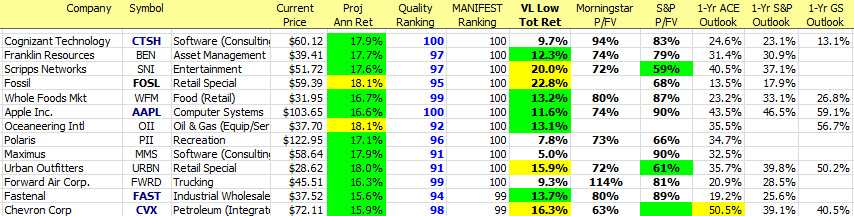
Stocks to Study In A Volatile Market

We set a limit of Quality Ranking > 90 so that we’d be looking at only the excellent companies in our database — only those companies falling in the top decile of all companies based on ranking of financial strength, earnings consistency and relative growth forecast and profitability vs. peers/competitors.

There are number of reasons for this. If the correction deepens, it’s likely that the highest-quality companies will suffer smaller price drops. High company quality can be a life insurance policy. This is particularly true for companies with thin (low) profit margins if recessionary conditions develop. For poor quality companies, recessions can be fatal. (For more on this subject, review the high quality discussion of Arnold Bernhard’s 1958 Best Companies that we covered last year.)

Volatile markets can create opportunity because frankly, average investors do stupid things.

When asked, I’ve been urging young assertive investors with understanding and risk tolerance to shop assertively. One friend bought Apple (AAPL) in the low $90s this morning. One of our favorite market barometers ($USHL) has now entered “yellow light” cautionary territory and for those thinking capital preservation, it could make sense to convert lower-quality companies and/or low return forecasts to cash just in case we get another 25-40% price drop. Raising cash equivalents isn’t done so much for defensive purposes — because the swoon could stabilize and the secular bull market could trudge on. It really could be a situation of building reserves to take advantage of future opportunities.

  • Cognizant Technology (CTSH) — Highest MANIFEST Rank
  • Fresh Market (TFM) — Highest MANIFEST Projected Annual Return
  • Joy Global (JOY) — Highest Low Return Forecast (VL)
  • Joy Global (JOY) — Lowest P/FV (Morningstar)
  • Fresh Market (TFM) — Lowest P/FV (S&P)
  • Joy Global (JOY) — Best 1-Yr Outlook (ACE)
  • Baidu (BIDU) — Best 1-Yr Outlook (S&P)
  • Apple (AAPL) — Best 1-Yr Outlook (GS)

Note: The price targets from Goldman Sachs are from public releases and represent a partial sample. The price target is logged as of the most recent public analyst report. Although every effort is made to keep this information as current as possible, some of the ratings may not reflect more recent research and updates.