Railroading Profitability: A Quest

Baron Buffett: What Did He Know & When Did He Know It?

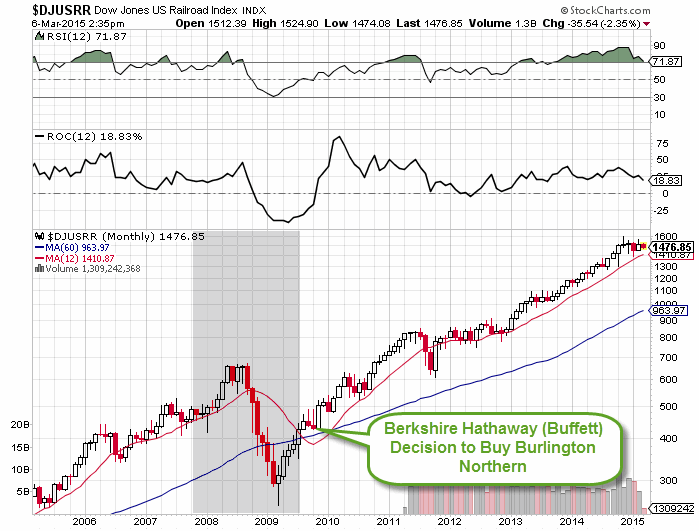
Investors have joked that Warren Buffett’s purchase of the Burlington Northern Santa Fe railroad was simply the fulfillment of a child’s unfulfilled Christmas wish. And on a grand scale.

On November 3, 2009, Warren Buffett’s Berkshire Hathaway announced it would acquire the remaining 77.4 percent of BNSF it did not already own for $100 per share in cash and stock – a deal valued at $44 billion. The company is investing an estimated $34 billion in BNSF and acquiring $10 billion in debt. On February 12, 2010, shareholders of Burlington Northern Santa Fe Corporation voted in favor of the acquisition.

I haven’t dug in to attempt to determine the rate of return on Burlington Northern (yet) but the average annualized return for the average railroad since the time of the transaction is 29.8%. (Berkshire’s return on BNSF is probably in the annual letter to shareholders.)

The Heritage & Industry Profitability

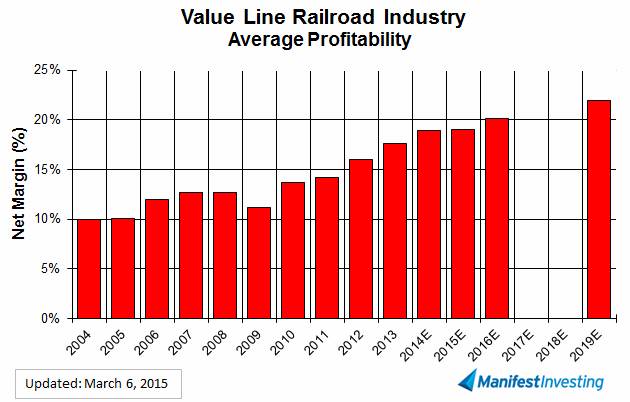
Everything I’ve seen and remember suggest that the profitability levels of 2004-2009 were fairly typical, representative of general net margin levels going back for quite some time.

Note the inflection and the increased profitability that’s been a powerful work-in-progress for the last 5-6 years.

How might he have known that this was going to happen?

Are there any documented instances or evidence of why this is something that could have been anticipated back then?

Is there any place or industry today that has a similar profitability enhancement potential?

Investors, start your locomotive engines.

Southwestern Energy (SWN)

Four years ago (3/11/2011) Southwestern appeared — as it often has — among our stocks to study during our weekly update. The stock price at the time was 36.12. And although the price reached 49.2 during 2014, the persistent backslide over the last year to 24.54 means that SWN has delivered an annualized return of -9.2%. The Wilshire 5000 has gained 14.8% during the Southwestern swoon.

Business Description

Southwestern Energy is primarily engaged in the exploration & production (E&P) of natural gas and oil.

2011 Outlook

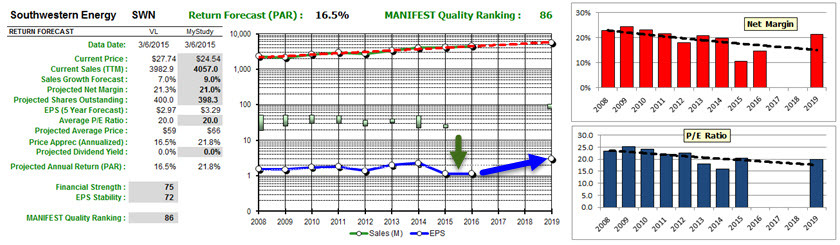
Our forecast at the time featured 10% sales growth, 26% net margins and a projected average P/E ratio of 19x for a projected annual return of approximately 9%.

Equity Analysis

What’s gone wrong? Overall, the sales growth forecast has remained intact. It seems reasonable to expect 7-10% from this relatively small and well-managed company.

The profitability is what has waned. Value Line’s 3-5 year forecast was 31% four years ago and we took some “shots” at that optimism at the time with some duct tape. Optimism is a good thing — in moderation.

The P/E of 20x or so is still OK. This is a good company.

Yes, Virginia, stock prices follow earnings. .

If it’s reasonable to expect the conditions shown in the accompanying analysis, the Southwestern stock price is going to ultimately follow the blue arrow. But it might gurgle for a while.

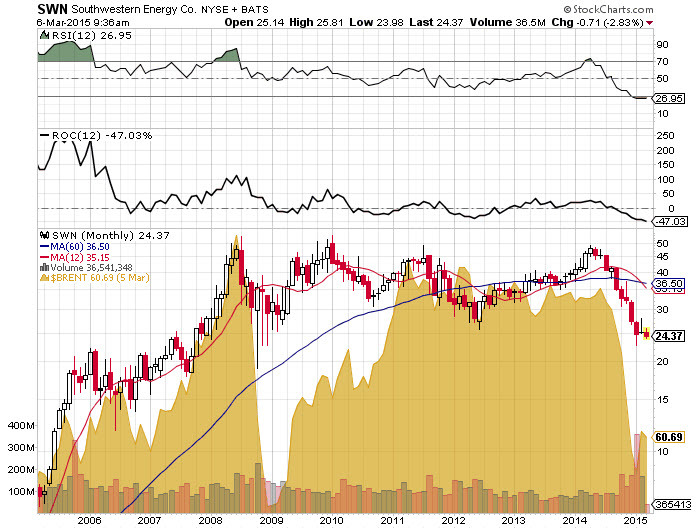
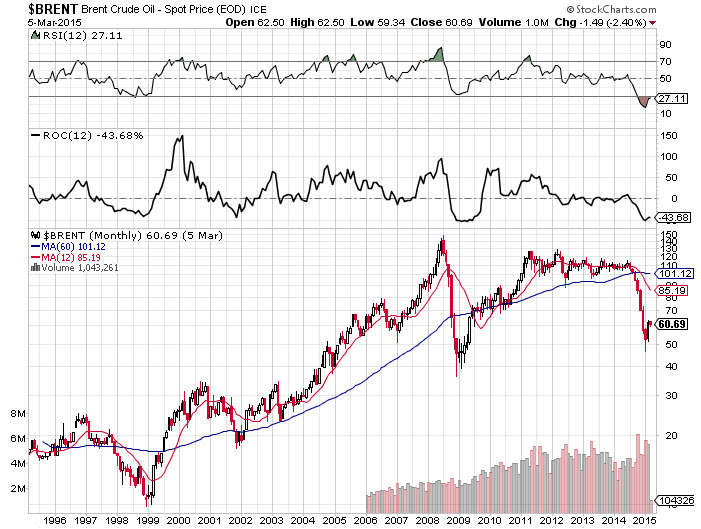
Why? Because the economic environment and the prices on gas pumps matter. When they tumble, like from $4.29 to $2.19 rather rapidly, companies like SWN get hammered — some more than others. Check out this side-by-side of the SWN stock price swoon versus the price of oil ($BRENT) as a proxy for “energy prices in general.” Believe it or not, Southwestern is less impacted than most and generally recovers faster than most. The natural gas and oil portfolio diversification of their operations probably helps here.

Q: Does the price of energy fluctuate?

A: Yes.

 brent 20150306

Conclusion

Many of us, including Hugh, have been talking about the accumulation opportunity that we’re currently experiencing with companies like BP (BP), Schlumberger (SLB) and others.

Looking at the preceding graph, unless you expect that long-term moving average (blue line) to invert and start heading “south”, energy prices will be higher at some point in the future. Companies like Southwestern will persist and ultimately do better.

Personally, I look at the long-term characteristic of that trend (+6.3% annualized over the last 6 years) and see $130-$150 price levels in 3-5 years. It’s possible. Virginia would like to remind all of us that stock prices follow earnings … eventually.

Duct Tape and Mission Salvation

A quick throwback to our weekly update from four years ago …

We watched Apollo 13 this weekend. Do Tom Hanks or Ron Howard movies ever get old? The movie is packed with drama and splashed down on the Hollywood red carpet with a wonderfully deserved nine Oscars, including Best Picture.

Maybe it’s my engineering heritage, but my favorite sequence comes with about three days left in their return voyage when the discover that the cabin is becoming progressively poisonous as carbon dioxide levels are climbing in the lunar module. In a real life MacGyver moment, a team of engineers in Houston scramble and put together an air scrubber using a pile of junk including packing materials and a variety of … well, garbage. But the star of the moment is duct tape. “Aquarius, you need about three feet, Jim.” “Just tear off a strip about as long as your arm.”

As Kevin Bacon fights to avoid passing out, the duct tape kicks in and the air purification is underway.

Sometimes our portfolios need a little duct tape. As roman candles flame out and cruise missiles reach their destination, there are times when plain old ordinary (in some cases, non-growth) companies can be provide a significant booster stage for our portfolios. Our Tin Cup model portfolio owes a great deal to Wolverine Worldwide and AutoZone back in 2000-2002 while the booster rocket debris was landing all around us.

Watch for our online discussion, “Roman Candles, Cruise Missiles & Ejector Seats” which we’ll encore during March … and I’m going back to applying a little more duct tape to our portfolios.

“Houston, we don’t have a problem so long as we have enough duct tape.”

Exxon Mobil (XOM)

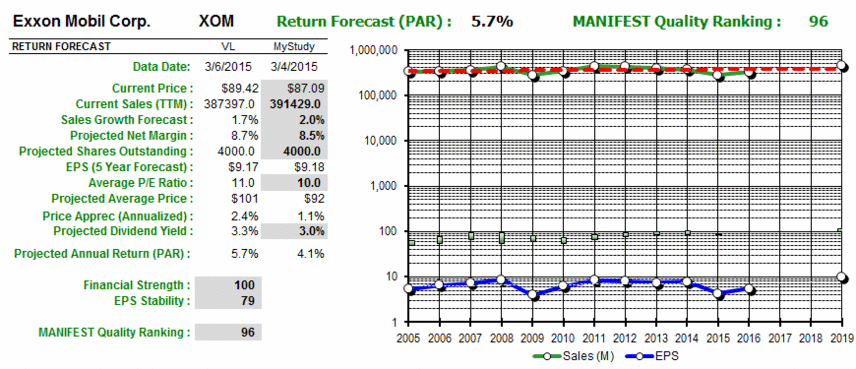
Much has been made of Berkshire Hathaway’s recent sale of Exxon Mobil ($XOM) in recent days — with Buffett himself stepping up to defend the company as a high-quality industry leader.  From a long term investing perspective, some of the integrated oil companies look compelling but may admittedly have some tough sledding for the next 18-24 months if current EPS forecasts are credible and materialize.

Because yes, Virginia, stock prices do ultimately follow earnings.

Here’s a look at current Equity Analysis Guide worksheet for Exxon Mobil (XOM) showing the turbulence. It’s not small.

That long-term growth trend is approximately 2%.

Xom eagle 20150304

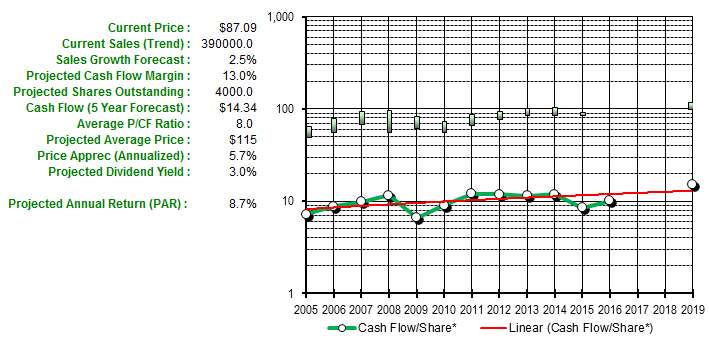
Exxon Mobil (XOM) can also be an example of using a different valuation method (P/CF) for building a return forecast.

In this case, do a regression-based sales forecast for 5 years from now (~460,000).

The cash flow margin (cash flow/sales) is quite consistent at 13%.

The price-to-cash flow (P/CF) is also very consistent at 8.0×.

Xom pcf 20150304

This supports an average long-term price forecast of $115 — and a return forecast of 8-9%.
Xom pcf forecast 20150304

Get Rich Carefully

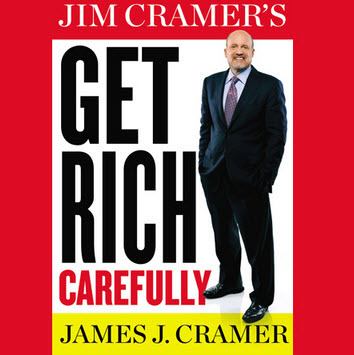
On Wednesday night, Ken Kavula, Nick Stratigos and I participated in a “book club” program delivered by NAIC/Better Investing featuring Jim Cramer’s Get Rich Carefully. We were joined by Eve Lewis and the panel unanimously felt the book is a worthy read for long-term investors.

Booyah. Jim Cramer surprised me.

I didn’t expect the book to be this good. The end result is a profile of a matured/maturing investor. Jim started with Goldman Sachs, learned a great deal from one of the most successful investors of all time, Michael Steinhardt … went on to manage his own hedge fund and ultimately become the influence that he is today.

The preface alone is worth the price of admission. Cramer covers the turbulent and challenging landscape facing should-be long-term investors today. The breach of trust, shenanigans and continuing nuisances of high frequency trading, dark pools and opportunists with too many brain cells and too much time on their hands persists today.

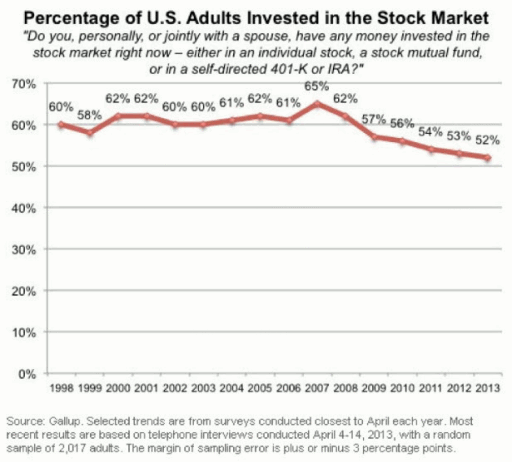
As George Nicholson, grandfather of the modern investment club movement, would most probably remind us: “It’s incumbent on us — all of us — to rise above this to champion better futures for the people we care about.” Buying excellent companies when they’re on sale — and holding them for as long as it makes sense to do so — is still relevant. Perhaps even urgent based on the accompanying illustration of recent trends.

In the July 2014 preface, Cramers “calls” the current level of the NASDAQ and its 16-year highs. He stipulates that the denizens of the NASDAQ are less likely to explode this time around. He puts HFT and the other nonsense into context. And …

Cramer closes the preface with … “I, on the other hand, prefer for you to get rich using stocks as your wealth builders, as long as you invest wisely and carefully when doing so.”

Closet Better Investor

Ken Kavula speculated that Cramer is absolutely a closet investment clubber. He largely focuses on core stocks, seeking and owning leadership companies and remaining vigilant for opportunities in several general themes. He also suggests that it’s OK for investors with experience and risk tolerance to stretch and reach for opportunity. This is absolutely consistent with Nicholson’s admonition about seeking high-quality core holdings as the strategic foundation of our portfolios while allowing for speculation and “playfulness” with a suitable portion of our portfolios, for example 10% of total assets.

In that context, the Cramer on CNBC and in current publications often takes the persona of the higher flying risk taker. (Some of this is assuredly related to audience and appetite.) His entries in the current Groundhog Challenge, were compiled from his 20 stocks for 2015. Cramer is currently high on the leader board.

Cramer’s Groundhog Selections can be monitored here: Cramer’s Celebrity Groundhog 2015 Entry

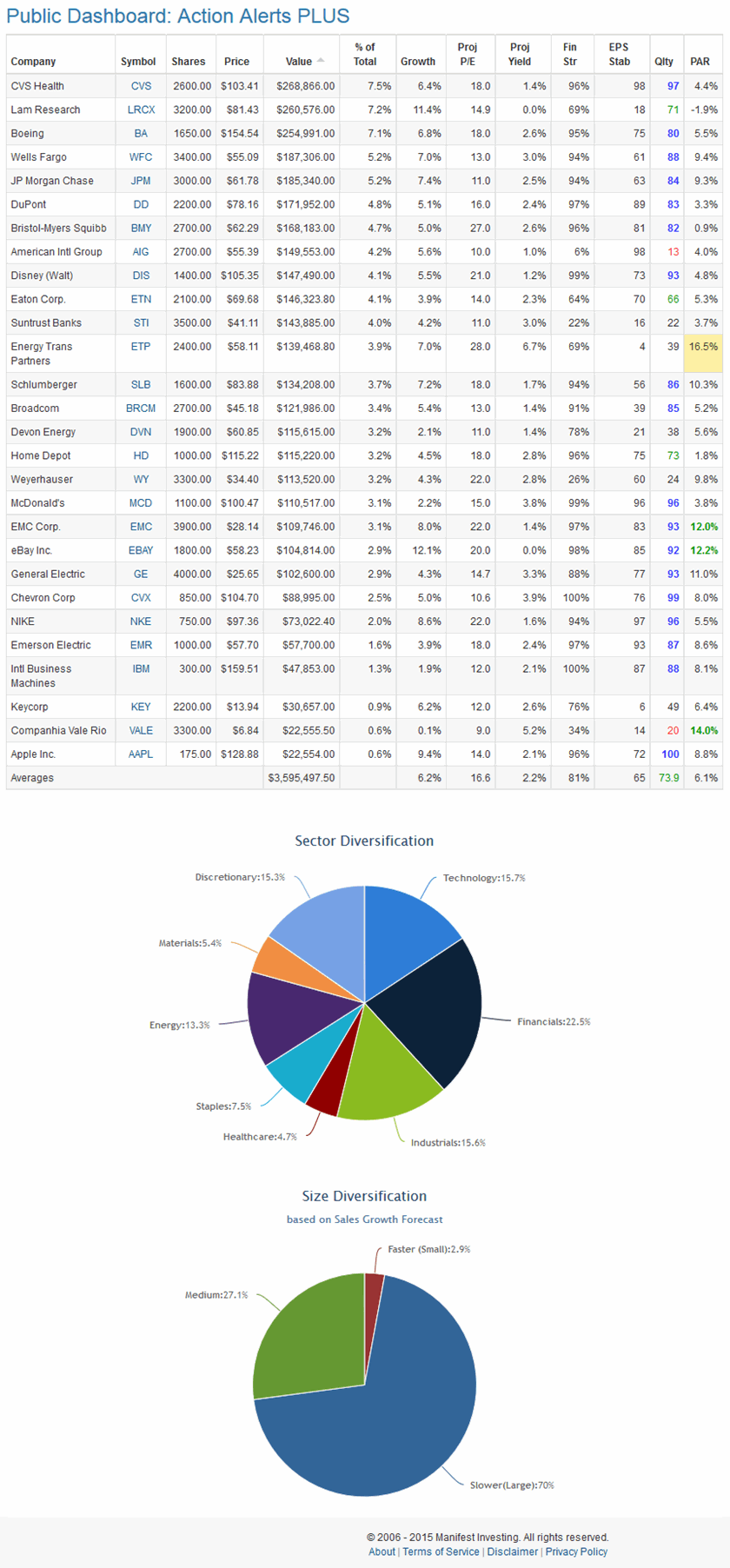
Contrast that list with the stocks in the ActionAlertsPlus charitable trust portfolio. I’m not sure exactly how current the portfolio is, but turnover is relatively low (certainly lower than the TV show lightning) but definitely a different breed of companies — virtually all of them leaders in their industries:

A New Market Barometer For Us

Cramer cites the non-farm payroll data as the report that he finds most influential. He keeps a close eye on this.

Again, I was skeptical.

Again, I was surprised.

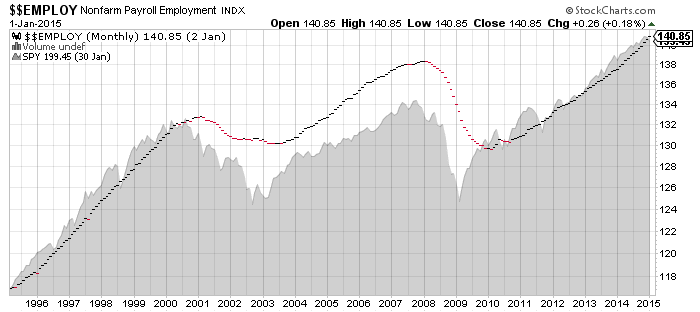
Here’s a look at the 20-year track record of U.S. Non-Farm Payrolls ($$EMPLOY) courtesy of www.stockcharts.com:

All the usual caveats apply. We don’t think of these charts as predictive. We never use them in isolation. But as “another arrow in the quiver” it simply makes sense that hiring trends and recessions go together. The disruptions in 2001-2002 and 2008-2009 are quite obvious … and we’d be concerned if the payroll trends flattened or declined at the same time as return forecasts bottomed and the $USHL deteriorated. Recessions and depressions can inflict significant damage. And harboring in high-quality, decreasing speculation and raising cash equivalents is logical for those seeking capital preservation or in the words of Nicholson, “to enable better shopping after the recovery is rolling.”

Community Investing

The power and potential of community investing is nothing new to us.

Cramer surprised me. I was reminded that his concern and hope is genuine. He really does want a nation of investors to do better. He’s meandered down several paths from Goldman to Steinhardt to Cramer Berkowitz to CNBC/MadMoney. …

Results matter too. I’d really like to see better long-term performance from the Action Alerts Plus portfolio — perhaps a little more of that Steinhardt magic/advantage or some of that portfolio design and management magic experienced over seven decades by many of us.

Cramer shares valuable lessons well and the maturation continues. Learn the lessons well. Share them. “We are now ready to triumph over the daily trauma of markets that we no longer fear. We have each other’s backs. We know there is no such thing as overnight wealth [for most.] That’s for fools who will never attain it. We’re busy taking our time, avoiding the pitfalls, trying to see around the curves and tiptoe past the endless land mines as we attempt, carefully, to get very rich and not to give it back when we get there.”

Booyah.

March Madness: What Works On Main Street

March Madness: What Works On Main Street

This editorial appeared in Better Investing magazine back in April 2000 in response to a widely-circulated “research paper” that assailed investment club performance. In my opinion, investment clubs unleash stewardship and deliver the potential for better futures to all who come to understand the philosophy and methods.

by Mark Robertson, Senior Contributing Editor, Better Investing

The coming of April showers means that, once again, March Madness has come and gone. March Madness. With each passing year, I find that I enjoy the mighty meetings of high school basketball teams, closely followed by their collegiate counterparts. By the time this magazine reaches your coffee table, there’s a pretty good chance that a number of magical moments will have happened. Gene Hackman and his Hoosiers were just one shining moment. There will be others. The goose bumps are “on ice” just waiting to be experienced. “Do you believe in miracles?”

We’ve acknowledged in past articles that George Nicholson always regarded NAIC and investment clubs as his “Grand Experiment.” Investment clubs are also human. The things that can be discovered are nothing short of miraculous.

Exploring the rewards of investing while stripping away the myth and mystery is something that brings a smile to our faces. Learning to smile together is a gift that we hope to share with as many people as humanly possible.

March Madness. It brings out the best. Unfortunately, it sometimes brings out the worst, too.

The January/February 2000 issue of the Financial Analysts Journal features an article by Brad Barber and Terrance Odean entitled, Too Many Cooks Spoil the Profits. This publication is received by Chartered Financial Analysts. Although fairly few people will ever see this report, we believe that exploring some of the conclusions is worthwhile. If nothing else, Barber and Odean have been regularly appearing in the media. We think they could gain much from a better understanding of investment clubs and strategic long-term investing.

Quoting their conclusion: “Unfortunately, [investment clubs] do not beat the market.”

We have “been here” before and it won’t be the last time. A year ago, a number of publications assailed our Beardstown Ladies. Too many cooks? Most of us rather like cooking with our friends. There is some impressive cookin’ going on. There will come a day that we’ll demonstrate that we not only achieve (in the words of Barber and Odean) “savings, education, friendship and entertainment . . .” but we also achieve very promising performance levels as well. Collectively, NAIC investors achieve high returns. Clearly, this does not happen for every single club or every individual, but we have scores of success stories. We think it’s valid to point to our Top 100, this issue’s main feature, as substantial evidence. With Intel, Lucent Technologies, Home Depot, Cisco Systems, Merck, PepsiCo and Microsoft among the most widely held companies, clearly somelevel of success has been attained by our practitioners.

Nearly 4,500 investment clubs (11.9 percent of registered clubs) responded to our latest Top 100 Survey with complete portfolio summaries and club accounting reports. Barber and Odean assail the “touting” of investment club performance in the media by citing sample bias. Barber and Odean base their findings on 166 investment club account statements from a single discount broker! Not only that, they cite turnover levels of 65 percent (nearly a complete overhaul of the stocks within a club portfolio every year-and-a-half.) Barber and Odean also share that these club accounts were concentrated in high beta, small-cap stocks. These characteristics lead us to a simple question, “Are you sure that you’re assessing NAIC club performance?” That doesn’t sound like what the long-term investors we know about are doing.

Most people are not statisticians, but I think that they can sense that 4,500 data points might be more representative than 166. Particularly when the “166” are “weak.”

The authors dwell on excessive turnover and poor returns due to commission costs. We ran a quick, biased, completely unscientific survey to investigate a hunch. Approximately 50 online investors responded. I think we can assume that these investors are “most likely” to be the most active. We asked them to provide their turnover figure for 1999. The highest turnover rate reported was 40 percent. The lowest, from several respondents, was 0 percent. (No sell transactions for the year.) The average was 8 percent. Unscientific, yes. And admittedly biased. But, in my opinion, closer to the truth about what long-term investors are really doing.

Here’s another aspect that the Barber and Odean study that raises questions. MANY investment clubs use dividend reinvesting. So, I went back and checked. In 1996, our investment club had 64 percent of our assets in DRPs. Our discount brokerage account would have been terribly UNinformative about the true performance of our club.

Barber and Odean include another rehash of the Beardstown Brouhaha of 1999 as “evidence” of poor performance. It bears repeating. Investment clubs, including our Beardstown Ladies, are human. A mistake was made. But, for the record, the Beardstown Ladies achieved a 15.3 percent annualized return for the 14 years ended in 1997. (This was part of the Price Waterhouse audit.) The annualized return for the S&P 500 for this same 14-year period was 16.9 percent.

If the ladies are guilty of under performance, consider this: In his book, Common Sense on Mutual Funds, John Bogle Sr. documents that only 14.1 percent of “growth and value” mutual funds beat the Wilshire 5000 (16.0 percent returns for the total market) for the 14 years ending in 1997. While committing their “crime,” our Beardstown Ladies “defeated” 5-out-of-6 mutual funds.

March Madness, indeed.

Is the point that the ladies would have been better off stuffing their recipes and cold cash into the corners of their mattresses? I certainly hope not, because if that’s the case, these two educators are not only failing to educate — they’re DE-educating.

A number of us recently gathered online to discuss James O’Shaughnessy’s book, What Works on Wall Street. What works on MAIN Street?

Patience. Discipline. Discovering the best companies, at the best prices, with our friends. Too many cooks? Not even close! It’s the best type of cooking capitalism has to offer.

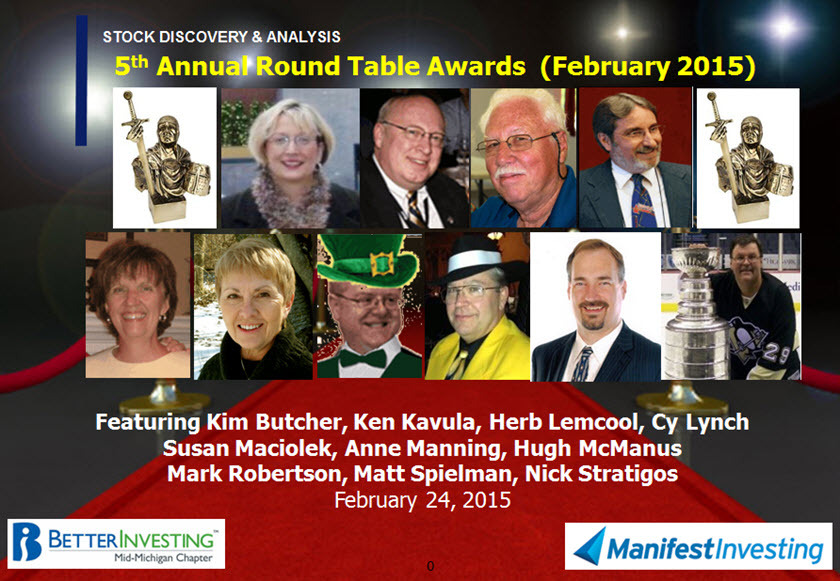
Round Table (February 2015)

You’re invited to join us as the colleagues of the Round Table present their favorite stock study ideas at the February session.

It’s our annual black tie over suit-of-armor extravaganza as we’ll also honor the best moments and decisions of 2014 and since inception of the Round Table five years ago.

Awards to be Presented

  • Best Stock Selection (2014)
  • Best Stock Selection (All-Time)
  • Best Picture/Story
  • Best Accuracy (2014 & All-Time)
  • Best Return Performance (2014 & All-Time)

Registration: https://www.manifestinvesting.com/events/166-round-table-february-2015

This Is How We Do (2014 Results)

For those of you who watched the Super Bowl (and those of you who watch the commercials and halftime show), recall that Katy Perry rode into the stadium for the halftime extravaganza on a huge lion, singing about roaring like a champion?

One of her hit songs is entitled, This Is How We Do.

This is how we do… yeah, chilling, laid back
Straight stuntin’ ya we do it like that

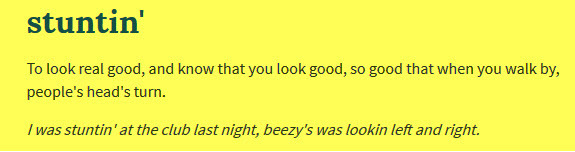
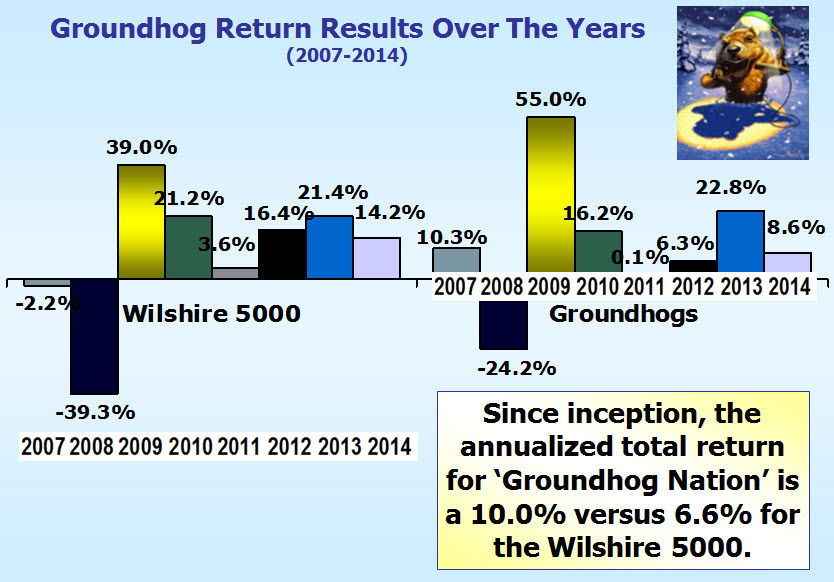
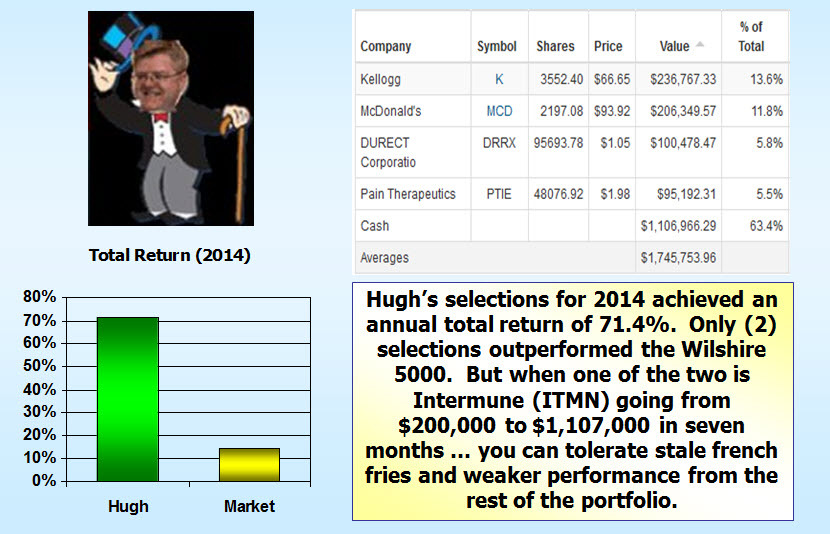
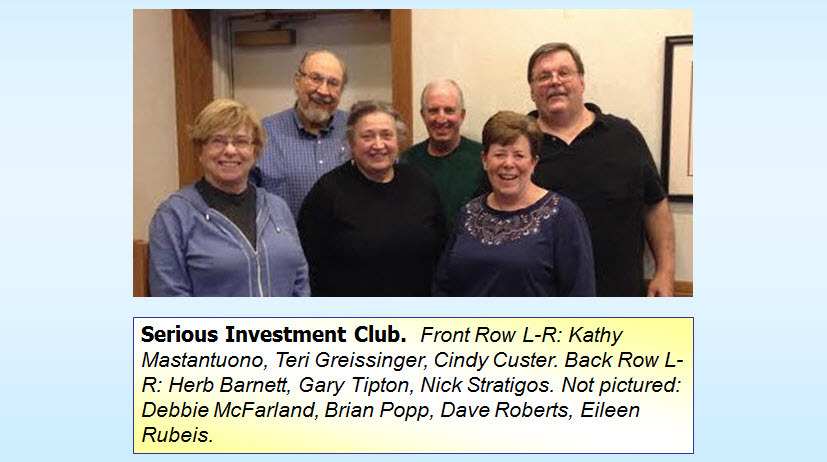
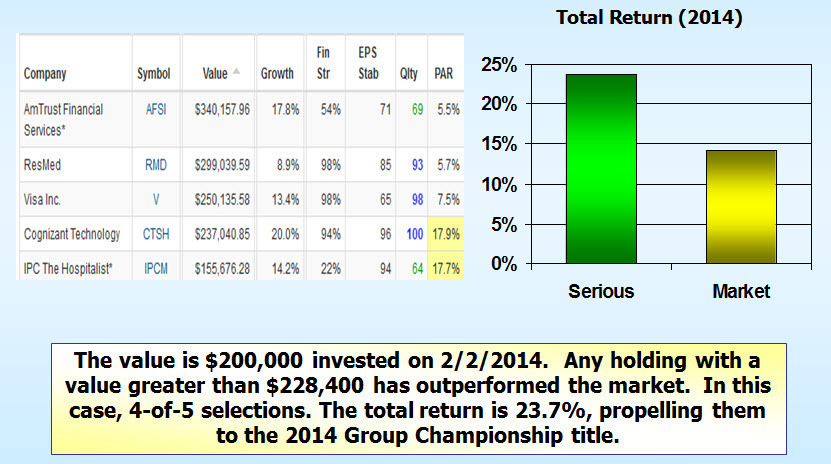
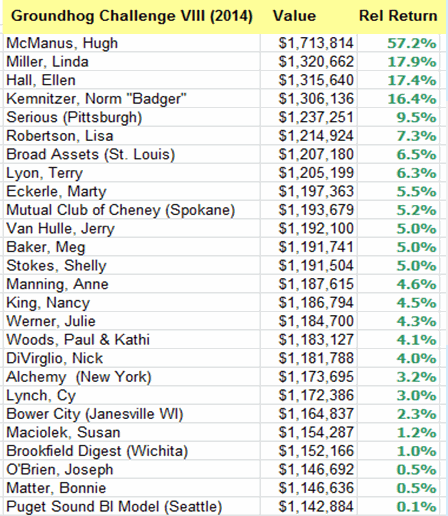
I didn’t know what “stuntin” actually referred to but based on this urban dictionary rendition, we think it applies to all things Groundhog. Hugh McManus of Pasadena and the Serious Investment Club of Pittsburgh are the latest in a long line of stuntin legacy — taking home top honors for Groundhog Challenge VIII in the individual and group categories.

Collectively, we “chill, lay back” and select a basket of 5-20 stocks that will go unchanged over the course of the Groundhog Calendar. Over the years, we’ve noticed very little swinging for the fences. A few participants will try to isolate a promising deep value situation with a potential catalyst that could deliver over the course of a year. But for the most part, the participants select high-quality stocks that would be suitable for the long term, a time horizon measured in years, if not decades.

Gh returns 20150202r
We kick off this performance results summary with a look at the collective performance over eight years where the average annualized return is 10.0% during a period when the Wilshire 5000 delivered 6.6% annualized returns.

Straight stuntin’ indeed.

The following table presents the leader board at the conclusion of the 2014 stock picking contest.  $1,000,000 invested on Groundhog Day (2/2/2014) became what is displayed here.

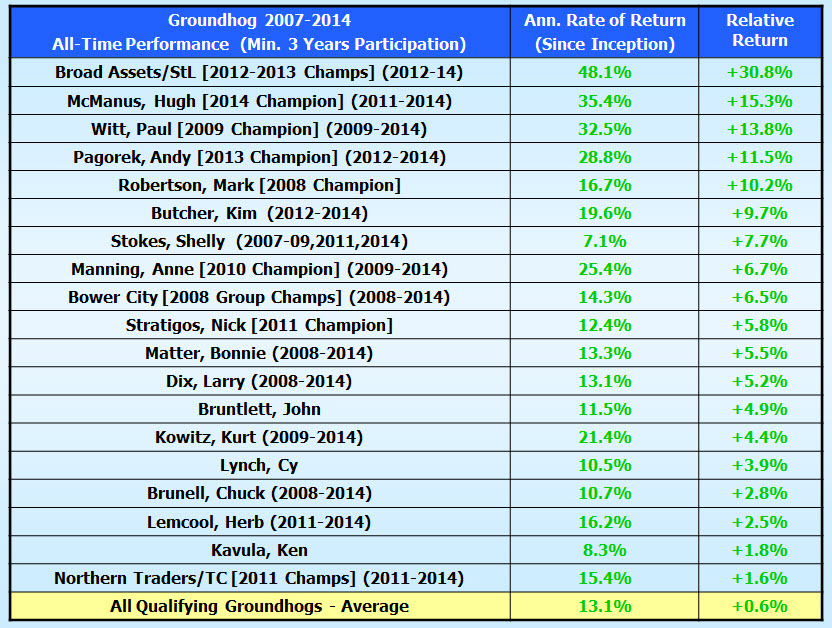
All-Time Results: Honor Roll

Methuselah & The Lottery Ticket

expectingalpha's avatarExpecting Alpha

The lottery winners hail from Arizona and Missouri. They’ll be splitting a $550,000,000 jackpot — probably choosing the lump sum payout, with proceeds to both of them estimated at $200,000,000. The event is inescapable on the news and it’s ubiquitous in all forms of media.

But it comes at a gut-wrenching expense. The reality is that it’s a tax (75-80% of all lottery proceeds go to the lottery crack dealers who skim some off the top and dole out the balance to government accounts.) A friend shared an observation this morning that as he bought a ticket for the fun of it last night near Philadelphia, two ladies clothed in rags — potentially homeless — skipped at least one meal to purchase $40 worth of lottery tickets. To me, that qualifies as a gut-wrenching tax.

Let’s compare the prospect of netting a winning lottery ticket to sitting down at the…

View original post 389 more words

Tesla Motors (TSLA): Speed Bump?

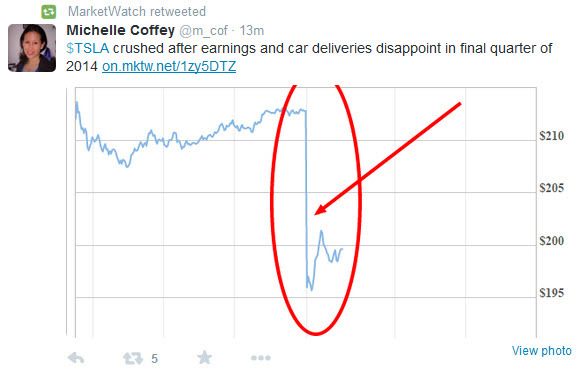
Some people think Tesla Motors (TSLA) got “crushed” on a weak earnings report.

Tsla crushed

Here’s the aforementioned MarketWatch article:

http://www.marketwatch.com/story/tesla-four-takeaways-from-earnings-2015-02-11

From a short term/trading perspective that first chart is a whack.

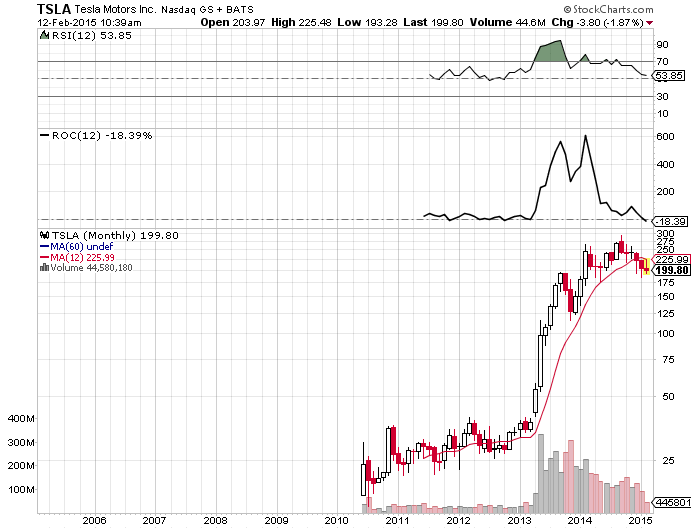
But on this chart, it’s a speed bump.

Tsla chart 20150212

This is what a crushing looks like.

Crushed car

I have no idea what the future holds for Tesla, I expect it to be “consumed” by one of the large car companies, but who knows?

But from a long-term perspective, this feels more like a speed bump …

Speed bump poster