AFLAC (AFL)

“I would like to see AFLAC under your scope.” — Jack Ellison

Thanks, Jack. For those who don’t know Mr. Ellison — he’s one of the leaders of the award-winning GaAs investment club near Sacramento, California. Gallium Arsenide (GaAs) is a compound of the elements gallium and arsenic and the chemical is used in the production of semiconductor devices. The connection to and inspiration from Silicon Valley is pretty clear.

The GaAs investment club was the leading group in the Value Line/NAIC club portfolio contest back in 2001 and was honored at the 50th anniversary national convention in Detroit.

AFLAC Duck: Uhhhh … he said arsenic. I really wish he’d not do that.

MI: No worries. Besides, we thought the only thing you ever said is “AFLAC!”

AFLAC Duck: That’s my stage persona.

MI: We hope the healing process is going well and sorry to hear of your set back.

AFLAC Duck: Thanks. I needed some rest. Since I stopped that whole migration thing … it’s way, way over-rated, by the way … I’ve gotten a little pudgy. A little time here with the workout equipment in Physical Therapy is probably just what the doctor ordered. Hollywood can wait.

MI: You’re not concerned that a gecko or some furry critter will steal your spot?

AFLAC Duck: Always a concern. Who are we kidding? Wally Pipp thought it’d be OK to take a day off. If you see any critters around the offices in Columbus that remind you of Gehrig, let me know.

MI: Consider it done. And now for a closer look at a community favorite and paragon of stability over the decades. But at the same time, we could make a case for a couple of really big speed bumps over the last few years — and some turbulent challenges that we’d consider more temporary than terminal.

AFLAC Duck: Terminal is not such a good word either around here.

MI: Sorry. Get well soon.

Aflac, Inc. provides supplemental life and health insurance services. The company is a general business holding company and acts as a management company, overseeing the operations of its subsidiaries by providing management services and making capital available. Its principal business is supplemental health and life insurance, which is marketed and administered through its subsidiary, American Family Life Assurance of Columbus, which operates in the United States and as a branch in Japan. The company operates business through two segments Aflac Japan and Aflac U.S. The Aflac Japan segment provides child endowment and ways products and operates as a branch of Aflac and principal contributor to consolidated earnings of Aflac. The Aflac U.S. segment sells voluntary supplemental insurance products including, loss-of-income products and products designed to protect individuals from depletion of assets. AFLAC was founded by John Amos, Paul Amos and William Amos on November 17, 1955 and is headquartered in Columbus, GA. [Wall Street Journal]

Business Model Analysis

The top-line for financial sector companies like AFLAC is book value (BV). The bottom line is EPS, as always — and the relationship (difference) between the top-line and bottom-line for financial sector companies is return-on-equity (ROE) and we pay close attention to the profitability trend on display for ROE.

Projected Average P/E

The forecast for a future P/E ratio for AFLAC is little different from the rest of the banking and/or insurance industry. Will ROE return to historical levels or “labor” in the New Normal? As an investor in financial sector enterprises, this is a key assumption or judgment.

In the case of AFLAC, we’d probably argue for stabilization and statistically a median of 10x (plus or minus 2x) seems to be reasonable.

Equity Analysis Guide

Using the 11% book value growth rate, a ROE forecast of 13% and a projected average P/E of 10x — the projected annual return is 11.6%.

This compares to a Value Line low total return forecast of 11.5%.

With the median return (all stocks) at 7.1%, the 11.6% return forecast is fairly compelling — particularly when considering the 99th percentile quality ranking for AFLAC (AFL).

Value Line Low Total Return Screen (2/22/2013)

We can’t help but take a closer look at the “dent” put in the long-term forecast for Landauer (LDR) — a recent favorite and a stock that we’ve featured in a number of venues. Is there any cause for concern or muted expectations?

The return forecasts for all of the electric utilities in this update are pretty weak and to yield chasers out there … don’t forget to keep total return expectations in your framework. We’ll take closer look at the electric utility industry also.

It was also nice to see long-time community favorite II-VI (IIVI) get a boost this week.

Materially Stronger: Badger Meter (BMI), Cooper (COO), Cutera (CUTR), Idexx Labs (IDXX), Two Six II-VI (IIVI), Manitowac (MTW), Newport (NEWP), Oshkosh (OSK), Toyota Motors ( TM )

Materially Weaker: Excelon (EXC), First Energy (FE), Landauer (LDR), PPL (PPL)

Market Barometers

The Value Line low total return (VLLTR) forecast held steady at 7.3% this week.


Roman Candles & Cruise Missiles

Roman Candles & Cruise Missiles

Sometimes it can be rewarding to “play with fire” so long as you know when to let go or disembark. Yes, the accompanying image is Slim Pickens in the role of Major T.J. “King” Kong in his rocket-riding glory in the movie Dr. Strangelove.

In this screen, we take a look at some companies with the highest year-over-year percentage changes in earnings, specifically the 3-year period from 2012-2014. So it’s obviously dominated by earnings forecasts. Disclaimer/Disclosure: The fiscal 2014 EPS estimates for a number of companies are still filing in. A few of the companies in the screen are based on 2-out-of-3 reporting periods. In other words, they could change significantly when the analyst consensus estimates for 2014 take shape.

The results were also limited to companies with quality ratings of excellent (greater than 65) and good (55-65) … stopping any company that isn’t in the top two quality quintiles at the door.

Earnings Momentum Leaders

This set of five companies is pretty compelling. Most of them have been part of recent conversations and nudges to explore a little more. That’s cool. In the case of Michael Kors (KORS), the company is a credible threat to Coach (COH) and we’ve talked about relatively empty stores vs. standing-room-only at Coach. This serves as a reminder that your own personal experience is just a small part of a bigger picture. When I see empty KORS outlets, I need to remind myself and deflect the emotions of doubt … or at least, keep all of the information in proper perspective. This flies in the face of Peter Lynch’s famous advice about panty hose and packed parking lots. But do you really think his research stopped there? Really?

Liquidity Services (LQDT) showed up in many of our Groundhog (stock selection contest) entries for 2013 and we can see why. That said, there has been some turbulence of late and a little deeper digging might prove to be prudent.

During our January Round Table, I featured Body Central (BODY) but attendees also heard mention of Francesca’s (FRAN) — a Houston based specialty retailer that merits a closer look.

Tangoe (TNGO) is also compelling. I know very little of the company. TNGO provides communication lifecycle management software and services primarily to large and medium-sized businesses. With all of our attention to the information-based (CTSH) and communication companies (CSCO) and my recently-fried modem, TNGO is also worth a closer look to see if the EPS gold rush of 2012, 2013 and 2014 is a flash in the pan or a compelling opportunity that often accompanies a company/product life cycle emergence.

Attendees from the Orlando MoneyShow came back uttering a single word and it wasn’t Dustin Hoffman’s “plastic.” It was Energy. Energy. Energy. For that reason, a closer look at recent favorite Schlumberger (SLB) and companies like ENSCO (ESV) seems particularly and potentially energizing, too.

We’ll close with our long-held suggestion that an understanding of trailing stop losses for momentum-based companies is generally a good idea. (Think Apple and 2012) Do your best to understand and decide whether to use them. I can think of several roman candles (Peoplesoft) during my investing career whether they either helped or offered salvation. And if you latch on to the next 2012 Netflix, it’s prudent to have an exit strategy while continuing to ride that cruise missile to avoid ending up like Slim at the end of Dr. Strangelove.

Cognizant Technology (CTSH)

Cognizant Technology (CTSH) is the top-ranked stock based on a combination of fundamental and technical analysis (our Fusion ranking) for the stocks in this week’s update.

As we shared in the stock selection feature for August 2011, Cognizant Technology (CTSH) is anything but a stranger to the subscribers of Manifest Investing and our long-term investing community.

“Knowledge is power.” — Francis Bacon

Apparently, knowing what to do with information is a path to returns based on the leadership returns achieved by all of the information-based companies in our MANIFEST 40 (Oracle, Cognizant, Quality Systems, FactSet etc.)

Cognizant Technology has been selected five times for the Round Table and $100 invested in CTSH as a top-performing member of the MANIFEST 40 tracking portfolio is now worth $440 — absolute total return of 340% and an annualized relative return of +35.4% since December 2008, one of the top-performing entries in this long-term demonstration.

Business Model Analysis

Using the last couple of actual results for years, in combination with analyst consensus estimates for 2013-2014, the sales growth trend/forecast is 17%. If Value Line’s 3-5 year revenue forecast is feasible, the growth forecast could climb to 19%.

Equity Analysis Audit

We’ll use the lower sales growth forecast of 17%, the consensus on projected net margin at 14% and a projected average P/E of 20×.

The result is a return forecast (PAR) of approximately 15%.

Tracking Momentum & Sentiment

To me, S&P is a little tangled in a knot. They have a “Hold” on CTSH despite a fair value of $99.80 that would suggest CTSH is undervalued by 23.5%. I blame the traders and short-term time horizon herd. The same is true for Morningstar. CTSH has been in a trading range for over a year. But I think the reason for the swoons (speed bumps, breathers, etc. — call it anything you want) is pretty clear. The 2008-2009 Great Recession hammered business at CTSH. And the same is true now with Europe lagging and the impact/influence on CTSH is material.

But if you’re in this for the long term — and we are — you believe that recessionary conditions will abate. In fact, you believe that they’ll be back again some day and you’re not stunned or aggravated by this reality.

And when the next round of meaningful recessionary abatement gets underway, this information technology juggernaut will probably reassume the flight trajectory shown the 5-year trailing average (blue line) on the chart.

CTSH is good at what they do. CTSH has a robust field of opportunity and no debt. I think we’re happy it’s a contributor to our Solomon Select, MANIFEST 40 and Round Table tracking portfolios and we’re not ready to send it packing, yet.

Value Line Low Total Return Screen (2/15/2013)

We were a little stunned to see Value Line drop the 3-5 year low price forecast on Microsoft (MSFT) from $50 to $40 — resulting in a significant “dent” in the low total return forecast for the company. The 3-5 year forecast for revenues was relatively unchanged.

Materially Stronger: Amazon (AMZN), CSG Systems (CSGS), Netflix (NFLX)

Materially Weaker: Baidu (BIDU), Microsoft (MSFT), Pandora Media (P)

Market Barometers

The Value Line low total return (VLLTR) forecast held steady at 7.3%, unchanged from one week ago.

The S&P 500 (SPY) continues to hover near overbought conditions — we continue to consider the index vulnerable to correction.

Microsoft (MSFT)

“I’m the stock watcher for Microsoft (MSFT) and would like to e-mail a copy of my EAGLE to other members before our meeting, but haven’t been able to copy and paste it. Is it possible? Keep in mind I’m quite technology challenged.” 🙂

Let’s take this opportunity to walk through a few things … and along the way, hopefully you’ll get some materials that you can use with your fellow investment club partners.

EAGLE stands for Equity Analysis Guide to Long-Term Expectations. Or Equity Analysis Guide, in short — reflecting a summary of the most important influences, drivers and factors when studying a company in the effort to build a considered forecast. Taken collectively, it’s all about our approach to stock analysis — using a 5-year continuously scrolling time horizon. And it manifests itself in a variety of different places and applications scattered throughout the site.

We’ll cover the first here, the Company Report — this is the analysis results based on a consensus forecast of the rhino herd. We monitor analyst consensus estimates for sales, profitability and P/E ratios (in the framework of a five year time horizon) and derive a return forecast based on that consensus.

In the case of MSFT, here’s a snapshot of the Company Report right now:

Msft cr eagle 20130208

If you’re relatively new to this, we like Value Line (www.valueline.com) a lot — and we think it’s a worthy part of any investor’s arsenal.

In this case, you can become more familiar with Value Line as a trusted resource by taking a look at the company report for Microsoft (MSFT) — because it’s available for FREE as part of the Dow 30 here: http://www.valueline.com/Dow30/index.aspx

Scroll down and pull up the report on MSFT. We think that a vast majority of the time, the Value Line low total return forecast (VLLTR, shown here) should RESEMBLE the results of your study. Keep in mind that this is the Value Line analyst’s 3-5 year return forecast (based on the price forecast range … and leaning towards the low end of the forecast range.) Trust us on this one. Actual returns 3-5 years from now are more likely to resemble the low total return forecast than the average or the high. (We can prove it.)

As shown here, the 3-5 year low total return forecast is 16%. Your study results should RESEMBLE (not necessarily match) this.

And for what it’s worth, correcting for the change in stock price since this report was issued (AND the change in forecast range) … the current VLLTR for MSFT is 21.7%.

Both of these forecasts will likely be updated with tomorrow’s release of Issue 13 … Value Line updates every company every thirteen weeks or quarterly. So do we for all companies with more frequent updates for the most widely-followed companies by our subscribers and/or any material news or forecast modifications between quarterly updates.

Business Model Analysis: Sales Growth Forecast

Based on this quick analysis of top-line conditions, and barring any major shifts in the 3-5 year forecast for MSFT tomorrow morning from Value Line, we’d expect the long-term sales growth forecast to moderate, albeit slightly, to 8% … as shown here.

Msft model 20130208

Welcome To The Sandbox

That’s right. We provide you with a playground where you can conduct sensitivity analyses of the milestone assumptions and judgments during your stock study.

Sensitivity analysis? Relax. That’s just some jargon you can throw around at the next neighborhood party or the next time you slump into the chair at the hair salon. It’s just a fancy way of saying “what if?” At Manifest Investing, you can go to MyStudies and perform your own tinkering with the major parameters. We pull in the major numbers and any box with a green icon in the corner can be modified.

For example, pulling current EPS probably results in a pull of operating earnings that are not conditioned to correct for one-time events, etc. like they do for us at Value Line. In this case, when we launched the sand box, the current EPS was $1.82. A more representative current EPS can be delved from the attached Value Line quarterly data. (We switched it to $2.80 based on EPS thru 3/31/2013)

Keen-eyed observers will also pick up on a “weird” trailing 12-month sales figure for some companies. The reason for this is we’re continuously INTERPOLATING based on the analyst consensus estimates — basically constantly trying to think of revenues based on the trend line in the business model analysis. It’s one of our methods of CONTINUOUSLY updating the stocks we follow … adjusting as the days roll by AND/OR correcting for adjustments to the analyst consensus forecasts.

Modifications:

(1) EPS to $2.80
(2) Sales to $77 billion — merely rounding off.
(3) Sale growth forecast to 8% based on the previous business model trend.
(4) Payout ratio to 35% — pulling current published payout ratios are often “erratic” — and 45% was probably a little high for MSFT.

The result is an annualized return forecast closer to 20% or the high teens.

It’s been a while since we did one of these, but there’s an Excel version of the Equity Analysis Guide for those who want to dabble with other stocks, etc. or simply prefer this to the MyStudies module.

Here’s what it looks like for Microsoft (MSFT):

Apple (AAPL)

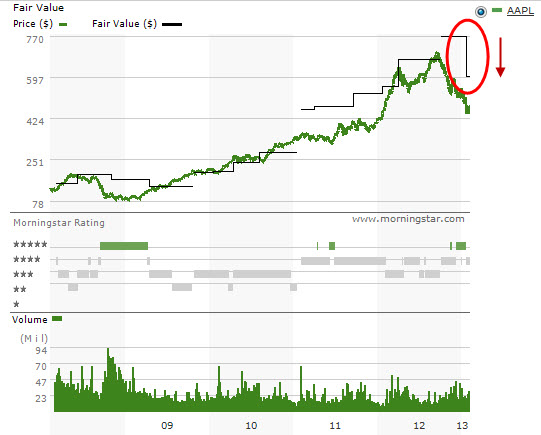
FYI … both Morningstar (from $770 to $600) and S&P have reduced their fair value estimates on Apple (AAPL) in recent days.  Analyst consensus estimates for sales and EPS for years ending 9/30/2013 and 9/30/2014 also reduced.  The impact on our return forecast will take it from 24% to 18-19% — still undervalued, just not as much.  Point-and-figure (PnF) sentiment on www.stockcharts.com has turned “Prelim Bullish”.

Image

Contest Picks: Heavy Hogs (2013)

Consensus Selections for Groundhog VII (2013)

Every year we celebrate our national holiday at Manifest Investing, Groundhog Day, with a review of the results achieved by our band of groundhog stock pickers over the last year. Now in its seventh year, we continue the celebration by launching a brand new set of contest entries.

This year, we’re going with Eddy Elfenbein’s $1,000,000 format with the only exception that participants can select anywhere from 5-20 investments. If you want to get really concentrated, go for five … feel better with a little diversification, choose closer to 20 — and everywhere in between. And like Eddy, we’re locking in the entries. No transactions will be made between Groundhog Days.

The selections were a little more distributed this year, with the most frequently-selected stock being Qualcomm (QCOM). Other high frequency selections included: Apple (AAPL), Bio-Reference Labs (BRLI), Coach (COH) and FactSet Research (FDS).

The public tracking dashboard is:

http://www.manifestinvesting.com/dashboards/public/heavy-hogs-2013

Best performers from Heavy Hogs 2012:

  • Portfolio Recovery (PRAA) ….. 65.2%
  • Resmed (RMD) ……………… 53.3%
  • Google (GOOG) …………….. 31.7%
  • Bio-Reference Labs (BRLI) ….. 30.8%
  • Walgreen (WAG) ……………. 27.3%
  • Oracle (ORCL) …………….. 23.2%

Weakest Performers from Heavy Hogs 2012:

  • Quality Systems (QSII) ……. (53.2%)
  • Coach (COH) ……………… (29.3%)
  • Baidu (BIDU) …………….. (24.7%)
  • AeroVironment (AVAV) ……… (23.5%)
  • CARBO Ceramics (CRR) ……… (14.9%)