The Stocks We Follow (December 2014)

 MANIFEST 40 Update

“We have always believed that the collective decisions made by our community of like-minded, long-term investors are worth huddling over … a place where ideas are born.”

This managed “tracking portfolio” of your collective favorites has outperformed the Wilshire 5000 by +3.3%. The absolute rate of return for the trailing 9 1/4 years is 9.6%.

Our MANIFEST 40 is a celebration of collective excellence in stock selection, strategy and disciplined patience. We continuously monitor the 40 most-widely followed stocks by our community of subscribers at Manifest Investing. We think it’s more than a fair assumption that many of these are in your real money portfolios … and for that, we’re optimistic and grateful. This managed “tracking portfolio” of your collective favorites has outperformed the Wilshire 5000 by +3.3% (relative rate of return, percentage points). The aggregate absolute rate of return has been 9.6% during a period when the annualized rate of return for the general stock market has been 6.3%.

Capturing Attention: Chargers

Schlumberger (SLB) moved from #39 to #34 and continues to attract interest despite the current challenges in the energy sector. Buffalo Wild Wings (BWLD) returns to the MANIFEST 40 at #36 as chicken wings, beer and sporting events continue to deliver for investors.

The results of $100 positions investing in any of the Top 40 companies can be viewed at any time at:

http://www.manifestinvesting.com/dashboards/public/manifest-40

Strongest Performers

The three top performers in the MANIFEST 40 since inception, based on annualized relative rate of return, are Cognizant Technology (+27.4%!), PRA Group (25.8%) and Apple (24.8%).

The charter members of the MANIFEST 40: Microsoft (3), Stryker (4), AFLAC (5), Johnson & Johnson (6), General Electric (7), Cisco Systems (8), Walgreen (11), FactSet Research (14), Oracle Corp (18), PepsiCo (17), Teva Pharmaceutical (16), Intel Corp (21), Medtronic (22), Danaher (26) and Wal-Mart (31).

We’ll continue to pay the most attention to these community favorites. Keep up the good hunting!

Season For Shareholder Loyalty

It’s absolutely a beautiful thing when we engage friends and family and lead them to the discovery of long-term investing. The opportunity to make a substantial difference, enabling better futures, is massive. We know that long-term investors also often become loyal (even rabid) consumers for the companies that they own. Regular vigilance combines with routine consumption. I wish I could change the names in the following story to protect the guilty … but it serves as a reminder of how powerful these forces of discovery can be.

I’d made the sojourn again from southeastern Michigan back to the shores of the Mississippi River in northwestern Illinois. As a fairly frequent traveler, my bags are generally packed carefully to make sure that I have all of the necessities for effective travel. I’d arrived back at my parent’s residence well after midnight and settled in for a good night’s sleep knowing that I’d see them at the breakfast table in the morning.

Sunrise came … but something was wrong. It was one of those gnawing feelings. I could have sworn that I stuck that tube of toothpaste in my overnight bag. No matter how deep I dug, it was clear that I was on the road without this necessary item? But my toothbrush was there? If it was there, how in the world did I forget the tube of toothpaste?

Sure enough, Mom and Dad were already seated at the kitchen table. We exchanged hugs and greetings and my instincts began to kick in.

“Dad, you wouldn’t have any idea why I can’t find my toothpaste, would you?”

Grinning, as he often does, like a Cheshire Cat but with his face aimed at his cereal, he responded, “Hmmm. That’s too bad, sorry to hear that. I probably have some real toothpaste you can use.” He was now snickering and giggling while continuing to munch on his cereal. He was also clearly avoiding eye contact.

“What’s with the Annual Report standing next to the bathroom mirror?”

Mom mumbled something along the lines of, “… Oh no. Here we go again.” The cereal crunching continued, but he offered up, “You’ve been warned.” There was still no eye contact.

“Enlighten me, Dad. I don’t seem to recall any warnings?” (It was a white lie. Hairs were now standing on the back of my neck and I was clearly in the danger zone.)

“You should know better than to bring that contraband into this house.”

Mischievous giggling continued. Mom was now grinning, siding with the suspect.

“Why don’t you join the rest of the world and use Colgate ($CL) toothpaste instead of that ‘stuff’ ($PG) from Cincinnati? Would you like to see a Fact Sheet?”

It was crystal clear now. My toothpaste had been hijacked and replaced with a Colgate-Palmolive annual report. Dad became a Colgate stakeholder after seeing a company presentation at an investment conference a few years ago. It seems he also became an ardent evangelist and enforcer for their products.

This Week at MANIFEST (12/26/2014)

Merry Christmas! Bless Us, EVERYONE!

Holidays. We have much to be thankful for … notably the smiles on the faces of investors who have persisted through the Great Recession and experienced/realized fairly massive returns over the last few years. As we approach the end of our 10th year at Manifest Investing, all of us extend the warmest Seasons Greetings to all of you!

We’re already looking forward to celebrating our 10th birthday — and the launch of our 11th year — as Groundhog Day 2015 (2/2/2015) approaches. We’ll celebrate in a variety of ways, continuing to extoll the virtues of investment clubs and community-centered investing. The Round Tables will be part of that and we’re thankful for the contributions of Ken Kavula, Cy Lynch and Hugh McManus. We’re equally thankful for our guest damsels and knights: Kim Butcher, Herb Lemcool, Susan Maciolek, Anne Manning, Matt Spielman, Nick Stratigos … and last but certainly not least, our audiences who cast their votes monthly. You guys are the BEST.

We’re planning additional festivities which you’ll be hearing about soon. And you can listen for the sound of reindeer on your roof knowing that you’re in the hands of Kurt Kowitz, our technology manager. We’ve said it before, but without Kurt, the cost to deliver Manifest Investing to you would increase by at least one digit, maybe two. We’ll be unwrapping some cool gifts soon … and the prototype tinkering with the Equity Analysis Guides is likely the tip of a features iceberg. Thanks, Kurt!

For now, we nudge you as you unwrap this week’s batch … and we share a compendium of correspondence. You are not alone.

Merry Christmas, everyone!

A Bridge To Better Understanding

We’ve shared similar letters of consternation from investors in the past … and they come in many flavors. One of our all-time favorites was our visit to Narnia and our suggestion that The Couch Is Alright. Another memorable exchange came with “Nell” as we helped her to Make It Through The Night.

Where am I going wrong? I check out a stock, like it, and check it out on Manifest Stock Research. It looks good, you like it too. For confirmation I dig deeper — and [audit and verify assumptions using MyStudy]. Next thing I know, I feel like I get shot down when you show four or more reasons why the company is not worth an investment and say the quality is not to our standards. Is one screen looking at long term and the other at short term? Are you practicing April Fool tricks five months early?

We asked for an example. Chicago Bridge & Iron (CBI) was provided. CBI is actually a very compelling opportunity. There are some strong market drivers, long term. And the company is part of this week’s update batch — so let’s take a closer look.

I’m wondering where we differ. The PAR is 20-25% or so — making it somewhat speculative. The global recession has taken its toll with a fairly substantial price drop over the last several months. (From $89.20 down to $37.78 … -58%)

I don’t know but I wonder if investors and pundits are troubled over the Shaw acquisition?

Here’s a look at a Value Line data-based Equity Analysis Guide for CBI:

Be sure to account for the Shaw acquisition in your analysis. (This means you probably have to ignore anything before 2012 on a traditional SSG.) The step change in sales in 2012 was due to buying Shaw. When imagining what the future holds, be sure to emphasize the information that deals with the new, combined, company.

That could also lead to some significant differences between your study and the analyst consensus.

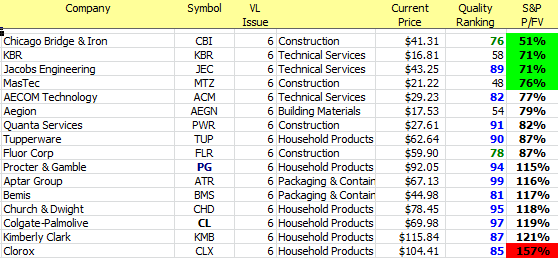
S&P has a fair value of $80.80 (recently adjusted downward from $87), so they think it’s significantly under priced at $41.

Thanks for the suggestion but, while I only mentioned one example when writing you, the same thing occurred over fifteen investigations. It leaves you with the feeling the entire market is overpriced so it might be better to hibernate until the pull back. I was particularly disturbed over CBI as they seemed a good candidate. Perhaps Lady Luck will lead me to a candidate where research and analysis will both agree. Thanks for your input.

Although luck is definitely involved in investing … we can look beyond Lady Luck a bit.

I think we’re seeing a symptom that’s related to the recent run in stock prices. This has been going on at the same time as an erosion of fundamentals. We’ve commented on this before — noting that in many cases, the only way to realize these return forecasts is if relatively high P/E ratios come home to roost.

I think CBI is a great candidate. The price has dropped enough to capture the attention of Hugh McManus. (grin)

Seriously, for a non-core stock (but one with relatively high quality) we need to demand a higher return forecast when considering purchase. We also must admit that a persistent or deepening recession will do things to CBI that are similar to 2008-2009. The stock price suggests, at least to me, that many people consider this to be a work already in progress.

If they’re wrong, it’s a heckuva buying opportunity. And for a long term investor with a long term perspective, CBI is probably a lot like BP (BP), Schlumberger (SLB) and others in the oil patch these days. The next year or two could be rough and represent an opportunity for accumulation. But make sure the companies are built for survival if you decide to “go there.”

We feel your frustration but we still believe that a good StockSearch, directed at high-quality companies with elevated return forecasts can do a lot to populate the area underneath just about any investing Christmas tree.

Coming Events and Attractions

Our expanded coverage of the update stocks this month continues as part of our quarter long test drive of this feature and the studies and shared ideas it delivers. Please tell us what you think and feel free to join in the Forum discussions for the deeper dives on some of the stocks.

Save the Date: The December Round Table will be held on December 30 at 8:30 PM ET. Register via: https://www2.gotomeeting.com/register/256833802

Round Table Tracking Portfolio

Stocks Likely To Be Covered:

  • Chicago Bridge & Iron (CBI)
  • Copa Holdings (CPA)
  • Qualcomm (QCOM)

Companies of Interest: Value Line

The average Value Line low total return forecast for the companies in this week’s update batch is 4.7%.

The number of companies with slightly reduced fundamentals combines with the price increases over the past month to produce some fairly low return forecasts.

Trex (TREX) has been a personal favorite since my Better Investing days … and it leads a lonely group of companies with bolstered fundamentals. As a reminder, we monitor changes in the long term forecasts by Value Line and share those that have been adjusted 20-25% or more (up or down) as “Materially Stronger” (Up) or “Materially Weaker” (Down). We consider this a best practice and a nudge for stock watchers or shareholders to update/audit existing analyses. In some cases, it may trigger a study of opportunity.

Materially Stronger: Trex (TREX)

Materially Weaker: Owens Corning (OC), Layne Christensen (LAYN), Tile Shop Holdings (TTS), Enernoc (ENOC), Rayonier (RYN)

Standard Coverage Initiated:

Discontinued: Kimball (KBALB), Foster Wheeler (FWLT), TIBCO Software (TIBX), Concur Technologies (CNQR), Conversant (CNVR), Compuware (CPWR), URS (URS)

Companies of Interest: Morningstar

The average price-to-fair value (P/FV) ratio at Morningstar for the companies in this week’s update batch is 106%.

Companies of Interest: S&P

The average price-to-fair value for the companies in this week’s update batch is 105% — according to S&P.

Market Barometers

The median Value Line Low Total Return (VLLTR) Forecast is at 3.4%, plummeting from 4.2% last week as the Thanksgiving Swoon gives way to a Christmas Rush of multiple 1-2% daily gains in the overall market.

Stocks to Study

The following update stocks are ranked in the top 10th percentile of all companies we follow (MANIFEST Rank > 90):

Manifest Investing is a subscription site (ONLY $79/year for individual investors).  Contact us (via manifest@manifestinvesting.com) if you would like to explore our resources as an investment club.  We offer group discounts to clubs.  Discover and explore our research on stocks and funds, our seminars and tools for portfolio design & management.  Experience the demonstrations of a 7-decade old time-honored philosophy and method that has supported legions of long-term investors.  Go to http://www.manifestinvesting.com and create a trial account today.  Send us an email if you’d like to access a FREE fully-functional test drive through 2/28/2015 without providing a credit card.  Merry Christmas!

C’mon Christmas! 2014 Buy List

C’mon Christmas Miracle for the 2014 Buy List

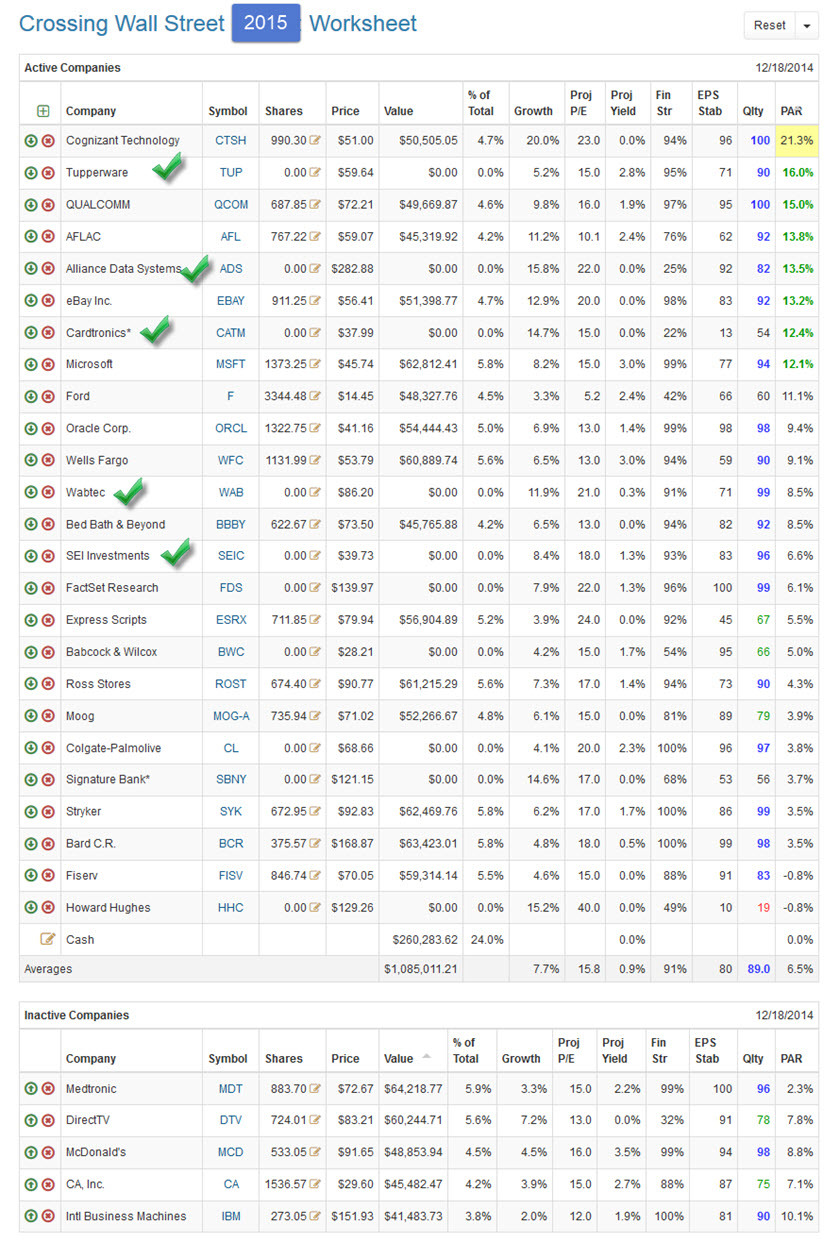
Eddy Elfenbein of Crossing Wall Street is widely regarded as one of the best buy-and-hold bloggers on the Internets. Every year in mid-December, he selects (20) stocks to hold for the next calendar year in a tracking portfolio known as his Buy List.

He has outperformed the S&P 500 for the last seven years.

As of 12/17/2014, the 2014 Buy List lags the S&P 500 during 2014 by a little bit … but we’re hopeful for a Christmas miracle. Anybody around here have Carl Icahn on speed dial so we can get some M&A rumors swirling on some of Eddy’s 2014 collection?

Context: You will find that Eddy thinks a lot like “us”. His weekly updates on the Buy List stocks are a worthy addition to the reading list for stock watchers and shareholders. Even if his 2014 Buy List doesn’t break the tape in a photo finish this year, we know better than to gauge anything based on a single year — and it’s here that we see the all-time performance of the Buy List (8 years) is an annualized rate of return of 10.7% vs. 7.3% for the S&P 500 — for a rarified +3.4% relative return.

Here’s a snapshot of the standings going into the stretch:

Crossing Wall Street Challenge

We play along with a couple of dashboards alongside Eddy’s 2014 Buy List with our own entries.

The 2014 Walking Main Street dashboard is quite simply drawn from our (40) most widely-followed stocks (MANIFEST 40), selecting the (20) with the best combination of PAR and quality back on 1/1/2014.

The Expecting Alpha 20 entry is sourced from the universe of ~2400 stocks that we cover — and seeks the (20) with the best combination of Value Line low total return forecast, suitable quality and better-than-average sentiment. It needs a dash of Christmas miracle, too … as 2014 winds down.

2015 Shopping … Auditing … Deciding

Eddy shared a couple of weeks ago that he’s making a list and checking it twice. His usual practice is to drop five of the (20) 2014 Buy List and to select five replacements for them.

We’ll use the dashboard-based sandbox “what if” portfolio design feature to take a look at the five that Eddy has singled out and the (10) replacement candidates that he’s kicking around.

The top 3-4 are pretty much slam dunks and we hope Eddy chooses them. SEIC is a formidable company, a long-time community favorite and has better-than-average potential. The release of IBM (IBM) can’t be easy but there’s not enough dividend there to offset the low growth prospects. Not a cardinal sin, simply a symptom of maturity facing the same global economic challenges as most of the consulting stocks.

We’ll do our 2015 shopping during the final days of 2014, but for now… let’s hope for a strong close for Eddy’s 2014 Buy List and our own Expecting Alpha 20.

Energy Patch: Black Gold or Minefield?

The recent swoon in the energy sector has prompted some to suggest that it’s time to back up the tanker truck — what could possibly go wrong? “All of these companies are on sale.”

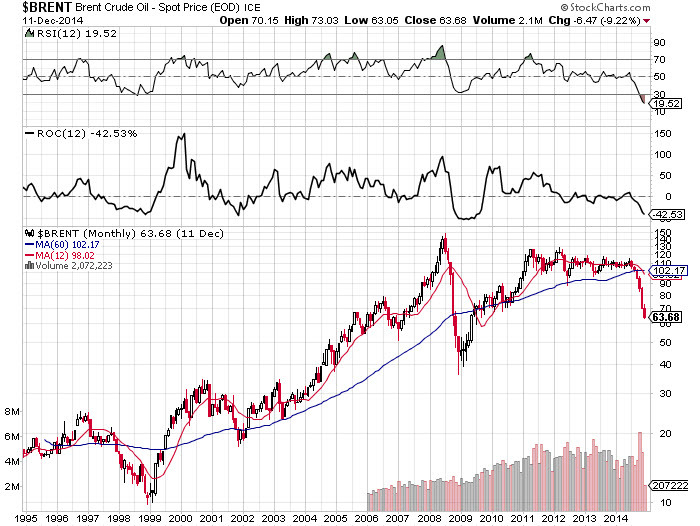
Not so fast. As we pointed out in last week’s update, we expected reductions in forecasts from the likes of Morningstar and others and it’s gently underway. As a case in point, Morningstar’s fair value for Schlumberger (SLB) has been recently reduced from $145 to $124. Other companies seem to be following suit. S&P already had suppressed expectations (relative to Value Line and Morningstar) and they have actually trimmed a number of estimates.

As the following graphic shows … after an extended trading range, the price of $BRENT has been pummeled, now down some -42.5% for the trailing 52-weeks:

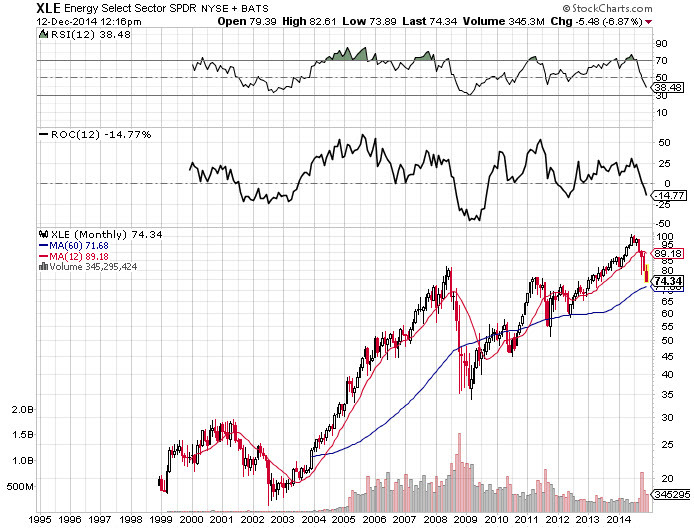
The S&P energy sector fund (XLE) has been punished also — with some lag — and with less damage, at least so far, as the sector leaders are down -15% over the trailing 52-weeks:

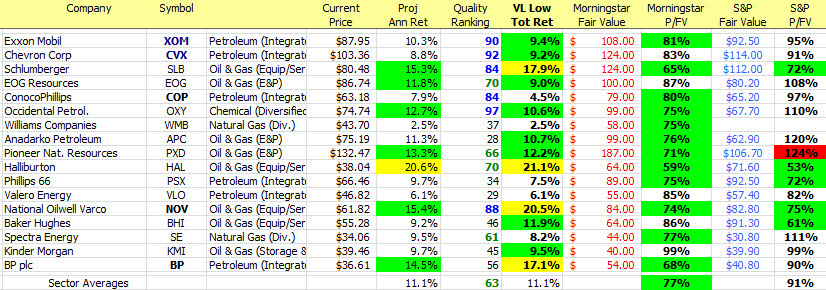
There are 44 companies in XLE and we’ve listed the top 16 here (with one exception … BP is not part of XLE … but we listed BP here in response to the Forum discussions) and you’ll see a number of industry leaders and stalwarts. The majority of companies in XLE are components of the S&P 500. Note that these 16 companies account for 75% of the index performance and the top three: Exxon Mobil (XOM), Chevron (CVX) and Schlumberger (SLB) account for 40% all by themselves.

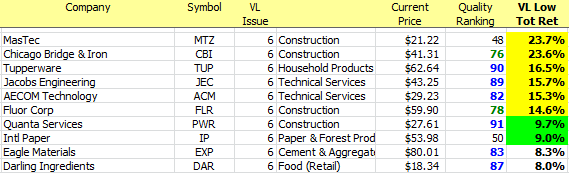
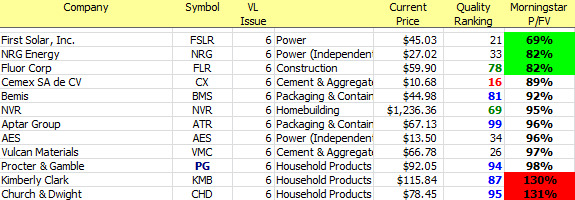
Energy Sector Sample. Projected Annual Return (PAR) is the consensus forecast via MANIFEST. Quality ranking is the percentile ranking of our quality characteristic based on financial strength, EPS stability and relative growth and profitability. VL Low Tot Ret is Value Line’s 3-5 year low total return forecast, adjusted for change in price and/or time horizon. Morningstar P/FV is the ratio of current price to Morningstar fair value.

The Morningstar P/FV cells that are highlighted are at least one standard deviation from the median P/FV ratio. These can be thought of as potentially “on sale” or worthy of study. The same highlighting applies to the S&P entries. The solo entry highlighted in red, Pioneer Natural Resources (PXD) has a P/FV at least one standard deviation greater than the median — potentially a selling candidate.

Our overall average forecast for the group matches the Value Line low total return forecast. The fair value reductions and continued slide in stock prices deliver an average Morningstar P/FV ratio of 77% but we’d expect further moderation of fundamentals (continued reduction in fair values). S&P is still much less optimistic (91%) with relatively few triggering the highlighted status.

Companies deemed most worthy: Exxon Mobil (XOM), Schlumberger (SLB), National Oilwell Varco (NOV), Halliburton (HAL) and BP (BP).

Sources: Value Line Investment Survey, www.morningstar.com, Standard & Poor’s

Is it time for some Christmas shopping?

Based on a multi-year chronicle for XLE, the return forecast has now reached a multi-year high — suggestive of one of the better buying opportunities over the last 7-8 years.

As always, quality matters … and the $/bbl trends are not supportive of higher cost producers, like the offshore drillers (yet).

Xle chronicle 20141212

“Oil Patch” Screening Results

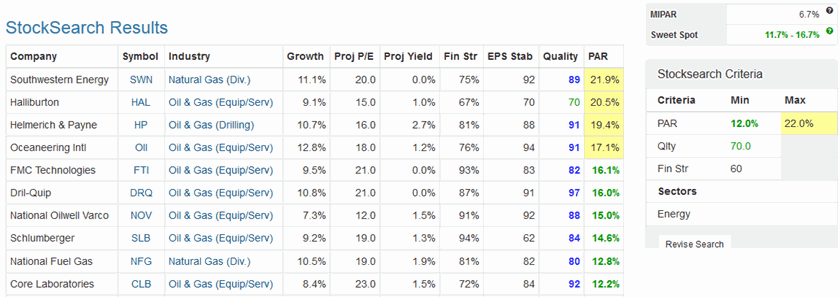
… because it’s not just oil. In fact, there may be some opportunity in companies that are less directly affected by the OPEC smoldering. In any case, here’s a quick shop until you drop for the energy sector:

Oil patch screen 20141212

Invest With Your Friends

Happy Birthday, bivio!


Expected Returns Cover Story … first posted on September 1st, 2009.  We revisit this feature today as we celebrate bivio’s 15th birthday and honor their service to legions of investment clubs and individual investors with the best service and most cost-effective record keeping software and support network for investment partnerships.  We’ve known you since day one. You’re simply the best!


In his own words, Nicholson talked of investment clubs as his “Grand Experiment.” Their purpose? Education. Period.

The talking heads are obsessing over Septembers nearly ten years ago or one year ago when massive upheaval in the financial markets was ramping up. In the end, the demise of household names like Lehman, Bear Stearns and Merrill Lynch would go on to prove that this was no ‘speed bump’ in history. My thoughts drift to other foundations as autumn approaches, to nearly 70 years ago when a small group of young men wandered into the office of a professional investor in Detroit. “We want to learn how to invest.” “OK, but we’re gonna have some rules of engagement: we’ll operate professionally in a business-like manner, we’ll invest regularly and we’ll stay invested as long as it makes sense to do so in leadership growth companies …”

bivio: “where two roads meet” We first met the key players at MANIFEST business partner, bivio, over ten years ago. Their mission then and their mission now is to create an environment of success for groups of investors. As their tenth birthday approaches, we look forward to what the future holds for investors.

bivio is a web-delivered application, enabling groups of individual investors to create and manage their own investment clubs – it’s like creating your own personal mutual fund. By making the administrative tasks easier, bivio has succeeded in widening the learning window. We look forward to working with them, building on that foundation and resources.

All the things I remember, Summers never looked the same …
Years go by and time just seems to fly, but the memories remain.
In the middle of September, We still play out in the rain. — Daughtry.

That autumn day in 1941 in Detroit was a critical moment in the modern investment club moment. The professional investor was George Nicholson, Jr. CFA and the principals went on to form the National Association of Investors ten years later. Some of you may wonder why our attention focuses so much on investment clubs. We clearly appreciate that some of you are not clubbers. That said, the vast majority of our subscribers are either active or have been active in an investing partnership.

Shortly after joining the Better Investing staff as senior contributing editor back in 1997, I worked with the Motley Fool founders on an article that proclaimed that fool.com was the world’s largest investment club. My Foolish friends were wrong. I followed shortly thereafter with an article that hailed technological advances and declared that the umbrella organization had become one big investment club. I, too, was wrong.

The heart and spirit are in the right place … and the power of Community is incredibly important. Look no further than our discussion of the “Wisdom of Communities” (Expected Returns, June 2008) or our back-to-school features and tributes to tradition like Muskrat Pageantry (ER, March 2008.)

In his own words, Nicholson talked of investment clubs as his “Grand Experiment.” Their purpose? Education. Period.

Building Better Futures

Let me be clear. We know that people engage learning opportunities in a variety of ways. Whether from reading books, attending classes, poking around online, observing best practices from successful individuals … it’s a long list. The genesis of investment clubs was clearly centered on a learn-by-doing experience by leaning on friends.

And that’s what wrong with the previous articles. Our family attends a church where 28,000 people can show up for worship on Christmas and Easter. I can’t imagine learning-by-doing with a group that large. Hence, we form small groups where “we” comes to life. Clubs (We) cultivate patience and discipline while seeking the opportunities achieved by incrementally better returns. It’s quite literally the stuff that dreams are made of.

The Genesis of Clubs

Nicholson shared in later years that the motivation for Fred Russell and the other young men was quite literally, freedom. Russell dreamed of the day when he could walk away from his day job to operate his own business. This ultimately became reality as he went on to a Howard Johnson franchise in years ahead.

Here is the core of the modern investment club movement:

1. Provide a way for many people to start an investment program in a small way, without too much experience, and build their investment knowledge to the point where they have the ability to acquire a sizable investment portfolio and manage it profitably.

2. Broaden the awareness and interest of individuals in the ownership of equities … in many cases, this takes shape as members/practitioners have as great an interest in helping others to learn about [effective] investing.

Most clubs form as a general partnership and suggest that their partners invest relatively small amounts ($20-50, usually) on a monthly basis into the club portfolio. In fact, if you’re visiting and considering joining a club and the figure is much higher than that — caveat emptor. It’s not about the total assets, it’s always been about growing the unit value at superior rate.

In the early days of investment clubs, think about the environment. The participants were still using slide rules and doing multiplication and division by hand. (Gasp) It was difficult to buy stocks in “odd lots” and commissions were substantial on these 100-share increments.

One of the earliest drivers was the pooling of the finances, enabling a lower cost ratio than individuals could achieve on their own. The intent was to spread out expenses.

But the “pooling” didn’t stop there. Think about access to information. Company reports were hard to obtain and clubs divided up the odyssey and the analysis for survival.

The Mutual Club of Detroit provides one of the standards of excellence. One member has donated $20/month since February 1948 building an account that reached seven digits (despite a fair number of significant withdrawals to fund life experiences) and a rate of return of approximately 13% since inception.

Model Behavior. Demonstration investment clubs, like the Brighton (Michigan) group meet monthly to explore and learn together. The club dashboard is one of the published portfolios available at MANIFEST. The club is education-centered and led by a group of volunteers from the southeastern Michigan region.

Fast forward to today. Transaction costs have plummeted and access to investment information has literally exploded. A couple of the original drivers of the “Grand Experiment” have changed pretty dramatically.

At The Crossroads

What hasn’t changed is (1) the business-like approach and (2) the incredible learning power of collaboration within the Community.

Enter bivio. One of the treasures delivered is effective accounting support. Keeping the club and individual records and generating a tax return with a couple clicks means that a very special resource is redistributed to club partners … TIME.

With administrative tasks reduced to background music, time is liberated to explore and seek better investing opportunities. The record-keeping is still crucial but the emphasis shifts to learning-by-doing, together with friends. Investing better.

And dancing in the September rain, with our friends, is what our investing journey is really all about.

At bivio, “Bags Fly Free” there are no hidden annual charges to file annual tax reporting.  Explore the resources at bivio.com and experience investing with some new friends.

The One Guarantee & Constant in Investing

Letter To A Grandson … and a Generation

Cover Story, by Mark Robertson, Managing Partner


Posted on October 1st, 2014


Start. Start as early as possible. One wish. A wish that we could have started sooner.

I spent last Wednesday night with a group of long-term investors in Lansing, Michigan … home to the Capital Area chapter of the National Association of Investors. President Cynthia Leet led off the session, challenging the group to encourage young people to embrace long-term investing. (There were a couple of relatively young people in the audience. Huzzah!) There is one guarantee and constant in the world of investing. Gather a room full of experienced investors and the sentiment is unanimous. Start. Start as early as possible. One wish. A wish that we could have started sooner …

Our daughter and her husband live near East Lansing. You’ve met Lindsay in the past — featured in our August 2009 cover story. Investing really can be all about moments, moments of truth during a lifetime and the freedom that can be discovered by doing it well.

As I headed to the Wednesday evening session, I grabbed an extra change of clothes just in case I decided to stay with our daughter and son-in-law for the evening. Lindsay had completed her last day of teaching the day before and was starting maternity leave for their first child. I figured I might be able to help with “something.”

I rolled over at 6 AM to the words, “Dad, my water just broke …”

Cue wonderful adventure.

Grandma joined us as quickly as she could and headed for Labor & Delivery. Over the next several hours and days, I gained some new attire and any number of Michigan State Spartan shirts and sweatshirts. (There are a lot of Spartans around here.) We also gained our first grandchild, Lincoln Richard Hurst.

He is wonderful. I can now forgive my parents for those times when Wendy and I seemed to be suddenly invisible while Grandpa and Grandma rushed to hug their grandchildren. I get it, now.

Letter To A Grandson (and a Generation)

Welcome. We’ve been waiting for you since the moment your mother said you were incoming. You are a gift and as evidenced by that record-setting horde in the hospital waiting room, there’s a whole bunch of people who care about you. Care back. Care often.

You were born on John Lennon’s birthday. You will learn more about him and will likely enjoy much of his work known as music. His song Imagine (1971) has always been a favorite and urges “Dream … Imagine all the People… Sharing all the World…” Dream freely. Dream often.

On the day you were born, the world faced its typical menu of challenges ranging from a centuries-old never-ending dispute in a place called the Middle East to a potential problem that your doctors know a lot about, a thing called Ebola. Also in the news was an item shared by Nicole Lapin, “According to a Vanguard analysis of more than 1 million 401(k) savers, women are 10% more likely to enroll in their workplace savings plan and save a bigger chunk of their paychecks. Yet Vanguard’s analysis found that female savers have an average balance of $78,000 — far below the male average balance of $121,000.”

No. Girls are NOT less capable when it comes to math or investing. Far from it. But (collectively) girls can be overly cautious and drawn to things labeled “guaranteed return” when something else is more appropriate. Your grandmother discovered this a few years ago with her own investing account. Your grandmother is not alone and she is VERY CAPABLE.

Comparing Predictions vs. Results. First thing to remember: Stock prices fluctuate. Mr. Bogle is right. The average 4-year forecast for the span shown here is 8%. The average 4-year annualized return is 6%. The forecast bars on the right hand side remain near historical lows. But for someone 6 days old, we’ll be investing. Investing regularly in the best companies because that’s where magic, miracles and Freedom can happen.

A great man named Jack Bogle also shared that “The typical worker saving diligently since 1982 should have had $373,000 in a qualified plan by age 60. Instead, that saver has $100,000…” Mr. Bogle is the founder of Vanguard, created the original index fund and is a proponent of passive investing. He’s been doing this long enough that we should heed his warnings about long-term return expectations and excessive costs.

You will hear about the wealth gap. Another way to think of this is that some people have more freedom to do the things they want (or need) to do than others. Some people want to have enough resources in order that they can freely help others who need it. Help others. Help often.

All of these gaps represent a massive opportunity. Because learning is the answer. Your mother is a great teacher and much of this will probably come natural to you. Your father is one of the hardest working people I’ve ever known. One of the best solutions to the quest for Freedom was inspired by a man named George Nicholson, Jr. a little over 70 years ago. He inspired the concept of investment clubs and nurtured the notion of a people’s capitalism — the power of mauling the mysteries of long-term investing that can enable dreams (remember John Lennon) to become true. Big words, perhaps. But really as simple as imagining that Freedom is possible. Imagine freely. Imagine often.

The recipe is pretty simple. Invest regularly. Invest in the Best. Collect, care for and accumulate the best companies when they’re “on sale.” Do this with friends. Tell your friends. Share. Share often.

One of your great grandfathers speaks of his investment club experience as “money from no where.” “It seems as simple as scraping the spare change off the refrigerator and — with time — it becomes a surprisingly large amount of [Freedom.]” Another great grandfather describes an investment conference where he and your great grandmother had a fascinating discussion with a nice person from a company called Biomet. $2000 invested in Biomet in 1982 was worth nearly $1,000,000 in the late 1990s. It’s a fact. (For more, see Raise A Cup: Million Dollar Moment — April 2012) It’s also potential freedom. Magic and miracles happen when given a chance.

Investing From The Shoestrings

Within a few days of your arrival, we started an online account with your mother’s help where we’ll be stashing a “Lincoln” or two on a regular basis.

We’ll most likely follow an investing plan similar to the Bare Naked Million portfolio. (This demonstration portfolio was inspired by a subscriber who was curious about investing a $1,000,000 lump sum back on 12/31/2006.)

The Bare Naked Million dashboard is now up to $2,237,475 (10.9% per year) and is built using a moderately passive approach. The core is the Vanguard Growth Fund (VUG) and is supplemented with industry leaders when their return forecasts are elevated. There have been two selling transactions since inception. By comparison, investing that million dollars into the Wilshire 5000 (VTSMX) would now be worth $1,613,900 or 6.4% per year. That +4.5 percentage point advantage is HUGE over time.

Our Lincoln Fund will have much more modest beginnings (like $0, true shoestring genesis) but will grow and build in the years ahead with little effort outside of summoning the necessary discipline to accumulate regularly. We’ll watch for opportunities to latch on to leadership companies but the heavy lifting — much like the Bare Naked approach — will come from investing in baskets like VUG for a while to come. For now, Welcome to the Club, Lincoln. Imagine at will. Often.

Manifest Investing is all about achieving success as a long-term investor.  It is a subscription research site featuring actionable ideas, tools and resources for portfolio design and management.  Apply for a “test drive” at http://www.manifestinvesting.com  The annual subscription is $79/year.  Questions: markr@manifestinvesting or @manifestinvest  Come discover and experience the lessons of over 70 years of investing with friends.

Celebrating Heroes & Decades

Stocks to Study (5/23/2014)

On The Shoulders Of Giants

This past weekend, we (Ken Kavula, Hugh McManus and Mark Robertson) spent some time with over 200 long-term investors in Chicago at the 63rd Annual Convention for the National Association of Investors (NAIC). If you’ve been around here for a while, you know that we often pay tribute to the likes of Messrs. Nicholson, Graham, Babson, Schloss, O’Hara, Janke, Seger and place/phenomenon called Beardstown here on these pages. We’ll do that again here.

But first, a quick reminder about the screening results at the top of the page. This weekly screen was inspired by Irina Clements. In fact, we call it our Irina screen. Every week we present the companies in the current update batch. We do fundamental updates on 1/13th of the companies at Manifest Investing every week using the same cycle as one of our trusted resources, the Value Line Investment Survey. Warren and Peter (we’re on a first name basis with them) both regard Value Line as a veritable and trusted resource. We do too.

  • Irina asked us to collect the top ranked study candidates … and allow us to compare the opinions of Value Line, Morningstar (another formidable and trusted resource) and Standard & Poor’s side-by-side. So we do that. We list our aggregate results next to the three of them. Keep in mind that every company report and equity analysis is as if we put a whole bunch of rhinos in a padded room, including the analysts who collectively form the analyst consensus estimates, and locked the door. They continuously are completing stock selection guide-centered stock studies and continuously generating the results as prices change (daily) and fundamentals (growth, profitability and projected P/E ratios) blow in the wind. We feed them occasionally because we know better than to frustrate or disappoint a Wall Street rhino.
  • The column on the left provides the ranking within the MANIFEST 40, our listing and tracking portfolio of the forty most widely-followed companies by Manifest Investing subscribers. This week, Intuitive Surgical (#37) and ResMed (#29) are among our community favorites. Teaser: During the current refreshing of the website, Kurt Kowitz will make this listing continuously available on the home page.
  • It may not seem like there’s any order or sequence — but there is. We combine the return forecast (projected annual return) with quality to come up with MANIFEST Rank. The companies on this list are ranked, top to bottom, using this combination characteristic.
  • The Value Line entry is the Value Line low total return forecast (VLLTR) for the companies. We believe — based on extensive research — that the VLLTR is a great second opinion and this figure should resemble the results of a considered stock study. (Note: The reason this figure may be different from the one on the company page is that we correct for the change in price and time horizon.)
  • The figures for Morningstar and S&P are based on their current fair value estimates. A low price (but probably not too low) price-to-fair value ratio suggests potential attractiveness from a return perspective.

There’s often a divergence of opinion from stock-to-stock and this week is no exception. Take a look at those ranked high by one agency versus the outlook from the others. This week, there’s a HUGE difference in perspective between Morningstar and S&P on Intuitive Surgical (ISRG).

73 Years of Heroes In The Making

It was every bit a phenomenon. From the cornfields of Illinois came a group of formidable investors who became known as the Beardstown Ladies. Formed in the aftermath of an investing small group first championed by the Business and Professional Women Association, Betty Sinnock and her colleagues transcended brokers who wouldn’t return an investment-related phone call from a WOMAN. Fast forward nearly 30 years and we can literally point to thousands of clubs and likely millions of investors who have been inspired to discover long-term investing. They were nudged by the likes of Doris Edwards (a persistent school teacher who gives me another book to read nearly every time I see her) and Maxine Edwards and now, a new generation of Beardstown.

Betty Sinnock accepted the Nicholson lifetime achievement award on behalf of Beardstown and the legions they’ve inspired over the decades. Promises kept. Indeed.

For more, here’s my report, Thanksgiving 2010 – Of Heroes & Harvests from a fairly recent trip to attend one of their club meetings — which are still often open to the public. Did I mention they have a section in a museum dedicated to their exploits and adventures?

Speaking of Beardstown, it’s one of the communities on Route 66. Last year, we took a spin down Route 66 stopping at places like Springfield (IL), St. Louis and Oklahoma City. One of the beaming faces at the end of the road in Oklahoma City, home of the Heart of Oklahoma chapter for NAIC was Irene Jondahl. Irene has been serving investors, building programs, assisting her colleagues and inspiring the seekers in their quest to discover successful long-term investing. Irene was honored with one of the awards for excellence in volunteerism. Irene is a blessing and a gift to all of us.

A few miles to the east in Cincinnati, there’s a team of volunteers in southern Ohio nestled in a hotbed of interest (and success) in building programs and PORTFOLIOS. It’s a machine. And reliable machines are often held together by the best fasteners, glue and duct tape. In this case, the Oki-Tri State has benefited from a lineage of leaders, and Linda Miller has been there nudging them along for over 25 years. Linda Miller accepted this year’s lifetime achievement award for excellence in volunteer leadership. The award is named for Ken “Mr. NAIC” Janke. I’m sure Ken is smiling about Linda’s exploits and achievements.

Last but far from least, we come to Ralph Seger. Ralph passed away during May 2014 and will always be remembered for his contributions to Better Investing, decades of stock selection and for the Repair Shop in the publication for years. His friends knew him as Captain Blunt. Because he was. He was a grumpy old man — probably since the age of 10. But with a heart of gold. When I joined the NAIC team back in the 1990s, Ralph welcomed me with open arms and helped me learn long-term investing up, close and personal. We shared literally hundreds of breakfasts, lunches and dinners. I will treasure them all.

It had been a couple of years since we last had lunch. I regret that. But I don’t regret the group dinner we attended at his retirement residence with his friends the Dankos and Sobols and our spouses.

When I learned of his passing, I did a [Search] for “Seger” on Manifest Investing. Ralph made a solitary post on our Forum back in July 2008. You can check out the sage and timely and timeless comment that he made here. Bottom line? Ralph was duly concerned — with a duly amount of grumpy wisdom about conditions in the banking industry. We can now look back and appreciate that within a few months, he nailed it. Ralph was featured in a Better Investing cover story, highlighting his frequent sage advice … and a lifetime of generosity to a community of long-term investors. Thanks, Ralph — we couldn’t be doing this now and going forward — without you.

Companies of Interest: Value Line

Materially Stronger: Winnebago (WGO), Tata Motors (TTM), Nuvasive (NUVA)

Materially Weaker: Geospace Tech (GEOS), Mindray Medical (MR), Volcano (VOLC), Invacare (IVC), Mettler-Toledo (MTD)

Market Barometer

The average Value Line low total return forecast is now 4.2%, up from 4.1% last week.

Listen For The Cadence

by Mark Robertson, Senior Contributing Editor, Better Investing

We Are NOT Afraid … To Be Millionaires!

“Youth! There is nothing like youth. The middle-aged are mortgaged to Life. Youth is the Lord of Life. Youth has a kingdom waiting for it. Every one is born a king, and most people die in exile.” — Oscar Wilde (1854-1900)

I thought I understood [investment clubs and long-term] investing.

After all, I’ve been doing this for nearly 10 years, have completed thousands of Stock Selection Guides (Stock Studies) and belong to a few investment clubs.

Kelvin Boston, in his remarks presented at Congress 2001, urged NAIC to realize that we have a responsibility to remind people that they need not be afraid to be millionaires. No fear. Thirty bright-eyed youngsters changed my outlook.

Captured by a Captive Audience

My audience ranged in age from 9 to 16. A group of seven boys and girls near the front row belong to the [Ujamaa] investment club. It was early on a Saturday morning.

Clearly, some of their friends were doing something else in places some of these kids wished they’d rather be. Others weren’t sure. “Who’s here because they want to be here?” A few arms bent at the elbow and hands were raised at half-mast. All of the investment club members raised their hands, perhaps a little higher than their cohorts. “OK. Who’s here because some adult has forced you to be here?” Another 10 hands go up. All the way up, with feeling. Beads of sweat formed on the back of my neck. I took a deep breath. I reminded myself that they can smell fear. It didn’t help.

“Wow. Who believes that no matter what I do or say that you’re going to be bored out of your skull and that you’ve already wasted a beautiful Saturday?” Three girls at the back, on the far right, nearly stood up.

I didn’t have a chance. Or did I? As the sweat found it’s way to my forehead, these three girls volunteered to become my teammates in a stock-picking game.

Of Movies, Camaros and Hawaii

I tried to remember what $20 a month was like when I was 9 years old. I had a paper route and did some odd jobs. In hindsight, it seems like a mountain of cash. One of the three grumbling girls reminded me that they spend $10 a week to go to a movie nearly every weekend — and that doesn’t cover the popcorn. A young man in the front row talked of how $20 a month now might grow to fund a car payment by the time he’s 16.

No fear. They are clearly NOT afraid.

The beads disappeared. I smiled. How do we know it’s possible? I shared the story of our incomparable chairman, Tom O’Hara, and $20 a month since 1948. We know it’s possible to achieve an annualized rate of return of 13.2% over 50 or 60 years. He’s done it. And he openly admits that other NAIC investors have done even better.

We divided into three stock-picking teams: the Good, the Bad and the Ugly. The three grumbling girls and I became the “Uglies.” A list of long-term companies from Fortune was provided to the teams. We discussed the companies and the youngsters tried to pick the long-term leaders.

My Teacher’s Guide had the 40-year rates of return. The accompanying chart illustrates the selections and the results of investing $20 a month at these rates of return.

The three grumbling girls picked all the stocks. Kudos to the Chicago South volunteers, these youngsters and their parents. Invest regularly. No fear. Listen for the cadence and march to the drumbeat of regular monthly investing.

This column originally appeared in Better Investing, July 2002. The theme is timeless and ever important …