McDonald’s (MCD) vs. Chipotle (CMG)

Years ago, I’d spend Thursday nights with BOTH of my grandmothers watching Verne Gagne, The Crusher and All-Star Wrestling. Go ahead. Try and explain it. No matter — the living room rumbles were rare. Tonight’s cage match includes McDonald’s (MCD) and Chipotle (CMG) … Panera Bread (PNRA) and Starbucks (SBUX) come over the top rope to keep things interesting.

Yesterday, Benzinga’s Tim Parker posed the following question: McDonald’s (MCD) Had A Great Quarter — But Is Chipotle (CMG) A Better Buy?

The article included references to Panera Bread (PNRA) and Starbucks (SBUX) … so I thought this could be an interesting opportunity to use some of the tools and resources at Manifest Investing to answer the question.

LET’S GET READY TO RUUUMMMBLE!

It’s a fascinating matchup — the seasoned stalwart, veteran blue chip, McDonald’s (MCD) versus an up-and-comer that actually got its start in the McDonald’s training gym, Chipotle Mexican Grill (CMG). McDonald’s has the growth rate of a stalwart and CMG is “bringing it” expanding rapidly and showing promising execution. Operating results continue to be promising.

As shown in the following dashboard, the comparison suggests that return forecasts for all four companies, including contenders Panera Bread (PNRA) and Starbucks (SBUX) is slightly greater than the average market return forecast of 7.3% (MIPAR, median projected annual return).

From a long-term perspective, all four companies are at least a strong hold with Panera and Chipotle bordering on “buy.”

Incidentally, only 59 companies (out of a 2400-stock population) have a quality rating of 84.3 or higher — so we’re dealing with four top shelf companies for this battle.

Value Line Outlook

As shown here, the Value Line low total return forecasts are a little more subdued, particularly for Panera Bread (PNRA). The average low total return forecast (for the overall market) is 7.9% — so again, MCD, CMG and SBUX are basically priced at levels slated to generate “market returns” going forward.

More Second Opinions Heard From — S&P and Morningstar

A quick check of price-to-fair value (P/FV) ratios from Standard & Poor’s and Morningstar provides a couple more opinions. In this case, S&P doesn’t think any of the four companies are a bargain. (A price-to-fair value ratio less than 100% is a potentially undervalued stock.) In the current opinion of S&P, all four companies have P/FV ratios greater than 100%.

Morningstar is a little more giddy over Starbucks (SBUX) but even Morningstar would probably like to see a P/FV ratio approaching 80% — to provide some margin of safety.

Turning to the Judge’s Scorecard

It’s something of a split decision. All four companies are acceptable from a long-term perspective. The MANIFEST ranking is the combination of return forecast (PAR) and quality rating … and all four companies rank in the top 12% of all 2400 companies. All have excellent quality ratings and return forecasts at least slightly greater than the average return forecast.

But we like buying opportunities with some upside. And in this case, at least for what could be the short term, Chipotle (CMG) gets a standing 8-count with a bearish overall trend. There’s no way to make that up on the judge’s scorecard until some momentum is restored. McDonald’s (MCD) is clearly what the crowd is chanting with a sentiment rank head-and-shoulders above the other three.

Panera Bread is closest to being potentially oversold based on the relative strength index (RSI) approaching 30. McDonald’s is closer to overbought than oversold at 67.1.

In the end, all four fundamentally-based MANIFEST rankings are fine — but we roll up our batch of technical indicators into the Fusion Rank (which also includes the aforementioned MANIFEST ranking) and we see that Panera Bread (PNRA) gets the overall nod — ranking in the top percentile (99) based on both fundamental and technical analysis.

Apple Sauce & Speed Bumps (AAPL)

Photo: Lynn Ostrem

Jeff Gundlach shared that he believed that Apple would see $425 before it revisited $600 during his Year of the Snake Q&A earlier this month.  He reinforced that yesterday on CNBC: http://www.benzinga.com/media/cnbc/13/01/3268485/jeff-gundlach-apple-is-broken-over-owned-stock

A year ago, we urged investment conference audiences to always remember that “Speed Bumps Happen.”  We also joined with Joshua “Reformed Broker” Brown to compare the price target gold rush for Apple to what we saw from the late 1990s and companies like Qualcomm.

Is 2012 Apple The New 1999 Qualcomm? (From April 3, 2012)

This week, we take a look at 1999 Qualcomm vs. 2012 Apple. My investment club was an active participant in QCOM 1999, something that Ken Janke called “the WILDEST RIDE he’d ever experienced in nearly 50 years of long-term investing.” What can we learn from history?

  • During a recent webcast, Barry Ritholtz of The Big Picture raised the question as to whether business and stock price conditions at Apple could be similar to Qualcomm a little over a decade ago. (www.ritholtz.com/blog is a TROVE of investment information.)
  • At the recent Mid-Michigan regional investing conference, we reviewed portfolios that were dripping Apple juice. It’s a good problem to have. Should we sell?
  • I urged attendees, particularly Apple loyalists to carefully ponder a couple of realities: (1) Apple has historically been VERY successful at protecting market share. Rabid advocates take customer loyalty to a whole new level.
  • (2) Apple has historically been weak at capturing incremental market share beyond the rabid faithful.
  • (3) Treat any analysis of Apple in much the same way that we regard Pfizer/Pharmacia/etc. and other bolt-on acquisitions. Even though the Apple new markets/divisions come from within, they behave with the characteristics of bolt-on acquisitions ultimately … a form of hybrid M&A. Be careful with those 60-80% quarterly year-over-year results.

There are certainly similarities when it comes to price behavior. Note that the relative strength index (RSI) trends are quite similar, indeed. So from a technical analysis perspective, it naturally begs the question about speed bump vulnerability.

But the price history provides a little different perspective. Although the incredible stock price surge in Apple (AAPL) is formidable, it actually pales versus the advance in Qualcomm during calendar 1999.

We also note that the Value Line low total return forecast for Qualcomm back then went seriously negative — a sign that the rhinos were pretty confused about business prospects (growth and profitability) in the wake of shedding handset manufacturing to focus on the achievable royalties from an emphasis on innovation.

The side-by-side business model analysis displays some similarities.

The biggest question revolves around achievable profit margins for Apple going forward depending on the product mix. For 1999 Qualcomm, the convergence of the bottom line (EPS) with the top line (Sales) suggested a significant shift in net margin (%) and was at the heart of the confusion at the time.

One of my most powerful memories of Y2K are the rapidly evolving forecasts as it seemed every analyst on Wall Street engaged in a game of one-up the other guy. The rhinos elbowed their way to higher fundamental expectations in a wake of “P/E ratios no longer matter any more.” “You’re such a dinosaur.” “Earnings? We don’t need no stinking earnings!”

We note the step changes in the fair value estimate from Morningstar here … and note that S&P has ratcheted from a fair value estimate of $426.70 (fairly recently) to a new plateau of $752.80!

Apple isn’t finished, yet. Whether reinventing the music business, making phones smarter, offices more portable, making meaningful Mandarin in-roads or redefining television. By the way, I find that I watch more TV on my laptop than in the living room these days — that’s clearly intriguing. At least as compelling as the day ten years ago when I realized I listened to, and bought, more music via my computer despite some crummy speakers. Remember Napster: The Original? Steve Jobs noticed and capitalized.

For all we know, Apple is working on a transporter beam … and the project is in “alpha.” 🙂

As shown here, the transformation of 1999 Qualcomm was at the heart of the mystery. Few of us saw the margin enhancement, maturation and persistence for Qualcomm at the time. In the case of present day Apple, having a vision for what is possible when it comes to profitability is at the core. (Sorry … couldn’t resist, pun intended.)

Is 2012 AAPL The New 1999 QCOM?

No. Yes. From a price momentum perspective, somewhat.

The business model transformation at 1999 QCOM was massive. The 2012 AAPL version is a little more subdued but nonetheless temporarily confusing to the rhinos. The talking head appearances are definitely approaching full deja vu status with $1000 and $1001 price targets for Apple as recently as yesterday.

Should we sell? Could Apple be a roman candle? We’d recommend consideration of trailing stops – particularly for any positions (or portions) that exceed concentration guidelines.

As the haircuts in the accompanying figure provide a reminder, speed bumps are inevitable.

Aapl 20-year chart 20120321

Seen the Remote? Universal Electronics (UEIC)

The countdown to the Super Bowl is underway.

Do you know where your remote/clicker is?

Founded 1986, Universal Electronics (UEIC) is the global leader in wireless control technology for the connected home. UEIC designs, develops, and delivers innovative solutions that enable consumers to control entertainment devices, digital media, and home systems. The company’s broad portfolio of patented technologies and database of infrared control software have been adopted by many Fortune 500 companies in the consumer electronics, subscription broadcast, and computing industries. UEIC sells and licenses wireless control products through distributors and retailers under the One For All® brand name.

Sales Growth Forecast

A sales growth forecast of 10-12% seems reasonable and achievable for this still relatively smaller and faster-growing company.

Profitability Analysis

Valuation & Return Forecast

Value Line has a projected average P/E of 20x for their 3-5 year forecast. Based on a consensus that includes S&P, we’re using a P/E forecast of 18×.

Using the three main milestone judgments for UEIC, we arrive at a return forecast (projected annual return) of 16%.

The historical range for the return forecast (and quality rating) is shown in the company chronicle:

Universal Electronics (UEIC) was featured in our weekly memo nine months ago (4/23/2012) at a price of $16.85. From that message:

The highest ranked companies (by virtue of the combination characteristic of MANIFEST Rank that merges the return forecast with quality) are: Synchronoss Tech (SNCR), ITT Educational (ESI), Sysco (SYY), the company formerly known as Macrovision – ROVI (ROVI) and Universal Electronics (UEIC).

When it comes to the hierarchy of needs, we “get” the Sam Adams and peanut butter (popcorn too) part along with the caffeine … but the educational stuff seems to conflict with the video games for many of us, that is — unless your Facebook Friends list numbers in the hundreds and you’ve ventured in Doom or other Worlds of Warcraft, perhaps gaming with John Madden.

We’re relieved to see worlds collide with Universal Electronics because they are involved in what has become one of the most powerful needs (and means for couch potato domination of your living room) … the remote. Most of the young people in your life would have a whole lot of trouble imagining the pre-historic savagery of having to walk to the tube to change the channel. Try this at home and watch/hear the “unimaginable horrors” that our young people will share. “Right, Dad. Now you’re probably going to try to tell me that cars didn’t always have air conditioners!”

As for me, I’m grateful that our children are available to program the remote — saving me from the agony of reading the instruction manual and one of those challenging educational services opportunities as our young people bring those indispensable handheld devices to life.

UEIC has gained 13.5% over the last nine months while the Wilshire 5000 has advanced 11.3% for a relative return of +2.2%.

Can Investing Really Be This Simple?

We believe that the answer is a resounding “Yes!” Manifest, even.

Our mission? Simplify investing.  Transform the experience of individual investors into something less mysterious, less stressful and more successful. We believe that the most important characteristics of any investment are the expected returns for a long term horizon and its quality, or investment grade. We believe that these two characteristics can be applied to any stock or fund (portfolio) and that they form the foundation of understanding and optimizing portfolio design and management.

Manifest Investing

Why Manifest Investing? Because the biggest challenge and inhibitor confronting the average individual investor is the confusion and fear that most people feel when faced with selecting and managing a portfolio of investments. We’re treated to agonizing images of “investors” on television attempting a root canal or brain surgery on themselves. The message from Wall Street is painfully clear: You can’t do this on your own.

Don’t believe it.

Our choice of MANIFEST lies in its very definition: to show or demonstrate plainly; a list… according to owner and location.

Image

We know that most things in life become easier when we understand them better. While working to remove the mystery and fear (often with groups of friends and colleagues) we discover that the challenge is not nearly as difficult nor intimidating as some would like us to believe. Whether you choose to work with an investment professional, financial planner or do-it-yourself, building a better (but rapid) understanding of the alternatives will improve your investing experience.

You can do this.

You can be an effective investor. We have witnessed this first hand in our work with groups of employees as they come to understand the choices facing them in their 401(k) plans. Yes, the decisions are still ultimately their own, but the understanding provides a degree of comfort and confidence in their quest to make effective choices.

A manifest can also be a list. People like lists. We believe a great deal may be learned from lists. Even when investing in mutual funds, it’s important to know what you own and why you own it. Every day, the stock market chaos and noise can obscure the reality that effective long-term investing means that we OWN a stake in our enterprises. This is even true with our mutual funds. What decisions has the fund manager made on our behalf? What do we own? Why?

A Foundation of Simplicity

The behavior of “average investors” provides one of the most puzzling riddles in the universe. How many pairs of shoes are “enough” for my wife and daughter is another riddle, for another day. It’s all about shopping.

Picture this. You and a bunch of your neighbors are sitting around the house talking about buying your next car. Collectively, as a well-formed herd, you and your neighbors head to the local dealership to all shop at the same time at the same place. You lead the way. A salesman snares you and you ask, “Which car has been getting the most attention with the largest increases in price lately? My friends and I want to fight over it and continue to drive up the price.” Isn’t this a dream scenario for the salesperson?

Sound a little far-fetched?

The sad part is that it’s actually a fairly precise description of stock market mania lived out daily by the majority of the professional herd and “average investors” around the world.

We need a better perspective.

The answer lies in understanding just two things about any potential investment: (1) quality and (2) the returns that we might reasonably expect to achieve over the long term.

The solution resides in seeking a quiet moment to build reasonable expectations about the future of your investment. We must learn to ignore the noise and focus on long-term potential.

Quality: A Measure of Excellence

ImageSimply put, quality is a measure of excellence. Excellent companies are those who have earned our respect and recognition. These companies deliver consistent operating results.

When it comes to strategic long-term investing, quality matters. It’s important that we understand and respect quality as we study and select our investments.

Manifest Investing builds a quality rating, a score from 0-to-100, for companies in our database. We’ll explore the details later, but in a nut shell, we examine the relative growth characteristics, relative profitability, financial strength and earnings stability and generate a quality rating, or score. The growth and profitability characteristics are scored relative to their industry peers. The highest possible rating is 100. We find that the best companies (those in the top 20% of the database) achieve quality ratings of 65 or greater. You will see this color-coded in the newsletter and web site with a blue quality score. Think blue chips. Good companies, those ranking in the next 20% of all companies are color coded green with quality ratings between 55 and 65.

The lowest quality ratings (less than 35) are coded in red and should generally be avoided.

You probably won’t hunt for your next car with all of your neighbors in tow and you probably won’t walk in and ask to see the cars with the worst reliability. Shopping for stocks and promising mutual funds is no different. If we’re to own them for a few years or decades (should conditions warrant) we want to identify the best. You may have used Consumer Reports ratings to support your search for that last automobile purchase. This is no different. Quality matters.

We want the best and we want to know when they’re on sale.

Return Forecasts: When is the Price Right?

When are stocks on sale?  It depends on the return forecast.

How does the stock compare to the average return right?  How does your stock’s return forecast compare to other holdings and the overall portfolio?

This, too, is a subject we’ll examine more closely in subsequent issues but the condensed explanation is that we apply a long-term sales growth forecast, an estimated net margin and a projected average P/E to generate a projected price expectation. The projected annual return (PAR) is the sum of the price appreciation from the current price and the expected impact of dividends.

We believe that an emphasis on quality and the expected returns for the stocks we evaluate is a great place to start.

Can investing really be this simple? Absolutely. Welcome. We hope you enjoy your investing experience.

Market Barometers (Extended Version)

This week with the market teetering near all-time highs, we need to think of potential inflection points … and explore the foundations of this rally. We’ll take a look at a number of indicators from a Big Picture perspective. Many of the economic and market factors are inspired by lessons shared by Barry Ritholtz.

This is a work-in-progress, something of a lab … but we’ll work towards an executive summary that attempts to capture the messages and signals from this collection of market barometers.

For now, I think they all add up to a fairly neutral condition. In the short term, some of those recent and quite rapid price gains probably dictate a speed bump or breather.

Value Line Low Total Return Forecast (VLLTR)

The Value Line low total return forecast (VLLTR) celebrated its WSJ MarketWatch appearance by dipping below 8.0% this week, now at 7.9% vs. 8.2% last week.

At 7.9% vs. a long-term average of 8.5%, we’d consider this relatively neutral. We’ll start to get more concerned if VLLTR continues to drift downward (this can be a result of increasing stock prices or degradation of fundamentals — or a combination of both.) Right now, we’re seeing a combination of both — a potentially vulnerable recipe.

Total Stock Market: Trends and Relative Strength Index

Sentiment: $USHL Indicator

We think this indicator adds to a more complete understanding of how to recognize the advent of bear markets. It takes a little getting used to — but it’s worth the journey.

We reviewed a number of references (including Dr. Elder and a Ritholtz post from 2006 by Paul Desmond of Lowry’s) about the relevance of breadth as a confirming indicator. Here’s a couple of excerpts from http://www.ritholtz.com/blog/2011/02/qa-paul-desmond-of-lowrys-part-ii/

BR: OK, all kidding aside, let’s talk a little more specifically about your most recent paper analyzing market tops. You’ve put forth the idea that markets at tops give very identifiable signals, that markets can be timed, that “buy-and-hold” really ignores a lot of information that comes at you. Is that a fair statement?

PD: Yes, it is very fair. I think the problem is there are an awful lot of investors who will say you can’t time the market.

BR: Well they are saying ‘they’ can’t time the market. They’re not saying ‘you’ can’t time the market (laughs).

PD: ‘They’ can’t time the market. And I think what they are doing is looking at fundamental information. And if you are looking at fundamental information, I think you are absolutely right. You cannot time the market off of fundamental information, because the stock market operates off of expectations as to what is going to happen six months or nine months down the road. In other words, investors don’t buy stocks because of what they know today. They buy because of what they think they are going to know six months or nine months from now. So the market is always ahead of the economy. And as a result, if you are trying to look at fundamental information, you are always too late. If you look at technical information, you can see signs of changes in investor psychology that are consistent from top to top. And that’s what this study that we just did shows very clearly, is that there is an extremely repetitive pattern that occurs at major market tops, and that pattern is one of selectivity.

Keep in mind that we’re looking for market indicators that would support (1) emphasis on quality and (2) strategic asset allocation, i.e. cash equivalents as %-of-total assets.

We’ve been looking for a while for an answer to the questions about MIPAR as our return forecast indicator(s) “hover” at low levels for an extended period.

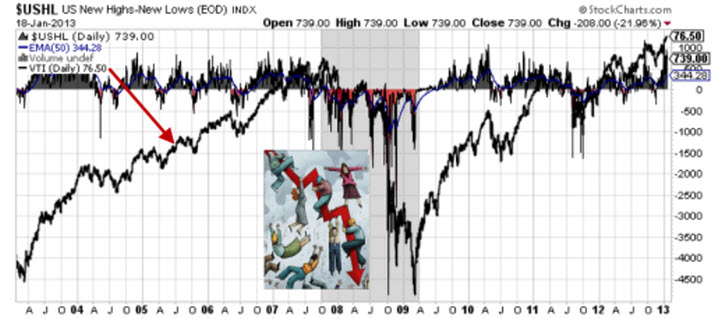
The work by Dr. Elder leans heavily on the levels of new highs and new lows (consistent with what Desmond was describing in that 2006 interview.) Here’s a look at a 10-year chart of the $USHL indicator on StockCharts.com …

$USHL 10-Yr 20130118R

There are couple of major takeaways. We think what really matters is the trailing quarter exponential moving average for this index (blue line in the chart). We also notice that summer time speed bumps (magenta shaded negative areas frequently seen around July) are very, very normal.

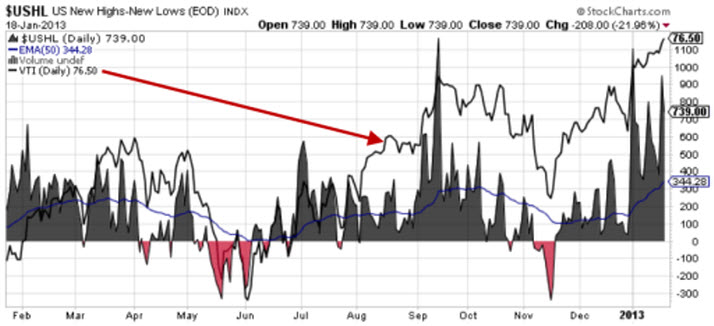
Here’s a look at recent history. Again, it’s the blue line that matters.

$USHL 1-Yr 20130118R

And that blue line is strong.

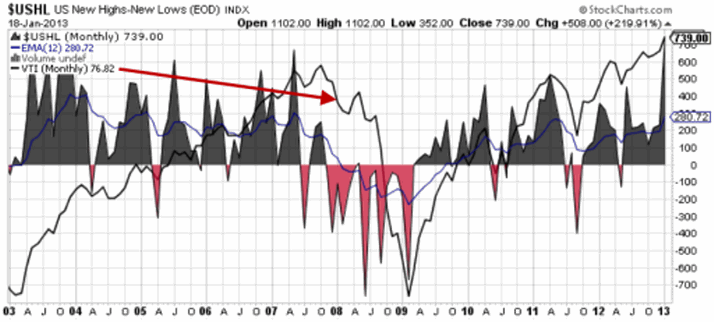
This longer term perspective on the $USHL indicator could quickly become a favorite. Note the break from positive to negative at the onslaught of the 2008 bear market for the trailing average.

$USHL 10-Year Mo 20130118R

Morningstar Fair Value

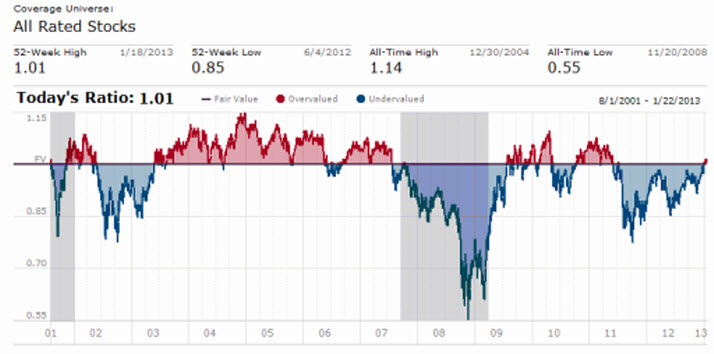
This indicator seems to “live” in the 0.85-to-1.10 neighborhood. A reading of 1.01, suggesting a smidge of overvalue — is historically pretty neutral.

Morningstar Fair Value 10-Year 20130118R

Transports

Some pretty hefty gains in this group of late — and the PAR for the Dow Jones Transports has been driven down to 7.1%. This would become a negative signal if the PAR approaches 3%, particularly if signs of fundamental weakness (reduced EPS forecasts) materialize.

There’s still considerable strength in FedEx (FDX) and UPS (UPS).

Retail

The first graphic is the long-term trend for the Consumer Discretionary sector.

And it’s here that there’s considerable apprehension because of the present threats to disposable income. Less money in our wallets and some things are more discretionary than others. Weakness in the companies displayed here probably translates to a economy-wide migraine. 4Q2012 and 1@2013 earnings reports are important along with the 2014 forecasts as they take shape.

Utilities & Staples

As Barry Ritholtz suggested, these sectors are where we watch for exodus and flight-to-safety behavior. Not much to report on the utility side … and we’re vigilant for anything resembling that pre-2008 recession spike in Staples volume. Basically, people were pouring into the Staples stocks without much regard for return expectations — a sign of a deep correction or recession. For now, Staples volume appears relatively normal.

Stock Market at Stall Speed?

When we first featured this a while back, it was about the economy — and we’ll refer back to this outline as we build out our Market Barometers (Extended Version) today…

Economy at Stall Speed?

I finished Bailout Nation this weekend (7/11/2012). As most of you know, I’ve followed the work of author Barry Ritholtz for some time. The following are his thoughts from 35,000 feet about the state of the current economy. We’ll take a closer look at his barometers and see if we can build some findings that have some bearing on prudent asset allocation.

Source: http://www.ritholtz.com/blog/2012/07/7-factors-to-watch-in-a-slowing-economy/

The data continues to come in showing the global economy is slowing. The key question is whether this slowdown is to full on recession or merely a sloppy-muddle-through-barely-above-stall-speed economy.

With all of the cross currents out of Europe and the US, its easy to get distracted with less important nonsense. We watch all of the usual macro signs, but to find clarity, watch this earnings season. I want to especially pay attention to the following 7 factors:

  • Transports have been very soft and confirm slowing global trade. Pay attention to UPS, Fed Ex, and Rails.
  • A corollary is energy prices and the shifting revenues of the major oil companies.
  • Retailers often feel the bite first. Middle market retailers, than luxe goods. Watch for signs of improvement amongst the discounters like WalMart, Target and the dollar stores as consumers feel stressed.
  • Defensive issues such as Utilities and Consumer Staples attract buyers (but should not see big changes in revenues)
  • Pay attention to visibility and revenue expectations from companies. I expect the uncertainty trope t0 be in full flower;
  • More important than that, watch S&P500 Quarterly earnings growth; Is the rate of growth (2nd derivative) slowing?
  • Valuations remain reasonable but not cheap; See where the SPX ends after earnings season is over.

These earnings are where the rubber meets the road, and I expect them to be telling.

Value Line Low Total Return Screen (1/25/2013)

Speaking of inflections, check out the number of weaker long-term price forecasts (listed below) versus those that have strengthened. This trend has been in place for some time.

Much rides on the 4Q2012 earnings reports, particularly this week.

We’ll also start to get a look at a few of the 2014 annual forecasts as they come out of the blocks.  Much rides.

There’s a plethora of study and investment candidates this week. We’re a little reluctant to look at any of these with a return forecast greater than 22.5% (simply from a statistics perspective) but there are plenty of those blue chip stalwarts that are currently getting kicked around. Might the Lost Decade be found?

Universal Electronics (UEIC) and Pepsi (PEP) are among those that trigger attention — and we’ll take a look at least one of these this week.

Materially Stronger: Bridgepoint Education (BPI)

Materially Weaker: Dolby Labs (DLB), Activision Blizzard (ATVI), Treehouse Foods (THS), Village Super Market (VLGEA), Apollo Group (APOL), DTS (DTSI), Career Education (CECO), Avid Technology (AVID), Diamond Foods (DMND), ITT Educational Services (ESI), Synutra (SYUT), Zynga (ZNGA)

Note: After continuing the update (incorporating and factoring in forecast changes and the opinions of S&P and Morningstar, etc.) degradation of fundamentals in Strayer Education (STRA), Synutra (SYUT) and Nutrisystem (NTRI) would have resulted in their removal from the Companies of Interest list. In other words, their quality rating dipped below 55 (Good) and they would no longer qualify for this screen.

Reflections on Inflections

“There is nothing more dangerous than to build a society, with a large segment of people in that society, who feel that they have no stake in it; who feel that they have nothing to lose. People who have a stake in their society, protect that society, but when they don’t have it, they unconsciously want to destroy it.”

— Dr. Martin Luther King, Jr.

While accepting the Nobel peace prize, Dr. King said:

“I have the audacity to believe that peoples everywhere can have three meals a day for their bodies, education and culture for their minds, and dignity, equality and freedom for their spirits. I believe that what self-centered men have torn down, men other-centered can build up. I still believe that one day mankind will bow before the altars of God and be crowned triumphant over war and bloodshed, and nonviolent redemptive goodwill will proclaim the rule of the land.”

The grandfather of the modern investment club movement, George Nicholson, drew many parallels to the potential of capitalism and freedom for solving some of the larger challenges of this world. On this day spent reflecting on the triumphs of Dr. King, I find many parallels between his words and those of George Nicholson.

From the Investors Manual for the Individual Investor (1984, page 7): “Capitalism will work better if people …”

  • understand investing,
  • are educated to do so successfully, and
  • intelligently provide capital to expanding industries.

“Investment education is essential to good citizenship in the modern world.”

Many parallels.

Mark Robertson

Large Companies On Sale?

We recently shared a graphic that we feels captures the importance (we’d dare say urgency) of balancing portfolios with a blend of blue chip stalwarts, medium-sized work horses and promising faster-growing smaller companies. Not the one on the right, the graphic here:

Advantage of Growth (Size) Diversification

“What about the other side? —@InvestEdInc

The ‘Too Big Of A Market Cap Stock’ Theory

Highlights:

  • I don’t know about you, but have you noticed how big-cap stocks are being priced by the market? If you haven’t noticed, they are cheap.

Cheap? There’s more to “cheap” than P/E ratios. We know that P/E is just one piece of the puzzle and can be misleading or uninformative in the absence of more information. Here’s a look at our collection equally-weighted S&P 1500 components using three exchanged-traded funds from Guggenheim:

As you can see, none of the three — not even the S&P 500 — stands out with a dramatically high return forecast, even after a lost decade. The fact that all three groups have similar average growth forecasts also suggests a whole bunch of “cross pollination” these days.

  • And if [lost decades are] the new norm in the large cap space — where stocks can go nowhere for years and years — why would someone want to be invested in a large cap stock over the long term, except of course for a good dividend? Also, is long-term stock appreciation not a possibility anymore with large cap stocks?

The problem was P/E compression. As Julie Werner has pointed out, Nardelli faced a lot of challenges at Home Depot (HD), but one of the bigger obstacles (from the perspective of generating superior shareholder returns as CEO) was the 40x current P/E at the time he plopped down in the CEO chair for the first time.

I don’t think lost decades are the ‘new norm’ in any stock category.

In fact, merely tendering the thought probably means that collective P/E expansion for the S&P 500 is around the corner.

Some people think it would be nice if we could just focus on the dividends. But we can’t — they’re just one piece of the puzzle too.

There’s price appreciation potential in stocks with lower growth rates. Hunt patiently.

  • Assuming this totally out of the box theory of mine makes any sense, reach for smaller cap stocks and let stocks over $50 billion in market cap (or even less) for large institutional investors.

To some extent, it does. The challenge of cash deployment at Apple could very well mirror the attrition of serial M&A ten years ago at Cisco Systems (CSCO). The concepts of saturation probably apply — somewhat.

Our advice from a few months ago to hunt down faster-growing stocks can probably be tempered to shift back to an evenly distributed emphasis on smaller and larger companies. See: The Difference Between Tricks & Treats

But we stand by our time-honored recipe. All of the categories take turns leading at the dance. No one can tell you when or which partner is going to lead (and it’s certainly not obvious in those Guggenheim ETFs — at least not right now.)

In fact, we think the Guggenheim suggestion right now is shop amongst all three growth/size ranges. The return forecast stratification is as high as we’ve seen it in a while in all three classifications. Seek the highest quality companies and wait for their return forecasts to justify purchase. Hold them for as long as it makes sense to do so.

Reform: Center Stage

Brown_JoshuaI’m relatively new to the world of Twitter, or as some have dubbed it, the Twitterverse. And one of the things that participants will often do (usually on Fridays) is share lists of resources (their “tweeps”) where they find value, entertainment or some combination thereof. I’ve been constructing my own “Follow Friday” list (stay tuned) but wanted to take a moment to commend a colleague on a moment that remains oblivious to way too many people.

First, I was quite taken with the balance of humility and pride on full display when Josh Brown recently encountered and shared a moment with Art Cashin.

But that’s not THE moment. For me it was a fleeting moment (a few days ago) on CNBC’s Fast Money Half Time segment. The moderator was grilling Joe Terranova about some “call” that he’d made a while back and he was … somewhat relentless. In fact, the discourse resulted in Joe saying “I was wrong” more than a few times. The moderator seemed to take a small measure of sadistic enjoyment while rubbing salt. As it teetered on awkward, the camera panned to Josh. Slightly paraphrasing:

“Hey. Hold on. Our business is a humbling business and the market takes no prisoners. We get things wrong. We extract lessons and try to do better. We’re in this together and frankly, I respect that Joe is willing to share that he was wrong and how his outlook has evolved. It’s an absolute demonstration that he’s really in this business and I think we all need to respect our colleagues as we all try to achieve success.”

And somewhere, a pin dropped.

Backstage Wall Street (A version of my Amazon book review from March-2012)

Having been involved in investment education and research for nearly 20 years, I think Josh has a timely, transparent message of hope. Seriously, the book is a little like Boiler Room and Gordon Gecko meet Jerry Maguire.

Continuing on the cinematic theme, I’ve only read a few books in my lifetime in one sitting. One was Alien. Another was Babson’s Brad Perry’s tome Winning The Investment Marathon and Jurassic Park was a pretty enthralling read also. I can now add Backstage Wall Street to the list. I’m not sure which one was the most frightening, when I finished Alien I didn’t want to turn out the lights.

Backstage is equally unsettling and Josh lays a foundation and history as he describes the “evolution” of Wall Street and the grinding of sausage. I actually think Josh Brown is part of a potential re-awakening of investing as it once was (or was at least intended to be) … a people’s capitalism with a potential outcome that would make Sigourney Weaver proud.

A rudimentary return to principled capital markets … a New Reformation is clearly in order. If you’ve been investing for some time but harbor reservations about the way things are, this might be Chapter One of a new day. If you find investing terrifying when it comes to your 401(k), you might find some relief that there are some advocates and champions for the way things ought to be.

Is there hope?

I think so.

I’m not sure who plays Josh in the movie, but it’s not Vin Diesel or Charlie Sheen. For the sake of millions of afflicted investors and citizens out there, reform at will.

Thanks, Josh.

P.S. For those who want to play along, my Twitter address is @manifestinvest. Joshua Brown’s is @ReformedBroker.