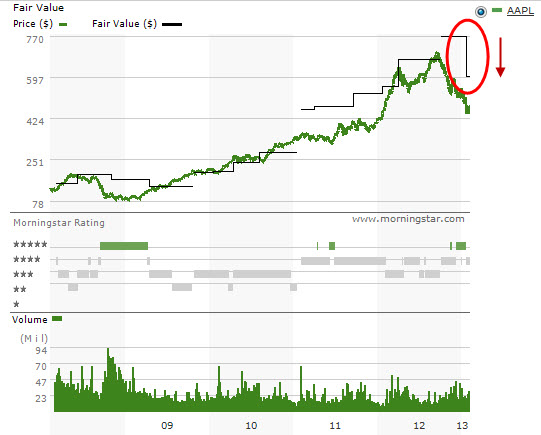
FYI … both Morningstar (from $770 to $600) and S&P have reduced their fair value estimates on Apple (AAPL) in recent days. Analyst consensus estimates for sales and EPS for years ending 9/30/2013 and 9/30/2014 also reduced. The impact on our return forecast will take it from 24% to 18-19% — still undervalued, just not as much. Point-and-figure (PnF) sentiment on www.stockcharts.com has turned “Prelim Bullish”.
Month: February 2013
Of Tortoises and Ground Hogs
Thriving on the Backs of Our Shell-Bound Colleagues
This is a modified version of a post from the March 2001 issue of Better Investing magazine. As our Groundhog celebration continues — and even as it winds down — we’re reminded of a heritage of long-term investing success, steeped in patience, discipline and yes, rituals.

Punxsutawney, PA. (Population: 6,782)– February 2, 2001
On this day, a small town just northeast of Pittsburgh finds its way to the hearts and minds of people worldwide. The principal inhabitant of Gobbler’s Knob, Punxsutawney Phil, plays host to the likes of presidents, news anchors and talk show hosts. In the chilly morning breeze, thousands gather to see whether Phil will observe his shadow — immediately following his stretching exercises, breakfast and morning coffee. For the record, he’s seen his shadow some 90 percent of the time over the last 100 years or so. I doubt that there’s much correlation between his shadow and wintry durations — but the masses gather anyhow.
Saturday Morning
Rituals occupy an important place in our lives. One of the endearing features of monthly investment club meetings is that they encourage a discipline of regularity. Invest regularly. Monthly meetings reinforce. They make it difficult to ignore the prodding that we should regularly contemplate and explore our investment efforts.
When I first started investing, one of my rituals was to make the sojourn to my local bookstore every Saturday morning. The itinerary included a stop for a cup of coffee and a saunter next door for that weekend’s edition of Barron’s. Like all newbies, I watched CNBC and checked my stock prices far too frequently.
Too frequently? How much is “enough?”
On the Backs of Roaring Tortoises
It’s a good question. In fact, it’s a great question. It was presented to me by a reporter from Forbes not so long ago. It stirred the memory of a question to Ed Finn, publisher and editor of Barron’s, delivered from the floor of Congress 1999, after Mr. Finn had concluded his keynote remarks. (Those memories were recently rekindled while listening to Mr. Finn’s keynote remarks at last week’s MoneyShow in Orlando)

“How do we reconcile the apparent reality that investment clubs achieve strong performance levels despite the fact that most of them only meet for an hour every month or so?” Mr. Finn suggested that the investment professionals might want to think about that — and consider becoming a little less active in their execution of transactions.
The Forbes reporter’s question tiptoed up to the question again. “Once you develop a solid comprehension of the modern investment club approach to investing, and your portfolio is in place, how much time would you say you dedicate to the management of your personal assets?”
I thought about it. There’s an element of “hobby” and certainly entertainment to the things that we do as investors. Clearly, some of us spend more time than others exploring and learning. But this question had a deeper nature to it. How much was essential? I thought about it some more and said, “8-10 hours per year.” That may stagger some of you. But I’m convinced that my impressions are correct in this regard. My thoughts drift to conversations with national event attendees. These discussions are a distinct privilege. “You’ve done well, very well — for decades — what’s it take?”
With a twinkle and a smile, several answer the question with stories of cruises and their best days on the golf course. With a wink, others confide that much like Punxsutawney Phil, they drag out their portfolio once a year to see whether the sun is still shining. With regard to my personal holdings, it’s no exaggeration whatsoever. Following a recent investment conference presentation, I was discussing a mutual holding with an attendee and was pleasantly surprised to learn of a large increase in price that had occurred in the last month or so.
Eight, maybe 10 hours per year? It’s more than possible. For many, it’s an absolute reality. Many practitioners spend a couple hours every quarter — checking in on how the management of the companies that they own are performing. Are they pursuing opportunity? Are they doing so profitably? Is the sun shining? How’s their shadow?
Our obsession with tortoises in this issue has a basis in a time-honored heritage. Listen for the roar. Invest regularly, in leadership enterprises, at good prices. Don’t hurry, but don’t wait, either.
Join us at Manifest Investing and Expecting Alpha as we build resources that make sense for your Saturday morning sojourns. We hope our community resources will become a favorite destination for your 8-10 hours per year and beyond. At Manifest Investing, we’re committed to remaining focused on what really matters: the growth, profitability and valuation characteristics of your holdings and potential holdings — and any threats or opportunities to both. We’ll do our best to sound the bell of opportunity or the clarion of a threat. And we know that our collective community will be vigilant and do its best to watch for shadows.
You can’t have a shadow without some sunshine.
Contest Picks: Heavy Hogs (2013)

Consensus Selections for Groundhog VII (2013)
Every year we celebrate our national holiday at Manifest Investing, Groundhog Day, with a review of the results achieved by our band of groundhog stock pickers over the last year. Now in its seventh year, we continue the celebration by launching a brand new set of contest entries.
This year, we’re going with Eddy Elfenbein’s $1,000,000 format with the only exception that participants can select anywhere from 5-20 investments. If you want to get really concentrated, go for five … feel better with a little diversification, choose closer to 20 — and everywhere in between. And like Eddy, we’re locking in the entries. No transactions will be made between Groundhog Days.
The selections were a little more distributed this year, with the most frequently-selected stock being Qualcomm (QCOM). Other high frequency selections included: Apple (AAPL), Bio-Reference Labs (BRLI), Coach (COH) and FactSet Research (FDS).
The public tracking dashboard is:
http://www.manifestinvesting.com/dashboards/public/heavy-hogs-2013
Best performers from Heavy Hogs 2012:
- Portfolio Recovery (PRAA) ….. 65.2%
- Resmed (RMD) ……………… 53.3%
- Google (GOOG) …………….. 31.7%
- Bio-Reference Labs (BRLI) ….. 30.8%
- Walgreen (WAG) ……………. 27.3%
- Oracle (ORCL) …………….. 23.2%
Weakest Performers from Heavy Hogs 2012:
- Quality Systems (QSII) ……. (53.2%)
- Coach (COH) ……………… (29.3%)
- Baidu (BIDU) …………….. (24.7%)
- AeroVironment (AVAV) ……… (23.5%)
- CARBO Ceramics (CRR) ……… (14.9%)
Thanksgiving 2010: Of Heroes & Harvests

Gerri Willis of Fox Business News asked about the Beardstown Ladies during an interview this week. Yes, they’re still in existence and prospering. They’ve added new partners. The media still mangles the facts about that mistake. The mistake was largely Disney’s — a federal judge agrees with me. The Ladies committed a human error. Their performance was better than is perpetually broadcasted. You can ask Price-Waterhouse about that. But more importantly, they continue to grow, explore and reach out to remove mystery and fear from investing — enabling a new generation to discover successful long-term investing. We shared some details in this message from Thanksgiving 2010 …
Thanksgiving is a time for reflection, gratitude and hope and in this case, a rekindling of a very special spirit nestled in the cornfields of Illinois …
Of Heroes and Harvests …
It was a beautiful autumn day in the heartland. I attended a couple of investment club meetings … the first in Mt. Carroll, Illinois — near my home town — and the second in the heart of Illinois in place called Beardstown.
I admired the scenery as the combines and heavy equipment toiled to bring in a robust harvest this year and the highway miles rolled by. I have many friends who are farmers. They work hard. It’s nice to see rewards harvested and smiles even if that farm equipment backed up traffic while migrating from one field to the next. The day included reminders of time-honored traditions and legacies while harboring a surprise or two.
The Beardstown Ladies have been using options for their club portfolio. They’ve been doing it for a while now.
I’ll let that one sink in.
The Beardstown Ladies have been an inspiration to a generation of investors. I count them among my friends and heroes.
Did you know that they have a room in a museum dedicated to their investment club?
Still ruminating on that options thing? We’ll come back to that.
It’s true. During my visit to Beardstown, I discovered that the city was once the epicenter of Illinois, larger than Chicago. Beardstown is strategically located on the Illinois river and was a center of commerce back in the 1800s. Abraham Lincoln launched his presidential campaign in Beardstown.
The traditional town square in the center of town hosted one of the Lincoln-Douglas debates.
And down the hall from the Beardstown Ladies room in the museum … is the court room where Lincoln practiced law. It’s the scene of one of the most famous legal arguments. The case is known as the almanac trial. Lincoln was defending the son of some good samaritans from his youth. (They had literally taken young Abe in when he was essentially homeless.) Their son was on trial for murder and Lincoln (think Perry Mason) tripped up the key witness by pointing out that the “full moon used under testimony” was no where to be found in a Farmer’s Almanac.
Yes, the Beardstown Ladies are using options. But that’s not the best surprise.
The club is getting larger and attracting some younger people to participate.
The Ladies meet in the basement of the town hall shown — a former Carnegie Library, typical of those sprinkled throughout the Midwest.
You Can Do This. We’ll Show You How
The words still resonate. I had discovered long-term investing back in the mid-1990s … formed a family and friends investment club, but frankly it probably was hanging in the balance.
And then I attended a luncheon featuring the Beardstown Ladies, Betty Sinnock and Doris Edwards. You can do this. We’ll show you how.
It’s a theme we hope to live and extend at Manifest Investing.
The first of Carnegie’s public libraries displays the motto, “Let there be light” at the entrance.
His first library in the United States was built in 1889 in Braddock, Pennsylvania, home to one of the Carnegie Steel Company’s mills. Initially, Carnegie limited his support to a small number of towns in which he had an interest. From the 1890s on, his foundation funded a dramatic increase in number of libraries. This coincided with the rise of women’s clubs in the post-Civil War period, which were most responsible for organizing efforts to establish libraries, including long-term fundraising and lobbying within their communities to support operations and collections.
The genesis of the Beardstown Ladies was the Business and Professional Women’s association.
A few miles to the north in Mt. Carroll, I had the opportunity to spend some time in the shadow of yet another Carnegie Library … on another Midwestern town square. The Nest Egg investors sport a portfolio that I’d not only be proud to own, I basically do. Their collection of community favorites and promising companies mirrors our most widely-followed stocks.
That’s not a surprise.
The surprise is they’re expanding and welcoming new ladies to the club. On this day, they welcomed our family (including my Mom and Dad) to their gathering. The leadership of ladies like Mary Ann Hutchison and Wilma Colehour is making a difference. Interest is growing with a younger generation and we’re hopeful that these seeds germinate and continue to thrive.
We look forward to watching future harvests and celebrating nurtured nest eggs.
This is just one more nest egg that can point to the Beardstown Phenomenon as a powerful influence and inspiration.
Back to Beardstown
I’m still working on our nest egg. But the Beardstown Ladies have made a significant difference for me and my family as we’ve sent two children to college and launched a business. As we bow our heads on Thanksgiving, I will be thinking of many blessings. I want all of the Ladies to know that they’re pretty high on the list and I told them that as we gathered.
We talked about a few stocks. I watched them thoroughly discuss (and sell) a very long-term holding.
They asked me for some thoughts and I shared the significance and relevance that we’ve discovered with the Value Line low total return forecast.
And then … one of the ladies whispered, “What do you think of options being used by investment clubs?”
I slumped into my chair extruding a “fake sigh.” Most of them seemed to be either “giggling” or looking at their shoes. 🙂
“You mean to tell me the Beardstown Ladies are using options for the club?”
“Yep. We’ve been doing it for a while.”
“Really?”
“Homer, our broker in Peoria, has been teaching and helping us with it. What do you think?”
“One, I think you’re in good hands. Two, I think it’s a great idea. The foundation of investment clubs is learning-by-doing. Explore. Discover. Fail. Succeed. Together. Some of my other heroes have been urging me to better understand conservative options strategies like covered calls and protective puts for the last few years. I’m learning right along with you.”

We’ll launch a new demonstration in January — taking our [BareNaked Million] — and deploying options strategies in full view. We’ll call it [Covered Million] and hope to demonstrate some incremental success using some of the conservative options strategies we’ve become more aware of.
Exploring. Learning. Discovering together. I’m sometimes asked if I believe investment clubs are “dead.” These two clubs provide strong evidence to the contrary and we don’t need an almanac to check sunrise or sunset to see it. Youthful exuberance inspiring the next harvest … it combines with the knowledge that every harvest sunset is also a harvest sunrise. It’s just a matter of perspective.
Happy Thanksgiving, everybody.
Apple Sauce: Equal vs. Cap-Weighting
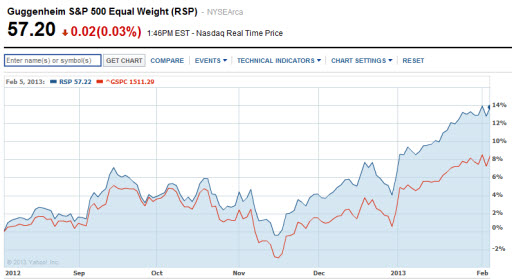
Impact of Apple Swoon. It’s not all due to Apple, but this comparison of an equally-weighted S&P 500 (RSP) vs. cap-weighted S&P 500 (SPY) shows a pretty significant drift over the last few months. This provides some reinforcement for our argument for a Value Line 1700 proxy using equally-weighted components.
Crossing Wall, Walking Main (Update)
S&P 500 Challenge. One month into this year’s edition of Eddy Elfenbein’s Crossing Wall Street Buy List (2013) and our participation with the Walking Main Street portfolio … and we’re both thumping the S&P 500 index.

What Works on MAIN Street?
Monday’s WSJ column about the waning of interest in investment clubs and dreadful undocumented under performance stirred memories of this column from Better Investing magazine about 12 years ago. Why? Because the talking heads keep bringing up that “comprehensive” study of 166 clubs and the Beardstown Ladies saga. We need a new scientific study … because our experience is that investors embracing and heeding the modern investment club methodology (whether on their own or within the warm confines of an investment club) are doing pretty well when taken in full perspective and when dealing with FACTUAL internal rate of return records. We’d rather focus on what’s working — even if so many of you lurk silently — and pardon me, but I might just puke if someone cites those 166 “clubs” again.
The coming of April showers means that, once again, March Madness has come and gone. March Madness. With each passing year, I find that I enjoy the mighty meetings of high school basketball teams, closely followed by their collegiate counterparts. By the time this magazine reaches your coffee table, there’s a pretty good chance that a number of magical moments will have happened. Gene Hackman and his Hoosiers were just one shining moment. There will be others. The goose bumps are “on ice” just waiting to be experienced. “Do you believe in miracles?”
We’ve acknowledged in past articles that [the grandfather of the modern investment club movement] George Nicholson always regarded NAIC and investment clubs as his “Grand Experiment.” Investment clubs are also human. The things that can be discovered are nothing short of miraculous. Exploring the rewards of investing while stripping away the myth and mystery is something that brings a smile to our faces. Learning to smile together is a gift that we hope to share with as many people as humanly possible.
March Madness. It brings out the best. Unfortunately, it sometimes brings out the worst, too.
The January/February 2000 issue of the Financial Analysts Journal features an article by Brad Barber and Terrance Odean entitled, Too Many Cooks Spoil the Profits. This publication is received by Chartered Financial Analysts. Although fairly few people will ever see this report, we believe that exploring some of the conclusions is worthwhile. If nothing else, Barber and Odean have been regularly appearing in the media. We think they could gain much from a better understanding of investment clubs and strategic long-term investing.
Quoting their conclusion: “Unfortunately, [investment clubs] do not beat the market.”
We have “been here” before and it won’t be the last time. A year ago, a number of publications assailed our Beardstown Ladies. Too many cooks? Most of us rather like cooking with our friends. There is some impressive cookin’ going on. There will come a day that we’ll demonstrate that we not only achieve (in the words of Barber and Odean) “savings, education, friendship and entertainment . . .” but we also achieve very promising performance levels as well. Collectively, NAIC investors achieve high returns. Clearly, this does not happen for every single club or every individual, but we have scores of success stories. We think it’s valid to point to our Top 100, this issue’s main feature, as substantial evidence. With Intel, Lucent Technologies, Home Depot, Cisco Systems, Merck, PepsiCo and Microsoft among the most widely held companies, clearly some level of success has been attained by our practitioners.
Nearly 4,500 investment clubs (11.9 percent of registered clubs) responded to our latest Top 100 Survey with complete portfolio summaries and club accounting reports. Barber and Odean assail the “touting” of investment club performance in the media by citing sample bias. Barber and Odean base their findings on 166 investment club account statements from a single discount broker! Not only that, they cite turnover levels of 65 percent (nearly a complete overhaul of the stocks within a club portfolio every year-and-a-half.) Barber and Odean also share that these club accounts were concentrated in high beta, small-cap stocks. These characteristics lead us to a simple question, “Are you sure that you’re assessing NAIC club performance?” That doesn’t sound like what the long-term investors we know about are doing.
Most people are not statisticians, but I think that they can sense that 4,500 data points might be more representative than 166. Particularly when the “166” are “weak.”
The authors dwell on excessive turnover and poor returns due to commission costs. We ran a quick, biased, completely unscientific survey to investigate a hunch. Approximately 50 online investors responded. I think we can assume that these investors are “most likely” to be the most active. We asked them to provide their turnover figure for 1999. The highest turnover rate reported was 40 percent. The lowest, from several respondents, was 0 percent. (No sell transactions for the year.) The average was 8 percent. Unscientific, yes. And admittedly biased. But, in my opinion, closer to the truth about what long-term investors are really doing.
Here’s another aspect that the Barber and Odean study that raises questions. MANY investment clubs use dividend reinvesting. So, I went back and checked. In 1996, our investment club had 64 percent of our assets in DRPs. Our discount brokerage account would have been terribly UNinformative about the true performance of our club.
Barber and Odean include another rehash of the Beardstown Brouhaha of 1999 as “evidence” of poor performance. It bears repeating. Investment clubs, including our Beardstown Ladies, are human. A mistake was made. But, for the record, the Beardstown Ladies achieved a 15.3 percent annualized return for the 14 years ended in 1997. (This was part of the Price Waterhouse audit.) The annualized return for the S&P 500 for this same 14-year period was 16.9 percent. If the ladies are guilty of underperformance, consider this: In his book, Common Sense on Mutual Funds, John Bogle Sr. documents that only 14.1 percent of “growth and value” mutual funds beat the Wilshire 5000 (16.0 percent returns for the total market) for the 14 years ending in 1997. While committing their “crime,” our Beardstown Ladies “defeated” 5-out-of-6 mutual funds. March Madness, indeed.
Is the point that the ladies would have been better off stuffing their recipes and cold cash into the corners of their mattresses? I certainly hope not, because if that’s the case, these two educators are not only failing to educate –they’re DE-educating.
A number of us recently gathered online to discuss James O’Shaughnessy’s book, What Works on Wall Street. What works on MAIN Street? Patience. Discipline. Discovering the best companies, at the best prices, with our friends. Too many cooks? Not even close! It’s the best type of cooking capitalism has to offer.
Value Line Low Total Return Screen (2/8/2013)
Market Barometers
The average Value Line Low Total Return (VLLTR) forecast is 7.3%, down from 7.7% last week.

Companies of Interest
The average low total return forecast for this issue of the Value Line Investment Survey is 6.1% — and the opportunities are a little sparse. The number of material price forecast reductions continues to outnumber the bolstered forecasts this week.
A couple of recent favorites, Schlumberger (SLB) and National Oilwell Varco (NOV) continue to be worthy of further study.

Materially Stronger: Host Hotels (HST), Helix Energy (HLX)
Materially Weaker: Harte-Hanks (HHS), DreamWorks (DWA), Scientific Games (SGMS), Hyatt Hotels (H), Monster Worldwide (MWW), Forest Oil (FST), RPC (RES)
Annual Stockpicking Results (Groundhog VI)

At Manifest Investing, we celebrate Groundhog Day by ending one annual stock picking contest (Groundhog VI for 2012) and starting another (Groundhog VII). Any and all investors are welcome to participate either individually or as part of a group. For 2013, participants may select as few as five investments (stocks or funds) with a maximum of twenty. $1,000,000 will be divided among the entry positions and we’ll create a dashboard and track entries from Groundhog Day to Groundhog Day.
Congratulations to Bernie Meister of Midland, Michigan for winning Groundhog Challenge VI (2012). The group champions are the Broad Assets Investment Club of St. Louis, Missouri. 1. Hoist trophy. 2. Pat back(s). 3. Get back to work on your 2013 selections. 🙂
The early years were phenomenal as you’ll see in the following slides — and performance has become more normal than we’re accustomed to seeing the last few years. Even with that, our Groundhog Nation generally outperforms the herd of analysts, pundits and institutions with many participants sporting lofty alphas (relative return) over the years.
When Punxsy Phil sees his shadow, we think it has less to do with the weather and more to do with positive trends and achievements for us next year and beyond.
For more information or to enter the fray, contact manifest@manifestinvesting.com
Good luck to the 2013 field.


Annual Super Bowl Poll (2013)

It’s time for our annual Super Bowl survey.
The San Francisco 49ers are an “old NFL” team. The Baltimore Ravens are not an “old AFL” team, so traders and investors have already won. The Super Bowl Indicator is a lock. It’s time to get out there and BUY SOME STOCKS. 🙂
At Manifest Investing, we’re 6-for-7 having selected the Giants over the Patriots last year.
XLVI: New York Giants (defeated the New England Patriots)
XLV: Green Bay Packers (defeated the Pittsburgh Steelers)
XLIV: New Orleans Saints (defeated the Indianapolis Colts)
XLIII: Pittsburgh Steelers (defeated the Arizona Cardinals)
XLII: New England Patriots (Super Bowl won by New York Giants)
XLI: Indianapolis Colts (defeated the Chicago Bears)
XL: Pittsburgh Steelers (defeated the Seattle Seahawks)