A Few Of Our Favorite Screens

 Rt banner 20150131

These Are a Few of our Favorite Screens

For the January Round Table, we spent some time with a few screening resources in the quest for some good ideas for further study. We’ll collect them here and tabulate the overall results, using a version of the coach’s poll for collegiate sports (20-16-12-8-6-4-2-1 for votes) and see what percolates to the top of the charts.

Screens Featured

The Top 25

Knighthunt4

Ivory Soap Screen

This screen is based on a recognition that the two most important characteristics of any investment are (1) the return forecast and (2) the quality of the company. The MANIFEST Rank is an index that combines the two characteristics with essentially equal weighting. Here are the top eight results of a current screen based solely on MANIFEST Rank > 99.44

Ivory screen 20150129

Triple Play Screen

This is one of the more popular screens that we’ve covered over the years. It generally works best after a bear market has raged for a while.

It focuses on some of the primary drivers for higher long-term return forecasts. The three things we’re looking for are:

  • Elevated return forecast … generally because of a (hopefully) temporarily hammered stock price.
  • Potential for P/E Expansion … a higher P/E in the future than the current P/E.
  • Margin Enhancement … projected profitability in the long-term forecast that is higher than current levels.

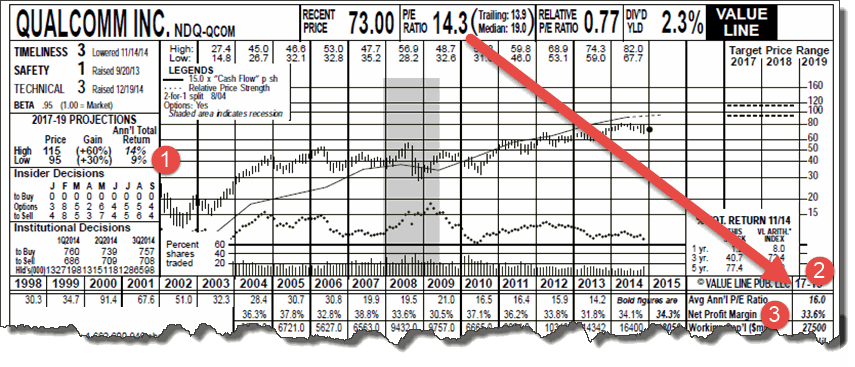
Using one of the current leaders for this screen, we note that Qualcomm (QCOM) has a low return forecast of 9-10% according to Value. Keep in mind that the average low return forecast for the Value Line universe is 3-4%.

We also see a future P/E of 16.0x versus current levels of 13-14×.

Value Line expects “flat” net margins in the 33-34%. The reason this triggered in our database is that the analyst consensus is more optimistic than Value Line when it comes to future profitability for Qualcomm.

For more on this Triple Play screening approach, check out the archived presentation at: https://www.manifestinvesting.com/forums/14/topics/2778

Triple play screen 20150129

Gateway Champions

This screen is inspired by our repeat group champions, the Broad Assets investment club of St. Louis. Broad Assets repeated as champion last year and is running 2nd this year as Groundhog VIII comes to a close in a few days. We featured the concept behind this screen in our Victory By Escape Velocity? cover story from May 2014.

Nutshell: If you really believe that stock price follows earnings, it makes all the sense in the world to look for those conditions.

In this case, we focus on year-over-year (2015 over 2014) earnings estimates and focus on the companies with the strongest upside. We also limit the field to companies that have shown increasing earnings for each of the 4-5 years displayed. (All year-over-year figures > 0%)

Lannett (LCI) continues to have strong expectations, but it will be interesting to see what Broad Assets does with LCI in the future as 2016 EPS estimates are finally plateauing. We also note the presence of Balchem (BCPC), a long time favorite of another St. Louis club — Mutual of St. Louis and our friends Jay and Ray.

Gateway groundhogs 20150129r

Schloss Screen

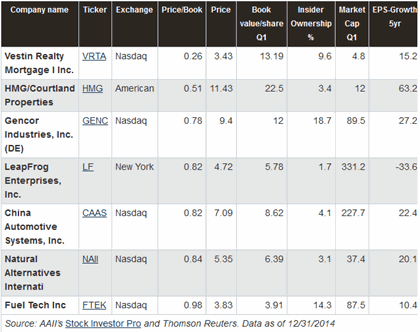
The American Association of Individual Investors (AAII) features a number of screens based on famous investors and methods including one of our time-honored all-time favorites, Walter Schloss.

Screening Criteria

  • Companies that trade on the over-the-counter market are excluded
  • ADR stocks are excluded
  • Companies in the financial sector are excluded
  • Stock has been traded for at least seven years
  • Current share price is less than the latest quarterly book value per share
  • Current share price is within 10% of its 52-week low (Hugh McManus has to like that one)
  • Percentage of insiders owning shares is higher than the median insider ownership percentage for the entire database
  • Long-term debt from the most recent quarter and fiscal year equals zero

Schloss vl screen 20150129

Piotroski Screen

Joseph Piotroski, associate professor of accounting at Stanford University’s Graduate School of Business, undertook a study of low price-to-book value stocks to see if its possible to establish some basic financial criteria to help separate the winners from the losers.

The result, a favorite screening method among AAII members, is the top-performing screen since inception nearly 20 years ago.

Low Price-to-Book-Value

Piotroski’s work starts with low-price-to-book-value stocks. Price-to-book value was a favorite measure of Benjamin Graham and his disciples who sought companies with a share price below their book value per share. While the market does a good job of valuing securities in the long-run, in the short-run it can overreact to information and push prices away from their true value.

Measures such as price-to-book-value ratio help to identify which stocks may be truly undervalued and neglected.

Motley Fool CAPS

Most frequently chosen Outperform Ratings by the CAPS All-Stars (successful stock pickers) that have 5-Star ratings on 1/29/2015.

Fool caps screen 20150129

Modified McManus

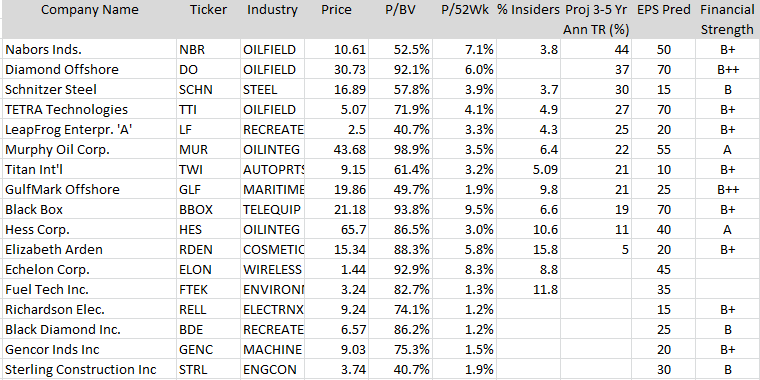
Hugh likes to shop for high-quality companies when they are trading near their 52-week lows. He keeps a fairly short list of qualified accumulation targets for his personal portfolio. We covered this screening concept here: Gone Fishing … Patiently

What makes this version of the list “modified” is that we’ve applied his shopping methods to the 6000+ companies in the Value Line database, limiting qualifiers to Financial Strength ratings of B+ (or better) and a return forecast (VL 3-5 Yr Proj Ann Tot Return or PAR) to double digits, in general, or better. (Data Source: Value Line Investing Analyzer)

Modified mcmanus 20150130

Great Buffalo

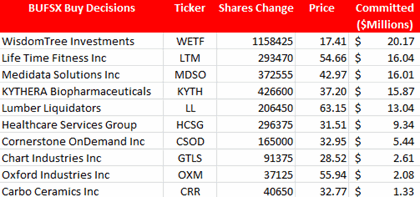
One of our favorite sources of ideas are successful/active fund managers. One of our favorite small company mutual funds is Buffalo Growth (BUFSX) shepherded by Kent Gasaway and his team.

The accompanying table (exported from Morningstar/Premium Version) provides a summary of buy/accumulate decisions made over the last quarter by the Buffalo team.

KYTHERA Biopharmaceuticals (KYTH) is a clinical-stage biopharmaceutical company focused on the discovery, development and commercialization of novel prescription products for the aesthetic medicine market.

Case Studies and Analysis Demonstrations

The stocks featured during the January Round Table:

  • Caterpillar (CAT)
  • Google (GOOG)
  • MSC Industrial (MSM)
  • QUALCOMM (QCOM)

The audience selected QUALCOMM (QCOM) from the candidates.

Sell Transaction

MWI Veterinary Supply (MWIV) was “sold” from the tracking portfolio during the session. MWIV is being acquired by Amerisource (ABC) for $190. Ken Kavula selected MWIV back on 11/29/2011 for $64.79, so $1000 became $2969 — an annualized return of 40.5% and a relative return of +22.9% versus the Wilshire 5000.

Archived Recording of January Round Table

The recording of this event is now available on the event page:

https://www.manifestinvesting.com/events/163-round-table-january-2015

It can also be found on YouTube at:

http://youtu.be/38J1L6uYT5c

If you enjoy this session, please leave us a comment or click Like on the YouTube page.  Thanks!

Season For Shareholder Loyalty

It’s absolutely a beautiful thing when we engage friends and family and lead them to the discovery of long-term investing. The opportunity to make a substantial difference, enabling better futures, is massive. We know that long-term investors also often become loyal (even rabid) consumers for the companies that they own. Regular vigilance combines with routine consumption. I wish I could change the names in the following story to protect the guilty … but it serves as a reminder of how powerful these forces of discovery can be.

I’d made the sojourn again from southeastern Michigan back to the shores of the Mississippi River in northwestern Illinois. As a fairly frequent traveler, my bags are generally packed carefully to make sure that I have all of the necessities for effective travel. I’d arrived back at my parent’s residence well after midnight and settled in for a good night’s sleep knowing that I’d see them at the breakfast table in the morning.

Sunrise came … but something was wrong. It was one of those gnawing feelings. I could have sworn that I stuck that tube of toothpaste in my overnight bag. No matter how deep I dug, it was clear that I was on the road without this necessary item? But my toothbrush was there? If it was there, how in the world did I forget the tube of toothpaste?

Sure enough, Mom and Dad were already seated at the kitchen table. We exchanged hugs and greetings and my instincts began to kick in.

“Dad, you wouldn’t have any idea why I can’t find my toothpaste, would you?”

Grinning, as he often does, like a Cheshire Cat but with his face aimed at his cereal, he responded, “Hmmm. That’s too bad, sorry to hear that. I probably have some real toothpaste you can use.” He was now snickering and giggling while continuing to munch on his cereal. He was also clearly avoiding eye contact.

“What’s with the Annual Report standing next to the bathroom mirror?”

Mom mumbled something along the lines of, “… Oh no. Here we go again.” The cereal crunching continued, but he offered up, “You’ve been warned.” There was still no eye contact.

“Enlighten me, Dad. I don’t seem to recall any warnings?” (It was a white lie. Hairs were now standing on the back of my neck and I was clearly in the danger zone.)

“You should know better than to bring that contraband into this house.”

Mischievous giggling continued. Mom was now grinning, siding with the suspect.

“Why don’t you join the rest of the world and use Colgate ($CL) toothpaste instead of that ‘stuff’ ($PG) from Cincinnati? Would you like to see a Fact Sheet?”

It was crystal clear now. My toothpaste had been hijacked and replaced with a Colgate-Palmolive annual report. Dad became a Colgate stakeholder after seeing a company presentation at an investment conference a few years ago. It seems he also became an ardent evangelist and enforcer for their products.

Invest … Reading Is Fundamental

“Investment in knowledge pays the best interest.” — Abraham Lincoln

This weekly message was first posted during November 2012, rekindled as a reminder that “Reading Is Fundamental.”

Reading is Fundamental

This Thanksgiving season, I was intrigued by a few conversations that covered the complete spectrum of the investing experience.

One discussion revolved around getting started. The individual happens to be stationed in Afghanistan with some time on his hands and is wrestling with where to start. I believe I convinced him that he was already ahead of the challenge. Why? Because he’d already begun imitating a sponge — absorbing everything that he could get his hands/eyes on. Read. Rinse. Repeat.

I still believe http://www.fool.com is a valuable resource for getting started and referred him to their broker smorgasbord and commentary on how to choose one.

The second discussion involved someone very close to me who is now actively funding a 403(b) and is giddy about the potential. We look forward to watching the account balance grow in much the same way that Tin Cup (our retirement plan model portfolio) continues to entertain us.

The third is actually a blend of a couple of separate conversations. One long-time subscriber called me to let me know that she’d no longer be subscribing. She’s 80 years old, for one thing. But she wished us well … a joyous holiday season … and then gave us an early Christmas present. “God bless you and your family and all of the Manifest Investing staff and community. It’s not that I’m not investing anymore — but I have reached ‘critical mass’ and I really want to thank you. I have a collection of high-quality stocks at Fidelity and Ameritrade … but I’ve reached the point where you’ve taught me how to watch them — and even more importantly, because of what I’ve learned, I have no trouble sleeping at night. In fact, I’ve slept well for a long time. Thank you.”

No. Thank you.

We’re humbled and grateful.

My wife and I and my parents went to see Lincoln this weekend. (1) Daniel Day-Lewis clearly knocks it out of the park and will be nominated for an Oscar, and is a likely winner. (2) If you’re going to see the movie, I’d recommend googling or spending a few moments with Wikipedia and the setting, characters and situation surrounding the passage of the 13th amendment. Tommy Lee Jones as Thaddeus Stevens is also worth the price of admission and a true courageous pioneer. (3) If you believe that bipartisan rancor and disagreement is something new on Capitol Hill, you’re wrong. Go see the movie.

Read. Rinse. Repeat.

Lincoln was voracious reader. There’s also a poignant scene in the movie where Lincoln urges simplicity while pondering a major decision. He shares “Occam’s Razor according to Euclid” with a youthful engineer and the telegraph operator, a powerful reminder that sometimes the best solutions are the glaringly simple.

And from a couple of young people getting started to a group of experienced long-term investing advocates who sleep pretty well at night, we’re grateful for the reminder.

And the optimism about what the future holds.

“I am a firm believer in the people. If given the truth, they can be depended on to meet any national crisis. The great point is to bring them the real facts — and some beer.” — Abraham Lincoln

Listen For The Cadence

by Mark Robertson, Senior Contributing Editor, Better Investing

We Are NOT Afraid … To Be Millionaires!

“Youth! There is nothing like youth. The middle-aged are mortgaged to Life. Youth is the Lord of Life. Youth has a kingdom waiting for it. Every one is born a king, and most people die in exile.” — Oscar Wilde (1854-1900)

I thought I understood [investment clubs and long-term] investing.

After all, I’ve been doing this for nearly 10 years, have completed thousands of Stock Selection Guides (Stock Studies) and belong to a few investment clubs.

Kelvin Boston, in his remarks presented at Congress 2001, urged NAIC to realize that we have a responsibility to remind people that they need not be afraid to be millionaires. No fear. Thirty bright-eyed youngsters changed my outlook.

Captured by a Captive Audience

My audience ranged in age from 9 to 16. A group of seven boys and girls near the front row belong to the [Ujamaa] investment club. It was early on a Saturday morning.

Clearly, some of their friends were doing something else in places some of these kids wished they’d rather be. Others weren’t sure. “Who’s here because they want to be here?” A few arms bent at the elbow and hands were raised at half-mast. All of the investment club members raised their hands, perhaps a little higher than their cohorts. “OK. Who’s here because some adult has forced you to be here?” Another 10 hands go up. All the way up, with feeling. Beads of sweat formed on the back of my neck. I took a deep breath. I reminded myself that they can smell fear. It didn’t help.

“Wow. Who believes that no matter what I do or say that you’re going to be bored out of your skull and that you’ve already wasted a beautiful Saturday?” Three girls at the back, on the far right, nearly stood up.

I didn’t have a chance. Or did I? As the sweat found it’s way to my forehead, these three girls volunteered to become my teammates in a stock-picking game.

Of Movies, Camaros and Hawaii

I tried to remember what $20 a month was like when I was 9 years old. I had a paper route and did some odd jobs. In hindsight, it seems like a mountain of cash. One of the three grumbling girls reminded me that they spend $10 a week to go to a movie nearly every weekend — and that doesn’t cover the popcorn. A young man in the front row talked of how $20 a month now might grow to fund a car payment by the time he’s 16.

No fear. They are clearly NOT afraid.

The beads disappeared. I smiled. How do we know it’s possible? I shared the story of our incomparable chairman, Tom O’Hara, and $20 a month since 1948. We know it’s possible to achieve an annualized rate of return of 13.2% over 50 or 60 years. He’s done it. And he openly admits that other NAIC investors have done even better.

We divided into three stock-picking teams: the Good, the Bad and the Ugly. The three grumbling girls and I became the “Uglies.” A list of long-term companies from Fortune was provided to the teams. We discussed the companies and the youngsters tried to pick the long-term leaders.

My Teacher’s Guide had the 40-year rates of return. The accompanying chart illustrates the selections and the results of investing $20 a month at these rates of return.

The three grumbling girls picked all the stocks. Kudos to the Chicago South volunteers, these youngsters and their parents. Invest regularly. No fear. Listen for the cadence and march to the drumbeat of regular monthly investing.

This column originally appeared in Better Investing, July 2002. The theme is timeless and ever important …

The Learning Never Stops

The Learning Never Stops

One of your all-time favorite cover stories dealt with the combination of well-placed skepticism and the conscious decision to “leave the couch” as a long-term investor. In a nutshell, we asked, “Can investing really be this simple?” The answer is wrapped in over seven decades of experience and deployed regularly with measured courage. At the same time, we recognize that the learning quest is a never-ending road. We believe in Occam’s Razor. You could say that our cornerstone is trend reversion centered on imagination and long-term time horizons. This month we visit some letters, questions and commentary … celebrating your curiosity and achievements. Can old dogs learn new tricks? What about young dogs?

We share the following blog post and some subscriber correspondence. Names are withheld, but you know who you are out there … and some have been paraphrased to combine multiple letters and comments into digest form.

As a kid, they were among the moments I dreaded most. The “choosing of sides” on the playground or the sandlot were gut-wrenching moments because I often didn’t merit selection as a draft choice. “What about him?” “Oh yeah … he can be on your team if you want.”

Things are not always what they seem.

I had pretty good hands and was pretty good at catching a football. When it came to basketball, there were times when I heard, “Wow, the ‘fat kid’ can really shoot.” Funny, but if I close my eyes and listen, I can still hear those words.

Fast forward a few decades. We were on a mission trip in West Virginia taking up residence in a Scout camp in the mountains. We decided to play a pickup game of basketball. My friend Don and I smiled at each other as the muscle-bound high school seniors and college freshman in the group loaded up their rosters with their colleagues. We were left standing on the sidelines. Make no mistake. It’s still pretty gut-wrenching to endure this rite of passage as an “old man” but we suspected that we had the unknowing youngsters in our crosshairs. Don and I ended up on the same team. Amusement transformed into amazement as the “old men” taught the punks a thing or two. I think Don made about ten closely guarded shots in a row. Me too.

Our message is simple. Whether you’re talking about old books or old dogs, be careful about the judgments you make based on the cover. In some cases, maturity is just what you need and it can prevail over youthful exuberance.

Of Tortoises and Ground Hogs

Thriving on the Backs of Our Shell-Bound Colleagues

This is a modified version of a post from the March 2001 issue of Better Investing magazine.  As our Groundhog celebration continues — and even as it winds down — we’re reminded of a heritage of long-term investing success, steeped in patience, discipline and yes, rituals.

 Mark  Robertson

Punxsutawney, PA. (Population: 6,782)– February 2, 2001

On this day, a small town just northeast of Pittsburgh finds its way to the hearts and minds of people worldwide. The principal inhabitant of Gobbler’s Knob, Punxsutawney Phil, plays host to the likes of presidents, news anchors and talk show hosts. In the chilly morning breeze, thousands gather to see whether Phil will observe his shadow — immediately following his stretching exercises, breakfast and morning coffee. For the record, he’s seen his shadow some 90 percent of the time over the last 100 years or so. I doubt that there’s much correlation between his shadow and wintry durations — but the masses gather anyhow.

Saturday Morning

Rituals occupy an important place in our lives. One of the endearing features of monthly investment club meetings is that they encourage a discipline of regularity. Invest regularly. Monthly meetings reinforce. They make it difficult to ignore the prodding that we should regularly contemplate and explore our investment efforts.

When I first started investing, one of my rituals was to make the sojourn to my local bookstore every Saturday morning. The itinerary included a stop for a cup of coffee and a saunter next door for that weekend’s edition of Barron’s. Like all newbies, I watched CNBC and checked my stock prices far too frequently.

Too frequently? How much is “enough?”

On the Backs of Roaring Tortoises

It’s a good question. In fact, it’s a great question. It was presented to me by a reporter from Forbes not so long ago. It stirred the memory of a question to Ed Finn, publisher and editor of Barron’s, delivered from the floor of Congress 1999, after Mr. Finn had concluded his keynote remarks. (Those memories were recently rekindled while listening to Mr. Finn’s keynote remarks at last week’s MoneyShow in Orlando)

“How do we reconcile the apparent reality that investment clubs achieve strong performance levels despite the fact that most of them only meet for an hour every month or so?” Mr. Finn suggested that the investment professionals might want to think about that — and consider becoming a little less active in their execution of transactions.

The Forbes reporter’s question tiptoed up to the question again. “Once you develop a solid comprehension of the modern investment club approach to investing, and your portfolio is in place, how much time would you say you dedicate to the management of your personal assets?”

I thought about it. There’s an element of “hobby” and certainly entertainment to the things that we do as investors. Clearly, some of us spend more time than others exploring and learning. But this question had a deeper nature to it. How much was essential? I thought about it some more and said, “8-10 hours per year.” That may stagger some of you. But I’m convinced that my impressions are correct in this regard. My thoughts drift to conversations with national event attendees. These discussions are a distinct privilege. “You’ve done well, very well — for decades — what’s it take?”

With a twinkle and a smile, several answer the question with stories of cruises and their best days on the golf course. With a wink, others confide that much like Punxsutawney Phil, they drag out their portfolio once a year to see whether the sun is still shining. With regard to my personal holdings, it’s no exaggeration whatsoever. Following a recent investment conference presentation, I was discussing a mutual holding with an attendee and was pleasantly surprised to learn of a large increase in price that had occurred in the last month or so.

Eight, maybe 10 hours per year? It’s more than possible. For many, it’s an absolute reality. Many practitioners spend a couple hours every quarter — checking in on how the management of the companies that they own are performing. Are they pursuing opportunity? Are they doing so profitably? Is the sun shining? How’s their shadow?

Our obsession with tortoises in this issue has a basis in a time-honored heritage. Listen for the roar. Invest regularly, in leadership enterprises, at good prices. Don’t hurry, but don’t wait, either.

Join us at Manifest Investing and Expecting Alpha as we build resources that make sense for your Saturday morning sojourns. We hope our community resources will become a favorite destination for your 8-10 hours per year and beyond.  At Manifest Investing, we’re committed to remaining focused on what really matters: the growth, profitability and valuation characteristics of your holdings and potential holdings — and any threats or opportunities to both.  We’ll do our best to sound the bell of opportunity or the clarion of a threat.  And we know that our collective community will be vigilant and do its best to watch for shadows.

You can’t have a shadow without some sunshine.

Thanksgiving 2010: Of Heroes & Harvests

Gerri Willis of Fox Business News asked about the Beardstown Ladies during an interview this week.  Yes, they’re still in existence and prospering. They’ve added new partners. The media still mangles the facts about that mistake.  The mistake was largely Disney’s — a federal judge agrees with me.  The Ladies committed a human error.  Their performance was better than is perpetually broadcasted.  You can ask Price-Waterhouse about that.  But more importantly, they continue to grow, explore and reach out to remove mystery and fear from investing — enabling a new generation to discover successful long-term investing.  We shared some details in this message from Thanksgiving 2010 …

Thanksgiving is a time for reflection, gratitude and hope and in this case, a rekindling of a very special spirit nestled in the cornfields of Illinois …

Of Heroes and Harvests …

It was a beautiful autumn day in the heartland. I attended a couple of investment club meetings … the first in Mt. Carroll, Illinois — near my home town — and the second in the heart of Illinois in place called Beardstown.

I admired the scenery as the combines and heavy equipment toiled to bring in a robust harvest this year and the highway miles rolled by. I have many friends who are farmers. They work hard. It’s nice to see rewards harvested and smiles even if that farm equipment backed up traffic while migrating from one field to the next. The day included reminders of time-honored traditions and legacies while harboring a surprise or two.

The Beardstown Ladies have been using options for their club portfolio. They’ve been doing it for a while now.

I’ll let that one sink in.

The Beardstown Ladies have been an inspiration to a generation of investors. I count them among my friends and heroes.

Did you know that they have a room in a museum dedicated to their investment club?

Still ruminating on that options thing? We’ll come back to that.

It’s true. During my visit to Beardstown, I discovered that the city was once the epicenter of Illinois, larger than Chicago. Beardstown is strategically located on the Illinois river and was a center of commerce back in the 1800s. Abraham Lincoln launched his presidential campaign in Beardstown.

The traditional town square in the center of town hosted one of the Lincoln-Douglas debates.

And down the hall from the Beardstown Ladies room in the museum … is the court room where Lincoln practiced law. It’s the scene of one of the most famous legal arguments. The case is known as the almanac trial. Lincoln was defending the son of some good samaritans from his youth. (They had literally taken young Abe in when he was essentially homeless.) Their son was on trial for murder and Lincoln (think Perry Mason) tripped up the key witness by pointing out that the “full moon used under testimony” was no where to be found in a Farmer’s Almanac.

Yes, the Beardstown Ladies are using options. But that’s not the best surprise.

The club is getting larger and attracting some younger people to participate.

The Ladies meet in the basement of the town hall shown — a former Carnegie Library, typical of those sprinkled throughout the Midwest.

You Can Do This. We’ll Show You How

The words still resonate. I had discovered long-term investing back in the mid-1990s … formed a family and friends investment club, but frankly it probably was hanging in the balance.

And then I attended a luncheon featuring the Beardstown Ladies, Betty Sinnock and Doris Edwards. You can do this. We’ll show you how.

It’s a theme we hope to live and extend at Manifest Investing.

The first of Carnegie’s public libraries displays the motto, “Let there be light” at the entrance.

His first library in the United States was built in 1889 in Braddock, Pennsylvania, home to one of the Carnegie Steel Company’s mills. Initially, Carnegie limited his support to a small number of towns in which he had an interest. From the 1890s on, his foundation funded a dramatic increase in number of libraries. This coincided with the rise of women’s clubs in the post-Civil War period, which were most responsible for organizing efforts to establish libraries, including long-term fundraising and lobbying within their communities to support operations and collections.

The genesis of the Beardstown Ladies was the Business and Professional Women’s association.

A few miles to the north in Mt. Carroll, I had the opportunity to spend some time in the shadow of yet another Carnegie Library … on another Midwestern town square. The Nest Egg investors sport a portfolio that I’d not only be proud to own, I basically do. Their collection of community favorites and promising companies mirrors our most widely-followed stocks.

That’s not a surprise.

The surprise is they’re expanding and welcoming new ladies to the club. On this day, they welcomed our family (including my Mom and Dad) to their gathering. The leadership of ladies like Mary Ann Hutchison and Wilma Colehour is making a difference. Interest is growing with a younger generation and we’re hopeful that these seeds germinate and continue to thrive.

We look forward to watching future harvests and celebrating nurtured nest eggs.

This is just one more nest egg that can point to the Beardstown Phenomenon as a powerful influence and inspiration.

Back to Beardstown

I’m still working on our nest egg. But the Beardstown Ladies have made a significant difference for me and my family as we’ve sent two children to college and launched a business. As we bow our heads on Thanksgiving, I will be thinking of many blessings. I want all of the Ladies to know that they’re pretty high on the list and I told them that as we gathered.

We talked about a few stocks. I watched them thoroughly discuss (and sell) a very long-term holding.

They asked me for some thoughts and I shared the significance and relevance that we’ve discovered with the Value Line low total return forecast.

And then … one of the ladies whispered, “What do you think of options being used by investment clubs?”

I slumped into my chair extruding a “fake sigh.” Most of them seemed to be either “giggling” or looking at their shoes. 🙂

“You mean to tell me the Beardstown Ladies are using options for the club?”

“Yep. We’ve been doing it for a while.”

“Really?”

“Homer, our broker in Peoria, has been teaching and helping us with it. What do you think?”

“One, I think you’re in good hands. Two, I think it’s a great idea. The foundation of investment clubs is learning-by-doing. Explore. Discover. Fail. Succeed. Together. Some of my other heroes have been urging me to better understand conservative options strategies like covered calls and protective puts for the last few years. I’m learning right along with you.”

We’ll launch a new demonstration in January — taking our [BareNaked Million] — and deploying options strategies in full view. We’ll call it [Covered Million] and hope to demonstrate some incremental success using some of the conservative options strategies we’ve become more aware of.

Exploring. Learning. Discovering together. I’m sometimes asked if I believe investment clubs are “dead.” These two clubs provide strong evidence to the contrary and we don’t need an almanac to check sunrise or sunset to see it. Youthful exuberance inspiring the next harvest … it combines with the knowledge that every harvest sunset is also a harvest sunrise. It’s just a matter of perspective.

Happy Thanksgiving, everybody.

What Works on MAIN Street?


Main and Wall

Monday’s WSJ column about the waning of interest in investment clubs and dreadful undocumented under performance stirred memories of this column from Better Investing magazine about 12 years ago.  Why?  Because the talking heads keep bringing up that “comprehensive” study of 166 clubs and the Beardstown Ladies saga.  We need a new scientific study … because our experience is that investors embracing and heeding the modern investment club methodology (whether on their own or within the warm confines of an investment club) are doing pretty well when taken in full perspective and when dealing with FACTUAL internal rate of return records.  We’d rather focus on what’s working — even if so many of you lurk silently — and pardon me, but I might just puke if someone cites those 166 “clubs” again.

The coming of April showers means that, once again, March Madness has come and gone. March Madness. With each passing year, I find that I enjoy the mighty meetings of high school basketball teams, closely followed by their collegiate counterparts. By the time this magazine reaches your coffee table, there’s a pretty good chance that a number of magical moments will have happened. Gene Hackman and his Hoosiers were just one shining moment. There will be others. The goose bumps are “on ice” just waiting to be experienced. “Do you believe in miracles?”

We’ve acknowledged in past articles that [the grandfather of the modern investment club movement] George Nicholson always regarded NAIC and investment clubs as his “Grand Experiment.” Investment clubs are also human. The things that can be discovered are nothing short of miraculous. Exploring the rewards of investing while stripping away the myth and mystery is something that brings a smile to our faces. Learning to smile together is a gift that we hope to share with as many people as humanly possible.

March Madness. It brings out the best. Unfortunately, it sometimes brings out the worst, too.

The January/February 2000 issue of the Financial Analysts Journal features an article by Brad Barber and Terrance Odean entitled, Too Many Cooks Spoil the Profits. This publication is received by Chartered Financial Analysts. Although fairly few people will ever see this report, we believe that exploring some of the conclusions is worthwhile. If nothing else, Barber and Odean have been regularly appearing in the media. We think they could gain much from a better understanding of investment clubs and strategic long-term investing.

Quoting their conclusion: “Unfortunately, [investment clubs] do not beat the market.”

We have “been here” before and it won’t be the last time. A year ago, a number of publications assailed our Beardstown Ladies. Too many cooks? Most of us rather like cooking with our friends. There is some impressive cookin’ going on. There will come a day that we’ll demonstrate that we not only achieve (in the words of Barber and Odean) “savings, education, friendship and entertainment . . .” but we also achieve very promising performance levels as well. Collectively, NAIC investors achieve high returns. Clearly, this does not happen for every single club or every individual, but we have scores of success stories. We think it’s valid to point to our Top 100, this issue’s main feature, as substantial evidence. With Intel, Lucent Technologies, Home Depot, Cisco Systems, Merck, PepsiCo and Microsoft among the most widely held companies, clearly some level of success has been attained by our practitioners.

Nearly 4,500 investment clubs (11.9 percent of registered clubs) responded to our latest Top 100 Survey with complete portfolio summaries and club accounting reports. Barber and Odean assail the “touting” of investment club performance in the media by citing sample bias. Barber and Odean base their findings on 166 investment club account statements from a single discount broker! Not only that, they cite turnover levels of 65 percent (nearly a complete overhaul of the stocks within a club portfolio every year-and-a-half.) Barber and Odean also share that these club accounts were concentrated in high beta, small-cap stocks. These characteristics lead us to a simple question, “Are you sure that you’re assessing NAIC club performance?” That doesn’t sound like what the long-term investors we know about are doing.

Most people are not statisticians, but I think that they can sense that 4,500 data points might be more representative than 166. Particularly when the “166” are “weak.”

The authors dwell on excessive turnover and poor returns due to commission costs. We ran a quick, biased, completely unscientific survey to investigate a hunch. Approximately 50 online investors responded. I think we can assume that these investors are “most likely” to be the most active. We asked them to provide their turnover figure for 1999. The highest turnover rate reported was 40 percent. The lowest, from several respondents, was 0 percent. (No sell transactions for the year.) The average was 8 percent. Unscientific, yes. And admittedly biased. But, in my opinion, closer to the truth about what long-term investors are really doing.

Here’s another aspect that the Barber and Odean study that raises questions. MANY investment clubs use dividend reinvesting. So, I went back and checked. In 1996, our investment club had 64 percent of our assets in DRPs. Our discount brokerage account would have been terribly UNinformative about the true performance of our club.

Barber and Odean include another rehash of the Beardstown Brouhaha of 1999 as “evidence” of poor performance. It bears repeating. Investment clubs, including our Beardstown Ladies, are human. A mistake was made. But, for the record, the Beardstown Ladies achieved a 15.3 percent annualized return for the 14 years ended in 1997. (This was part of the Price Waterhouse audit.) The annualized return for the S&P 500 for this same 14-year period was 16.9 percent. If the ladies are guilty of underperformance, consider this: In his book, Common Sense on Mutual Funds, John Bogle Sr. documents that only 14.1 percent of “growth and value” mutual funds beat the Wilshire 5000 (16.0 percent returns for the total market) for the 14 years ending in 1997. While committing their “crime,” our Beardstown Ladies “defeated” 5-out-of-6 mutual funds. March Madness, indeed.

Is the point that the ladies would have been better off stuffing their recipes and cold cash into the corners of their mattresses? I certainly hope not, because if that’s the case, these two educators are not only failing to educate –they’re DE-educating.

A number of us recently gathered online to discuss James O’Shaughnessy’s book, What Works on Wall Street. What works on MAIN Street? Patience. Discipline. Discovering the best companies, at the best prices, with our friends. Too many cooks? Not even close! It’s the best type of cooking capitalism has to offer.

Celebrating Heritage: Wall Street vs. Boondocks

Maybe it’s just the historian in me, but I think it can be very useful to go back and take a look at what we were exploring and talking about during October 2008.

Close your eyes. Remember the Bear Stearns meltdown? Merrill Lynch? Detroit was in the throes of another one of those generational 100-year floods known as automotive recessions.  The problem is that these now seem to happen every couple of decades or less. You could refinance your house with a signature over a fax machine. You could assume a mortgage several times larger than ever before and live in more house than you could ever really need … at the time. What could possibly go wrong?

Grab your favorite beverage and stoke up the fireplace. Read what was on our collective minds at the time.

Boondocks 4 years later 20130125

Maintaining Our Time-Honored Long-Term Perspective

I feel no shame, I’m proud of where I came from
I was born and raised in the boondocks

One thing I know, No matter where I go
I keep my heart and soul, In the boondocks …

It’s where I learned about [investin]’
Its where I learned about love
Its where I learned about working hard,
And having a little [edge] was just enough
It’s where I learned about Jesus
And knowin’ where I stand
You can take it or leave it
This is me. This is who I am.
Give me a tin roof, a front porch, and a gravel road
And that’s home to me, feels like home to me.

With certain apologies to the country band, Little Big Town, the last few weeks have presented an old-fashioned whumping of vast abuse to well-intended investors worldwide.

Part of Warren Buffett’s charm is that he hails from Omaha, Nebraska. In his words, it’s an advantage to be a thousand miles or so from lower Manhattan … in the boondocks so to speak. I believe it’s also been an advantage for legions of long-term investors that heed the wisdom and philosophies of George Nicholson and the modern investment club movement: EXPORTED FROM DETROIT.  What we do is Better Investing … yes, in the boondocks, with our focus on fundamentals, quality, excellence of management, building return forecast expectations and an effort to channel misguided emotion into the energy of opportunities.

Some Perspective: Halloween 2007

Lest we all forget, this agony actually started nearly one year ago. As Dan Hess observed, we’re now treated to 4-day and 4-hour bull and bear markets — marked by 20% swings in the major averages. The massive gains of Monday have already been eroded.

What’s going on?

We could do a full-hour version of Stephen Colbert’s Wag-of-My-Finger lambasting the guilty, but we’d run out of fingers before we ran out of hooligans.

Yes, the slowing economy, the housing bubble, irresponsible mortgage transactions (both ends), that oh-so-normal market paranoia and panic. But the core — at least to me — revolves around two main themes: (1) Greed and heinous liberties taken by “innovative” rhinos, and (2) the human condition that makes understanding cycles so challenging.

Volatility … It’s Hard to Call You a Friend, But We Must, We Must …

Make no mistake. This ain’t easy. It hurts to see balances in retirement accounts sag. Our Tin Cup model portfolio has gone from $450,000 to $620,000 and back to $481,700 in less than four days.

Very few stocks are immune from the symptoms. Equilibrium has been wrecked by the “innovative rhinos.” We’re seeing the effects of a MASSIVE breach of confidence and trust and it will take a while to restore equilibrium, independent of whatever flavor of recession we endure.

We hope you’ve enjoyed the contributions of Hugh McManus with respect to the banking challenges and opportunities whether he’s writing from the boondocks of Switzerland or California or any number of boondocks in between. Hugh and I have spent a fair bit of time trying to understand this “event” and we’ll probably take a closer look at Charles Morris’ Trillion-Dollar Meltdown in days ahead.

My take is that the credit default swaps (CDS) are literally a form of lottery ticket. The problem is that infinitesimal odds were in place … and redemption was never supposed to be an issue. We should know better. If the idiots responsible haven’t noticed that we’re having 100-year floods every 3-5 years now, they need some remedial math.

I still don’t understand how the “leverage thing” works when it comes to these lottery tickets, but I’m still working on it. It’s little different than if I wandered my neighborhood urging my neighbors to tear up their insurance policies. “I’ll cover your house for $100/month — no problem!” After knocking on (20) doors and collecting $2000/month in “premiums”, life is good. My favorite “innovative rhino” and I are going Maserati shopping together. Why worry? Not a single house has burned down in our neighborhood since we moved in over 10 years ago. No worries.

The disruption is massive and it hurts.

Our daughter is a teaching intern at a local high school. She came home with stories of how the educators are “bailing” on their 403(b) plans. Virtually every teacher has converted their holdings to “guaranteed income.”

But hope lives in the boondocks.

I’ve also received calls from several friends and family seeking investment opportunities. Our heritage keeps hope alive.

If fundamentals stay intact — and we’re stepping up our monitoring/updates of EPS results and forecasts, etc. — we see opportunity in the very shadows of a panic:

VLMAP (Value Line Median Appreciation Projection) has rarely ascended so rapidly. It’s now in places that beckon for the reverse gear on our investing trucks. But only if the long-term trends stay intact at levels to support the elevated return forecasts … we’ll be watching closely.

One More Time Around The Block in the Boondocks

History repeats. It simply does. And every time we go through things like this, we promise to learn from it and “do better next time.”

Next time is here.

At the risk of sounding like one of our presidential candidates, “My friends, we’ve been here before.”

As the accompanying chart shows, projected returns have soared to rarely-seen levels on a number of occasions in the past. If you’re a member of an investment club or individual investor who persisted in investing regularly, seeking the best companies at the best return expectations you know exactly where this is headed.

This 40-year profile of weekly VLMAP levels (the median projected annual price appreciation for the Value Line 1700 stocks) provides some interesting milestones:

1. 1974 Oil Embargo. Disruptions in oil supply, prices and waiting lines. Some of the best selections in the history of the Better Investing monthly Stock to Study were made during the mid-1970s.

2. Culmination of a really nasty recession. The start of the Reagan Expansion and approximate 20-year bull market — with speed bumps, of course.

3. Days of malaise. Better days were ahead. There are always better days ahead.

4. Desert Storm. Recessionary speed bump — advent to 10 of the best years investors have ever experienced.

We’re virtually certain to see this weekend’s VLMAP “lap” the field and move into either the #3 or #4 best investing time in the last 40 years. Note that the 2008 VLMAP peak is virtually even with the most promising days of late 1987.

… It’s All About a “Little” Edge

When Peter Lynch assumed the reins of Fidelity Magellan, his performance target was to beat the market by 2-3 percentage points. It doesn’t seem like much until you try it.

Here in the boondocks, we believe it’s prudent to aim for a five percentage point advantage relative to the overall market. Not everyone achieves the 5% advantage and George Nicholson “confessed” that he had no idea how aggressive this objective was at the time.

Solomon Select

The results of investing $100 into the Solomon Select featured stock each month since the inception of MANIFEST is shown in the accompanying figure:

The relative return for this tracking portfolio is a little more than 5 percentage points — versus matching investments in a total stock market index. The monthly selections have outperformed the total stock market benchmark with an accuracy rating of 59.1%. (The last time we checked, a typical accuracy rating for the CAPS stock picking experiment was on the order of 40%.)

Think of the voyage as a ship riding the cresting and bottoming waves. Our objective is to stay “above water” no matter how perfect the storm gets. (No George Clooney jokes, please.) Steadily maintaining this margin is one of the keys to successful long-term investing.

As Hugh shared earlier today, the measure of success isn’t necessarily the performance results versus any given benchmark — because achieving an 8% long-term return is vastly superior to stuffing Andy Rooney’s mattress .

A Clamor For Context

The average EPS growth rate for year-over-year results since 1970 has been 10%.

Problem is … average doesn’t happen very often. The annual results were 10% in 1979 and 1996.

Stock prices fluctuate. Return forecasts fluctuate. I hope nobody is surprised that EPS forecasts and results fluctuate. Historically, they fluctuate quite a bit. As the following figure shows, the range is pretty wide (-50% to +60%) and our EPS critter is pretty restless:

Truth is … the fluctuations have actually subsided in recent years.

The periods of recession according to the annointed economists who declare such things have been shaded. Note the EPS growth dips that generally accompany these recessionary periods.

Now take a look at our recent history and the projections for the next few years. There will be some differences due to sample and (I’m guessing) a large-company bias on the longer term Value Line results. How do the swings compare for recent years?

Right. Pretty steady, huh? This is the kind of stuff that snuffs memories and leads turnip-truck rhinos to declare that cycles have been repealed.

Those Cycles … They Can Beguile

I think one of the largest influences on the events of today is the reality that we have so little experience in dealing with economic/business cycles over the last 20 years. Look no further than the historical frequency of the gray highlighting (recessions) shown on that year-over-year EPS chart.

We used to get a whole lot more practice at these “things” called recessions.

Now, hands are a-wringing and the whining is saturated with adjectives that include things like Armageddon, holocaust and doomsday. Make no mistake, I certainly know that the pain is real but context, perceptions and perspectives have been assaulted. My family and I live at one of the epicenters … or should I say Ground Zero? … to pour on the emphasis? Many of our friends, family and neighbors work for either Chrysler, Ford or General Motors.

We started this conversation with blame distributed among (1) greedy rhinos and their opaque playground, and (2) the challenge of cycle recognition. Turns out the two are related …

In an interesting display of “leadership” that can only be framed as “Be Afraid, Be Very Afraid” , an automotive executive shared the following:

The times for the auto industry are not just unimaginable, but “truly unimaginable,” he wrote. And also “challenging,” he added three sentences later.

The current economic period is not just difficult, but “the most difficult any of us can remember.”

Truly unimaginable? Really? Somehow defense attorney Demi Moore in A Few Good Men comes to mind.

Demi: “I object!”

Judge: Over-ruled!

Demi: “Then I STRENUOUSLY object!!!”

The problem is … he’s wrong. (Or simply afflicted with short or very selective memory)

Check out the long-term track record for the sale of domestic light-duty vehicles over the last thirty years or so:

Breaking it down into year-over-year comparisons provides a better/closer look at the situation replete with a number of cycles and historical challenges:

By the way, those 2009 forecasts are deemed worst-case scenarios according to think tanks and economists in their research.

And 2008 probably isn’t even in the Top Ten Worst … yet.

The point is that we’ve clearly been here before. Granted, the specific aspects of the challenge are different but from the larger perspective, cycles have been cycles and will continue to be cycles for the forseeable and unforseeable future.

There are cases where our analysis would be well-served to include much more than 10 years of retrospective. It’s something we’ll be taking a much closer look at because we believe that cycles will be cycles … and they deliver beguiling challenges.

When The Music Stops … Will You ‘Own’ A Chair?

Dan Hess is right about yesterday’s market surge. And frankly, it’s precisely one of the things I consider the most dangerous about these times that we live in. We all remember the childhood game of musical chairs.

Our daughter, newly-minted degree from Michigan State in hand, is a teaching intern at a local high school. As the latest episode of market turbulence has erupted, she’s shared stories of teachers seeking refuge in their 403(b) plans by converting their equity-based holdings to cash or “guaranteed return” options.

The music will stop.

As Warren Buffett has shared in his op-ed a couple of weeks ago, no one — not even the Oracle of Omaha himself — can say when, where and how much … but the music will stop.

Here’s a look at a one-day chart of market performance. Again, I emphasize that this one day would have been representative of greater than 50% of most market * years * of stock market heritage.

String several days like this together and SUDDENLY an entire wing of gifted, but fugitive, educators (and a nation of “average” investors) has been left in a chilling wake of forfeited opportunity.

Follow the Money

We’ve been hearing a lot about “huge piles of cash” on the sidelines and in doing some homework, I’ve discovered an area ripe for even more confusion. When we look at the cash levels in the average equity funds, it’s running about 4.5% at the present. This ranges from 2-10% (approximately) over the years. Many pundits are looking at these cash levels and suggesting, “it’s not that high.”

These levels are driven/influenced by: (1) relative interest rate levels, and (2) redemption activity. With low interest rates and fund managers struggling to cover redemptions, I’m not surprised at all that the level is so “low.”

When we make a comparison of cash accounts versus total assets, the picture changes considerably:

Source: SeekingAlpha: Cash Levels & Signals of a Market Bottom

Study this closely. This is what the gasoline for the engine called “Sudden” looks like. Much has been made that some of these intra-day major moves in the market have been on low trading volume. Many of the rhinos are sleeping or treading water. They never sleep for ever.

The current cash/assets ratio is approximately 32%. [Source: www.ici.org]

None of us know what the bottom looks like or if we’re any where near it. But history teaches us about the chilling wake. Ken Fisher recently shared during a Bloomberg interview that every time he hears, “But … it’s different this time …” he immediately begins shopping for high-quality companies for the long haul.

Historically, investors have increased cash positions during bear markets but have been slow to reallocate to stocks. Sudden corrections — and sudden rallies — have been a normal part of the stock market over time, and attempting to move in and out of it can be a costly endeavor.

Our family is steadily committing cash positions in our retirement accounts to the likes of companies featured here perpetually at Manifest Investing. We believe in the long-term perspective for world class companies — no matter where they’re domiciled. We believe in the resilience of the American people, our leadership companies, and the dogged nature with which we’ve always tackled the challenges that confront us. We may not know a market bottom when we see it, but we know what avoiding the lure of musical chairs has meant for hundreds of thousands of effective long-term investors over several decades.

… knowin’ where I stand
You can take it or leave it
This is me. This is who I am.
Give me a tin roof, a front porch, and a gravel road
And that’s home to me, feels like home to me.

Thanks for listening. 🙂

Shop and study at will.

Mark Robertson

Of Grandmothers & Garage Sales

[From February 2003, Better Investing] One of my favorite goldies — this one hits really, really close to home… about pockets of priceless opportunities …

As our extended family gathered over Thanksgiving to be with Grandma Vi, memories were rekindled. My wife’s grandmother is the matriarch of that side of our family. Her wisdom and serenity provide an exemplary ambition for all of us. Grandparents play a special role in our lives and the moments that our children have spent in Grand company are, as the commercial says, “Priceless.”

Grandma Vi lives for a good game of cards. Of course, she defines a good game of rummy as one that she wins.

My memories are many. But at the same time, they’re too few. I can always use more of those essential reminders that better shape days ahead. Tom Brokaw writes of Greater Generations,and Grandma Vi is among those he writes about.

We picked her up at the airport one wintry afternoon a few years ago.

Instead of relaying her to other relatives for the remainder of her voyage, we decided to keep her at our house overnight. It was a selfish moment. We plead guilty with no remorse.

As the card games continued well into the night, she shared stories of working as “Rosie Riveter” on an assembly line during World War II. Somehow, raising four children under those conditions places raising two today in different light. My wife and I learned things we never knew about toughness and coincident gentleness.

I shall never forget the look on her face as we described, and she noticed for the first time, how much we pay for a cup of Starbucks coffee.

A crowning moment came at a garage sale a few years ago. I’m not sure why, but we’d decided to subject ourselves to the trauma of holding a circus in our front yard. Grandma Vi is a garage sale expert. She came to share the passion and help us survive the ordeal.

During a break from the frenzy, she wandered over to the clothes rack and found that my wife was willing to sell one of my favorite coats.

Imagine that.

Grandma Vi studied the merchandise and decided to make an offer. She’d explained earlier that morning that price tags are meaningless. There’s so much more to this garage sale sport than that.

Grandma Vi inquired, “Are you sure that you’re willing to sell this fine coat for $10?” (The price tag said $20.)

It was a good coat, with no imperfections. I replied,“Well, sure. But you can have it if you have a friend that you’d like to give it to.”

She continued, “Oh no, it’s for me and only me. And $5 or $10 is more than fair.”

I was out of my element. The confusion nearly overwhelmed me. I stuttered, “Uh… but you’re aware that it’s clearly a coat for a man? And it’s free to you?” She smiled. It was one of those smiles.

We see them often near the end of most card games.

Grandma Vi closed the deal. “You see, I never intend to wear the coat, though I’ll give it to somebody who needs it when the opportunity arises. But I’m intrigued by the fugitive $50 bill in the left coat pocket. At this rate, I may be able to afford a cup of that newfangled coffee. How many more coats are you selling?”

Look Beyond Price Tags, Check Pockets

Some lessons sink in more rapidly than others. Just last week I did a load of laundry. My family winces whenever I do because I seem to have great difficulty with color separation and identifying those items designed to elude the clothes dryer.

As a reminder, my wife displays a pair of dress pants much like a trophy of a downed animal. When I was finished with this particular prey, the liner extended below the
pant legs. Replacement shopping opportunities usually follow.

There’s a reason that I’m on the holiday card list at Kohl’s.

It’s also important to check pockets for fugitive pens. You know the rest of the story.

Check the pockets.

Microsoft has some $40 billion in cash. Novartis has $13 billion and Intel has $12 billion. Johnson & Johnson,Cisco Systems and IBM have some $7 billion in their “pockets.”

What do you think they’re going to do with some of it?

Meanwhile, the stock market garage sale is in full swing. Find the companies with price tags less than book value. Discover the companies with disproportionate amounts of book value consisting of pockets of cash.

There’s always a bigger fish. Some of the bigger fish are hungry with cash burning in their pockets. Some of the smaller fish are swimming in the barrel in the garage.

Shop better. Shop Grand. Check the pockets. Thanks, Grandma Vi.