Positioning: Pounce Piles

Putting Yourself in Position

by Mark Robertson

I coined the term “pounce pile” in this investment club lesson back in 1994 (reprised here) and discussed it in a few articles at Better Investing (e.g. Exploring The Art of Pouncing, August 2000)

Wouldn’t any of us like to go two years without a setback or defeat? Lindsay, our 8-year-old, participates in a girl’s soccer league. She and her friend, Lindsay O., have contributed to two such teams that have yet to lose a game. (They’ve been tied once.) All of the girls on the team have demonstrated considerable improvement and have a lot of fun.

While watching the game last Saturday, I was particularly impressed with the way that they lurked in position, PREPARED for an opportunity. For a “herd” of 8-year-olds, this kind of discipline is pretty rare.

I have a hunch that successful investment habits require the same order of discipline, and the 1994 market has been a real test.

Wayne Gretzky, absolutely one of the greatest sports figures in history offered the following explanations for his unequaled accomplishments. “Anybody can chase the puck and lots of people do. I’d rather go where I THINK the puck is going to end up.”

The investment herd keeps spewing new spins that “this time, it’s different.” It may indeed be a minefield and although it seems like it’s taking forever, we have to get in position and be ready. The challenging moments shall pass.

The art of pouncing involves identifying good companies that our club would like to own if, and only if, the price is right. It’s a solid investment club practice to keep and monitor a pounce pile of desirable investments and wait for the opportunity to own them to materialize.

Soccer is not unlike hockey, and we thoroughly enjoy watching Lindsay’s “herd” of undefeated achievers. Perhaps we can all take notes and learn from these youngsters and their Coach?

Worthy Properties of Rattlesnakes

This was adapted from a column that appeared in the August 2000 edition of Better Investing.

Benjamin Franklin was responsible for suggesting that the first symbolic emblem of the United States of America be our native rattlesnake. Such images are accompanied by mottoes and rallying cries to express beliefs and promote unity. There is little, if any, truth to the rumor that we considered the motto shared here (see accompanying figure) as our new membership campaign. We are convinced that joining is a great idea, certainly preferable to the expressed alternative, and we know that the conferences in the year ahead will serve as yet another annual reminder of what is possible when we engage long-term investing.

Make no mistake. I don’t like snakes.

It probably stems from my personal encounter with a timber rattlesnake while wandering the woods as a small boy. I was reaching into a pile of wooded debris, collecting fuel for a campfire, when I grabbed a piece of wood that was alive! I managed to escape getting bitten, but our moment of eye contact left a considerable impression.

I can personally attest that rattlesnakes have no eyelids.

Mine weren’t working very well for a while after the encounter, either.

Franklin’s Furtive Forethought

Benjamin Franklin, operating under the anonymity of the signature, An American Guesser, proposed the rattlesnake – instead of the bald eagle – in a letter to the Philadelphia Journal on December 27, 1775.

In the letter, Franklin shared his observation that the rattler was a common emblem used by militia. Intrigued, he explored the “worthy properties of the animal.” The serpent has long been held by the ancient as a symbol of wisdom.

The snake is also held in a certain attitude of endless duration.

Franklin also observed that “the rattlesnake is found in no other quarter of the world besides America, and may therefore, be chosen, on that account, to represent her.”

“The eye of a rattlesnake excels in brightness… and has no eyelids. Therefore, it be esteemed an emblem of vigilance. A rattlesnake never begins an attack, nor when once engaged, ever surrenders… an emblem of magnanimity and true courage. Was I wrong in thinking this is a true picture of the temper and conduct of America?

“It is curious and amazing to observe how distinct and independent of each other the rattles of this animal are, and yet how firmly they are united together, so as to never be separated by breaking them to pieces. One of these rattles singly is incapable of producing sound, but the ringing of a group together is sufficient to alarm the boldest man living. The animal is solitary, associating with her kind when necessary for preservation. In winter, the warmth of a number together preserves lives, while singly, they would probably perish. She is beautiful in youth and her beauty increaseth with age. Her abode is among impenetrable rocks.”

Successful Journeys

The Motley Fool’s Selena Maranjian shared a message in this month’s issue about challenging journeys [Ed. Note — It was about the Donner party.] Going the distance alone is more than lonely – the path can be frightening and regrettably lifethreatening.

Stories abound of once-burned investors who never return. Time-honored road maps, combined with the navigational voice of a committed community, can be a powerful alternative to the guidance of one Lansford B. Hastings, provider of the “hot travel tip” that led the Donner party to their doom.

On the heels of Albuquerque, thoughts shared by Barry Holstun Lopez, in his work, Desert Notes: Reflections in the Eye of the Raven, caught my attention. Lopez wrote of desert journeys and thirst. “You will have to sit down and study the land for a place to dig for water. When you wake in the morning and find a rattlesnake has curled up on your chest to take advantage of your warmth – you will have to move quickly, or wait until the sun’s heat arrives. But, you will always know this: Others have made it. The maps have been reliable… and the community is growing. We can make a good map with only a napkin and a broken pencil. We know how to avoid what is unnecessary.”

Better roadmaps. Better Investors.

Enough Mayans, Back to Nostradamus

Enough Mayans, Back to Nostradamus

Welcome 2013. Again, a new year. It’s also that time of year when we reflect in two directions. It’s hard to look forward without looking backward. Our expectations are products of experience. Our predictive models are actually pretty simple, the sort of tools that would likely have made Ben Graham relatively comfortable. “If the math involves more than algebra … it’s probably not of much utility in the realm of investment analysis.” As we look forward, we celebrate successful models (like Crossing Wall Street.) And multitudes of others who believe in a method with over seven time-honored decades.

“In a pyramid near the middle of the New World”
“Work will stop on a calendar in the 12th month of the 21st century.”
“Celebrating the Solstice, the architect of days will fiesta.”
“Agave juice turns fiestas into siestas and future generations will roil.”

OK, Nostradamus didn’t write that. But he could have. In fact, it could be among some long-lost and yet-to-be-discovered piles of parchment, filed under “Da Vinci Code and Related Stories.”

It’s a new year. The Mayans were wrong. Or we misunderstood them. Or they may have been “early?”

Pressing On

And it’s time for throngs of fearless forecasters to step up and deliver their prognostications for 2013 and beyond. Don’t miss “The 12 Best Stocks to Own for 2013,” and “10 Scorching Funds Who Will Stay Blazing During 2013.” Uh huh. At the same time, we’re reminded that it makes sense to blend a little nostalgia and history as we try to come to grips with the best resources to yield some of our attention.

Some crystal balls are better than others and some practitioners are clearly more likely to be descendants of Nostradamus. As many of you know, we’ve recently celebrated the achievements of one Eddy Elfenbein. Why? Because he stands out. And he stands alone. How so? Not a single stock fund has beaten the S&P 500 index for the last six years. None. Nada. Zilch. But Eddy has.

At his www.crossingwallstreet.com blog, Eddy selects (20) stocks on December 31 and doesn’t touch them until changing calendars. His Buy List has now outperformed the S&P 500 for 6-out-of-7 years, including the last six in a row. You can find a public dashboard of his (20) selections for 2013 at: http://www.manifestinvesting.com/dashboards/public/crossing-wall-street-2013

Stroll down the list. Eddy obviously shops in the same aisle that we do. With annual turnover of five stocks (25%), he also shops with the same levels of frequency.

Value Line: Overall Market Perspective

For an outlook that is a little bigger picture, but still harbors Nostradamusesque qualities, we turn to one of our favorite indicators, the Value Line low total return forecast courtesy of the Value Line Investment Survey. It’s something that I’ve tracked for a few years — but decided to take a closer look.

Looking back, this low total return forecast indicator has been correct (within range) for four of the last six years. The average forecast during that period has been 12.7% and the actual annual market return has been 10.5%. For 2012, the forecast was 10.4% and the actual result came in at 17.4% for the Value Line Arithmetic Average (^VAY) of 1700 equally-weighted stocks. Here’s a closer look at how the 2012 forecast was formed. It’s basically a compilation of the 4-year, 3-year, 2-year and 1-year forecasts based on the annual ending values. The projections are built by taking the low total return forecast at the time (12/31/2011, 12/31/2010, 12/31/2009 and 12/31/2008) and building an aggregate forecast from all four points in time. Here are the components of the 2012 forecast:

The forecast value for ^VAY was 2975.12. The actual year-end close was 3164.70, achieving slightly better results than forecast, but in range. What range? Based on the four forecasts, the low forecast ranged from 0.7% to a high of 24.2%.

The width of the range varies from year to year, but we think it’s important to underscore what is possible (and reasonably expected) — a message that we regularly send with our stack of boxes in the accompanying graphic. And in this case, the 2012 box was expected to “land” where it did.

Here’s a look at the trailing 10-year Value Line low total return-based forecasts. The challenges following 2000-2002 were pretty clear and pretty disruptive. I suspect that as we go back a few more years, we’ll see more green ink and less red. But the results for the last several years are compelling … and they get even more compelling (at least to me) when we zoom in on 2009. Yes, that’s not a typo. Those 60% returns (forecast and actual) are pretty intriguing. The S&P 500 results are included merely for a frame of reference. But two things:

1. The forecasts actually come closer to the S&P 500 actuals. Hmmm.

2. We find it intriguing that the average error for all of the 4-year forecasts is actually LOWER than the 1-year forecasts. The intuitively more challenging long-term forecasts were more accurate than the short time horizon — at least for this set of results. Double-hmmm (and more on that in the future).

As we noted at the time during late 2008 and 2009, this wasn’t a “back up the truck” moment … this was a “how many trucks have you got?” moment. Hugh McManus and I were recently discussing these results and the sticking out like an opposable sore thumb moment that was 2009. Were we assertive enough? We counseled high-quality going into the Great Recession and that served us well. Did we nudge enough in the realm of special situations? I don’t know. But I do think it’s worth a look back at 2008: A Dark Night for any newcomers to Manifest Investing … and revisiting that moment in time is probably a good idea for all of us.

… And The 2013 Cat Is Out Of The Bag

Using this approach, the 2013 forecast is for a total return of 6.3% when 12/31/2013 arrives.

The forecasts range from a low of -4% to a high of 13%. What impact does this have on our expectations and/or behavior?

First of all, not much. Continue seeking high-quality companies and be selective — make sure that the return forecast justifies your interest. If anything, ratchet up your minimums for quality and financial strength when screening. With MIPAR at 7-8%, we’re hovering near levels of “fair market value.” Any surges to the upside in price or avalanche of earnings disappointments could lead to a significant correction in the stock market. If you’re preserving capital and deploying a balanced strategy — heed the cash equivalent suggestions from Value Line’s asset allocation and monitor our Balanced demonstration portfolio (it’s currently at 40% “cash.”)

Walking Main Street

We’ll be playing along with Eddy and Crossing Wall Street for 2013 with our own crop of favorites from the MANIFEST 40 and our own Christmas Countdown. For more on this, see Walking Main Street

Move over Mayans. We’ll be back next month with Punxsy Phil, our peerless prognosticator.

The Throwing of Towels

From the January 2003 issue of Better Investing … a reminder to focus on what really matters following yet another particularly challenging period in the stock market.

Enough is enough. Are we ready to throw in the towel? Is it now time to sell all our stocks and abandon our investment club?

No. It’s not. Nobody said this was going to be easy all the time.

In fact,we know that just the opposite is true. Sometimes the largest rewards are realized by those who find a way to ignore the dreary consensus and invest regularly in companies that will survive the stock market storm.

Up and Down and Working

As the market trudges along during 2002,we seem headed for a third consecutive year of lower stock prices.

As this issue goes to press in early November, the Dow Jones industrial average (DJIA) is down another 15 percent year-to-date. It may be hard to believe, but we’ve been tested before. In many ways the tribulations of 1973-1982 were far worse.

Sneak a peek at the accompanying chart. The graphic shows that the DJIA seemingly made no gains for a period of nearly 10 years. Many of the painful prognosticators on television and in the print media are fond of pointing out that stock prices went virtually no where between early 1973 and mid 1982.

At first glance it’s hard to argue with the facts. The DJIA increased from 118.40 to 144.30 some 10 years later — an annualized appreciation rate of 2 percent.

But that’s an urban myth.

Someone who invested $20 per month into the DJIA over those 10 years would have contributed a total of $2,400. The value of this $2,400 stake actually reaches $3,400 at the end of 1982. The reality is that during this terrible test of investor resolve, a committed and disciplined effort to invest $20 a month (in the DJIA) netted an annualized rate of return of 11.5 percent.

Ugly Charts, Ugly Ducklings?

The story doesn’t fluctuate.

Stock prices do. Looking at the ugly chart shown above, I thought it might be interesting to take a look back at what our NAIC editors said during times like 1975, 1978 and 1982. These had to be times when it seemed like the stock market would never continue its upward advance. It had to be particularly depressing as the DJIA approached and retreated from 1000 three separate times over that 10-year period.

As the 1980s began, our editorial reflected on the challenge of the 1970s.

“With the 1970 and 1974 credit crunches, the oil embargo, the high rate of inflation, escalating fuel prices and international instability, it’s hard to picture a worse time for investing. The poor investor who hasn’t had guidance in this period has been lost at sea.”

“NAIC’s suggestions are basically simple. We believe that investing in stocks is a way to take advantage of the growth that businesses continually strive for.”

“By carefully selecting good companies and paying no more than reasonable prices for them, investors can enjoy their progress.”

At the time, a scholar had written a book and placed NAIC stock analysis tools in a featured place in his text.

In his opinion, our tools were the “Standard of Excellence” of all the stock analysis material he had seen.

Long-time NAIC investors who own good quality stocks over their lifetimes have excellent results.

No one knows how long a market decline will last. When the fall continues over a long period,it becomes very difficult to continue investing.

But profits come quickly once the turnaround begins, and they begin to multiply. Note the right-hand side of the chart.

Put down that towel, throw another $20 into the club kitty and hug an ugly duckling.

2008: A Dark Night?

The following post is a little lengthy.  We present it here because it was developed as an introspective during the darkest days of the Great Recession.  As we studied company after company with long-term return forecasts of 20-40%, confidence was shaken as the financial crisis brought Wall Street and Main Street to their knees.  The retrospective of what happened during 1974 and 1938 combined to bolster all of us.  The early days of 2009 were a unique moment in time when it truly was time to back up the truck (as many trucks as you could muster) and those who did were rewarded and the long-term perspective fully restored and reinforced.

When would that have been?

I can vividly recall sitting in my office at Better Investing back in late 1998 with Don Danko, the magazine’s sage editor. We were nestled in the middle of that bubbly bull market and Don expressed some concerns that nobody else seemed to be aware of. It had to do with unbalanced, accelerated returns over short periods. In his words, “The comparisons matter … this is going to be tough to compare to … five years — and ten years — from now.” For me, it was an unforgettable moment and lesson.

In other words, the outlook for a roman candle is worst when the audience is going “Oooo … and Ahhh” as the projectile reaches its apogee.

NAIC/BI founder George Nicholson, Jr. CFA had wrestled with these issues a couple of decades ago. The following chart illustrates pretty clearly the last time investors faced a situation similar to 2008:

A nod to MANIFEST subscriber Gary Simon, for providing the inspiration for this graphic. The caption used to say something about 10-year annualized returns basically “never” being negative.

Those words no longer apply.

And Nicholson’s anxiety becomes obvious … the year was 1975.

Check out where the 1985 box “landed” — reflecting the results of the next ten years following 1975. Note the positions of the boxes for 1976, 1977, 1978 and 1979 … ten years hence the Go-Go years of the late 1960s.

Now heed the landings of 1986, 1987, etc. The takeaway is that when roman candles return to ground zero — it’s time to go shopping, even if you have to grit your teeth.

Here’s another look that is eerily familiar as the toppling market in 1974 certainly resembled what we’ve experienced over the last 18 months or so:

Seasoned investors may remember David L. Babson’s cautionary words back in the 1965 and late 1960s as he assailed the gunslingers of the day, market professionals that seemed to be ignoring valuation and chasing momentum stocks. In a speech (attended by a huge crash of rhinos) from March 1968, Babson said and wrote, “The long-range expectations of many investors are becoming increasingly distorted by the speculative atmosphere that pervades the financial community today. Stock trading is the heaviest in history and is a direct result of the growing emphasis on quick profits and rapid portfolio turnover. The successful long-term investor avoids being over-influenced by the emotions of the day. This is the way to achieve really good results without exposing valuable capital to above-average risks.”

Institutional portfolio turnover was approximately 40% at the time!!! (The average turnover for recent years has been closer to 100%.)

In any event, the roman candles of the mid- to late-1960s were setting the stage for malaise ten years later.

Rely on Financial Editors — Nicholson, January 1975

What was on George Nicholson’s mind during late 1974? He was concerned about the irresponsible behavior of the media. Interestingly enough, my colleague Kurt Kowitz brought up the 24/7 nature of the media this very morning: “They’re not helping.” Nicholson wrote a series of commentaries urging patience and responsibility from media leaders … and then he turned his attention on the lessons of history, the environment of 1938 and the experiences of investors as he was just getting started in the realm of investing. Here are some of the highlights:

Paper losses on stocks are no more real than paper profits because prices swing with fickle public opinion.

1830 Prudent Man Rule: “Do what you will, the capital is at hazard.” — Judge Putnam.

Looking ahead to 1975, we know we have to think, work and use self-discipline to make progress.

Look back at 1938, when auto production dropped 50%. (Hitler’s military was nibbling away at Europe)

But 1938 was a good year to invest. The DJIA had fallen 50% from the 1937 high by March and rose 60% before Thanksgiving.

The [stock market participants] who sold their stocks in 1938 missed the boat. 1938 separated speculators from investors.

From 1928 to 1938

By the roman candle logic, the 10-year period following the roaringest of the roaring 20s was destined to be a tough comparison, providing the justification for Nicholson’s retrospective:

Prior to 2008, this was clearly one of the toughest sledding 10-year periods in stock market history.

Here’s a closer look at the 1-year results for 1910-1940:

I think few people realize that some of the best years (including the #1 all-time, 1933) in stock market history came during the Great Depression. One of the things weighing heavy on Secretaries Paulson and now, Geithner, is the entry we see here for 1931. The theory is that too much time lapsed between October 1929 and the ultimate corrective actions attempted. Whether or not we agree with the intervening efforts made to date — this image should help to drive home the import of expedience.

1929, even with the Crash, was not the ugliest year. That “honor” belongs to 1931. 1930 and 1932 (and 1937) were nothing to write home about either. Ted Brooks covered much of this and shared some solid perspective, along with this data. Thanks, Ted!

But pay special attention to 1934-1936 and 1938. This was part of Nicholson’s focus.

The corollaries appear to be strong. His mention of the 1938 auto production swoon is nothing short of “haunting” for those of us at our own version of Ground Zero near Detroit. It also adds fuel to my commentary about when executives lean on “unprecedented” as an excuse. As I’ve suggested before, there is very little “unprecedented” about the situation that the American automotive firms find themselves in. (What appears to be unprecedented is the lack of reserves to sustain during the cycles.)

Investment is Keystone — Nicholson, February 1975

Nicholson continued the prodding of the financial journalism world a month later, along with a reminder to the citizens of Better Investing nation that investing is crucial to the generation of future freedom:

In this year of crisis, learning investment has new meaning — that is, restoring the capital markets and the economy.

Has America forgotten to invest? How important is investing to individual Americans? The [media] in their anti-business, anti-investment crusades have overlooked the role of investment [in achieving and maintaining a peaceful balance.] Investing is indispensable to mutual survival …

Three months ago, the media would jump on [Alan] Greenspan for his remarks on the jobless plight of investment personnel. Now both construction workers and auto workers know in general that, when the investment industry breaks down, some of their workers go from private to emergency government payrolls at greatly reduced rates.

(Yes, he’s talking about the same Alan Greenspan that you’re thinking …)

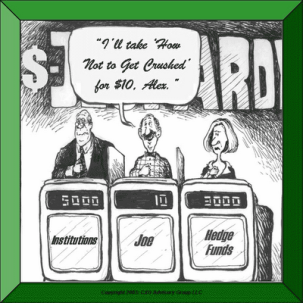
The financial community — institutions … and analysts — are as open to criticism as the media for their shortcoming of wanting too much regardless of consequences. Their standard guideline should henceforth be “better” not “more.”

But in the final analysis the individual investor, not the institutions, has the responsibility for supplying money for big and small businesses. American investors, through individual action and moral persuasion, must make investment work in the world.

Sound topics for your February 1975 club meetings: 1. [Our time-honored principles] 2. [Quality companies] and 3. Triple Play Investing as particularly applicable to today’s market.

I have been investing proceeds in Triple Play situations during 1973-1974 in preparation for the next bull market. If past performance is a guide, the performance should exceed the DJIA by a wide margin.

Triple Play Investing

My instincts on this stuff are generally pretty good … but I have to admit that I smiled a little when encountering this reference to Triple Play investing — considering our recent presentations and efforts at MANIFEST.

Restoring the Capital Markets — March 1975

“Bank director, officers and financial analysts, if they want to avoid another debacle, should understand the 1830 Prudent Man Rule … in its entirety and grasp its essence — which is, that finance must back prudent businessmen, if the Nation is to prosper.

“Manufacturers and labor should speak up — impress their views on the financial community — finance all industries or perish.

“Restore broad and vigorous capital markets. We all need to do our part — savers, investors, labor, management and bankers.

“Thirdly, examine critically Benjamin Graham’s article of Sept-Oct 1974. Does he fail in not separating income from value in a period of inflation?

“Does he stick with the technique of comparison of income to the detriment of using common sense as to value in light of the facts of inflation?

When Harvard Lost But Won — Nicholson’s World, April 1975

In 1831, Harvard lost a law suit. Now it has over a billion dollars.

From 1823 to 1828, the Harvard account balance had declined from $50,000 to $38,000. John McLean died (10/23/1823) and Harvard attempted to recoup the loss via litigation.

The ruling was made in favor of the trustee : “All that can be required of a trustee to invest, is, that he shall conduct himself faithfully and exercise a sound discretion. He is to observe how men of prudence, discretion and intelligence manage their own affairs, not in regard to speculation, but in regard to the permanent disposition of their funds, considering the probable income, as well as the probable safety of the capital invested.”

The Harvard Trust was 100% invested in common stocks and in fundamental industries essential to the industrial growth of a Nation: banking, insurance and manufacturing.

Justice Putnam’s decision was far-sighted and good for the Nation.

Prudent Investing

Nicholson wrote often of the Prudent Man Rule, celebrating his alma mater’s defeat in the courts and their victory in learning more about successful long-term investing and accountability.

Diligence matters and Nicholson was convinced that returns could be enhanced by paying attention to the characteristics of opportunistic growth, excellence in management and superior profitability — the very essence of our continuing quest to this day.

For those paralyzed by watching too much media :), bear down … complete your studies carefully — and when you discover a high-quality company that is appropriate for you, with relatively high projected annual returns, become a watchful owner.

Bull Market & Boom Ahead — Charles Allmon, July 1975

Charles Allmon is nearly unequaled as a stockpicker. His commentaries are among my favorites in the Better Investing archives. He was notoriously bearish on any given day. His portfolios achieved high relative rates of return and his outstanding results have been chronicled and hailed by the Hulbert Financial Digest. That he did this — often with massive amounts of cash equivalents — was an irritant to some of my professional investing colleagues and I’ve witnessed some gnashing of teeth over the years. 🙂

His words here are a timeless testimonial to an exemplary Community of investors. Take a bow.

Is this bull market for real? Probably. There are sufficient doubters around to assure that a generally rising stock market might endure into 1977 or even longer.

One particular group of NAIC investors rate high marks in my book. They’re the experienced investors (20 years or more) in the 60-80 age bracket. It was something of a revelation to find that a surprising number held a contrary view during October 1974 … and generally agreed that better days — even happy days — might lie immediately ahead. I spoke with scores of investors at the 1974 convention. Only the “oldsters” seemed to be tuned to my wavelength on this matter of investor psychology and where they thought we’re headed.

So what else is new?

Sticking to the Knitting, 1973-1983

I’ve written previously of the outstanding stock selections made during the 1970s test of the investing mettle of our Community. We’ll take a closer look at some of the specific selections from the monthly stock features in another “report.”

I’ve also written about the virtues of investing regularly in carefully chosen stocks. Much is made of the “flat spot” in the market from 1969-1982. But we don’t invest in markets, we invest in leadership companies when the price is right. And investing regularly has incredible virtues versus tracking a lump sum invested in 1969 in an attempt to suggest that equity investing is futile — or dangerous.

Hog wash. It’s an UGLY urban myth. One of the ugliest.

In the “Throwing of Towels”, I documented the difference between investing regularly and shared that a return of 11.5% was achieved, during a period when the stock market notoriously gained ONLY 2%.

I’ve experienced similar encounters with the multi-decade crowd that Mr. Allmon salutes — and trust me, they’re thinking about the opportunities presented today a whole lot differently than the media is doing lately.

Do you buy the Bowl or the Goldfish? — Nicholson, August 1975

The goldfish bowl appears to have been an oblique reference to the Prudent Man Rule at the time … We’ve had some discussions about the threat of inflation and its impact on our studies — and we’ll continue that in earnest. Gerald Ford was focused on inflation and it would wreak havoc over the next few years and Nicholson spent considerable time on “inflation investing” during the period. He starts with an extremely contrarian view from Benjamin Graham:

At the midway point of 1975 …

Moreover, the economy seemed to be saucering out and ready to climb. Inflation was weakening. So what was there to worry about?

Price: Another aspect of the moral question is price and inflation. Ben Graham (10/1974) Financial Analysts Journal on “The Future of Common Stocks” emphasized the importance of common stocks and the need to buy at appropriate prices.

Forbes interview (6/15/1975): What about inflation? Doesn’t it wipe out the growth value of common stocks?

Graham replied, “I’m not ready to accept that, after 100 years of being a bullish argument for stocks, inflation could turn out to be a bearish argument. Through inflation, businesses have tremendous assets selling at a discount from their replacement costs. I think it shows the shortsightedness of the financial community not to recognize it.”

Goldfishbowl

Buffett’s 12-Year Horizon & Expectations

The financial media has been picking on Mr. Buffett again, attempting to spew meaningful conclusions over recent investments in General Electric and Goldman Sachs … and assailing his positions in Wells Fargo and American Express. (Will they ever learn?)

His horizon is different and exceeds the comprehension of those assigned to fabricate reasons for market gyrations on a daily basis. I don’t envy them. We’ve seen them use the same reason on different days to explain market direction in opposing directions. 🙂

Morningstar’s Bill Bergman recently shared an outstanding perspective on a very long-term put option purchased by Buffett’s Berkshire Hathaway last year. In a nutshell, Buffett only has to pony up if the stock market is lower 12 years from now than it is right now. In the meantime, Warren gets to “play” with a few billion dollars. ($4 billion, if you’re keeping score)

Bergman’s commentary provides an excellent perspective to wrap this discussion of our dark night, 2008. It includes the answer to, “How often have returns been negative for a 12-year period for as far back as we can measure?” In other words, has Buffett lost his mind?

“Since 1950, using daily data on the S500 (adjusted to include dividends), there are roughly 11,850 days to compare where the index was relative to where it was 12 years earlier. The average 12-year return on the S500 since 1962 was 165%. In other words, since 1962, the S500 has on average more than doubled over any 12-year period. The S500 actually fell below where it was 12 years prior on 58 days over that time frame, or about one half of 1% of the time. The average 12-year change in the S500 for those 58 days was negative 3.5%. In other words, the S500 declined over a 12-year period only one half of 1% of the time, and when it did, the decline was less than 5%.”

“Looking at these data also reinforces how infrequently the 12-year returns have been below zero—and when they were, declines were modest. A single three-month period in 1978 accounts for almost all of the 58 times the 12-year return came in negative. In turn, given that we’ve had a few instances of negative 12-year returns in recent months, a naive look backward suggests the conditional probability of a negative 12-year return from 2007 to 2019, given that longer-term returns have collapsed since 2000, might be even lower than our experience on average since 1950 would suggest.”

Looking Forward

It’s hard to look forward without looking backward. Our expectations are products of experience. In capital markets and economics, one set of tools includes predictive models based on complex math fed with historical data. But the most complex tools are not necessarily the best things in the tool chest. Simpler, wiser judgments can easily trump complex math. On that score, an observation Buffett recently shared with a network TV audience may provide some valuable perspective:

“Ever since 1776, betting against the American people hasn’t been a good idea.”

As Ben Graham suggested, if the math involves anything more than algebra … it’s probably of not much utility in the realm of investment analysis. Stow the tools. Lean on Buffett’s instinct.

Buffett has also mused about the current bear market — sharing openly that he’s seen several of these — and he only hopes to live long enough to see a couple more.

Somewhere in Omaha, an accomplished long-term investor is taking another sip of Cherry Coke and putting his feet on his desk again. He’s thinking about opportunities, closing his eyes, and visualizing where that company seems to be headed over the next five years. Sound familiar?

If Warren is shopping and you’re paralyzed, I’d argue that it’s time to join him. Dark nights are no joke but Nicholson would encourage us to see the opportunity, instead.

Mark Robertson

Value Line Low Total Return Screen (1/11/2013)

I first became aware of Novo Nordisk (NVO) back in 1996 when Charles Carlson mentioned it in one of his newsletters and explained his thesis at an investment conference. His thesis is still intact. The company designs and delivers medical treatments (including innovations in insulin delivery) for diabetes and a variety of other conditions (including coagulation and hormone replacement therapy.) Over the past sixteen years, Novo Nordisk has an annualized total return of 21.3% during a period when the S&P 500 delivered 4.3% — for a relative return of +17.0%! It’s nice to see Value Line give the 3-5 year forecast price a boost in this week’s update. Novo Nordisk might be something of a gold standard for a pounce pile. Buying opportunities have been limited (current conditions aren’t quite there yet) but they’re worth waiting for. We’ll be waiting, watching and willing to accumulate when that time comes.

Materially Stronger: Mylan Labs (MYL), Novo Nordisk (NVO)

Materially Weaker: DuPont (DD), AstraZeneca (AZN), Kelly Services (KELYA), Pan American Silver (PAAS)

Release The Dividend Hounds

Charles Carlson is a long-time favorite in our community (The Individual Investor Revolution, Little Book of Big Dividends)

For the dividend doggers out there, release the dividend hounds!

http://bigsafedividends.com/

On this site, you’ll find up-to-date BSD (Big, Safe Dividend) scores, Quadrix® ratings, dividend and yield information, dividend-payment schedules, and other relevant dividend data on every dividend-paying stock in the Standard & Poor’s 1500 Index. The site provides literally a one-stop shop for all things dividends and is a powerful tool for researching dividend-paying stocks. And by the way, all the information is provided free of charge.

Hallowed Hedge

Goldman Sachs is regarded by many as a potentially effective source of ideas. We count Abby Jo Cohen among our favorites.

Goldman is out with their 40 most undervalued stocks going into 2013. You can check out the dashboard here along with the Business Insider review of the 40 favorites here:

GOLDMAN: These Are The 40 Most Undervalued Stocks In The Market

As displayed on the dashboard, we’ve invested $25,000 into each of the (40) for a total of $1,000,000.

Where’d we get the $1,000,000? Since we’re not in the practice of minting our own $1,000,000,000,000 coins around here, let alone $1,000,000 — we created our own $1,000,000 by finding a willing hypothetical broker who would let us “short” 25 stocks ($40,000 each) to generate the necessary funds.

The dashboard for these (25) despised stocks is available here

Where’d we come up with this list? Business Insider compiled a list of the 25 stocks with the highest short interest as a percentage of float. In short, these are a group of stocks with the most institutional (rhino) smart money betting AGAINST them.

See: The 25 Stocks That Everyone Is Shorting Like Crazy

In a perfect world, our shorted stock reserves will go down in value (it’s what we owe and ultimately must repay) while the (40) loved stocks will advance. But we’d settle for the value of the Goldman faves outpacing the Most-Hated for the purposes of this hedging demonstration.

We’ll check back in a few months to see if the hedge is en fuego.

Making A Point: Rain or Rainbows?

Do You See Rain or Rainbows?

This column originally appeared in the October 2004 issue of Better Investing. I’ve received a number of letters chastising me for forever altering what people see when they look at the Federal Express logo. I got another scolding email this morning. (Grin)

Do you see it? Do you see the arrow that’s part of the Federal Express logo?

How you answer the question will quite often depend on your age. If you’re 15 years old or younger, the answer most often comes in an instant. “Sure, there it is. Doesn’t everybody see it?”

The vast majority of adults need a little more help. Try focusing less on the purple and orange letters and look at the white space between the “E” and the “x.”

I’ve tried this out on a whole bunch of people for the last couple of months. My findings are nearly unanimous. During a recent trip with a group of young people, I conducted my informal poll. Most of the youngsters took it for granted that all of us can see the arrow. In stark contrast, I have encountered very few adults who reacted the same way. The rare exceptions were usually engaged in some form of artistic expression or vocation. Others had heard or read a story about the arrow within the logo.

Making a Point

A debate usually ensued from there depending on your personal levels of curiosity and skepticism. Is this hidden arrow intentional? Is this a form of subliminal advertising by FedEx?

Mike Pulfer of the Cincinnati Enquirer writes:“Little is left to chance in the world of marketing and advertising and, especially, corporate identity. The arrow, in this case, didn’t just happen to be flying through some highly-paid art director’s studio.”

Jess Bunn, FedEx Corp. spokesperson, says: “The arrow was indeed intentional as a secondary design element. If the viewer sees it, it’s a neat, interesting visual bonus. If the viewer doesn’t see it, that’s OK. It’s still a powerful logo. The arrow is intended to communicate movement, speed and the dynamic nature of our company.”

For me, the more interesting aspect of this is why the children and adults who act like children see it differently. Please know that I use the phrase “adults who act like children” with respect and admiration. By its very nature, investing requires a certain level of optimism.

I believe that some of the best investors find a way to harness and maintain a sort of youthful exuberance in their studies of companies and opportunities. Our community of investors focus efforts on discovering leadership companies that display strong growth characteristics.

Continuing to invest in the best companies while prices sag during corrections and bear markets requires a dose of childlike vision and optimism.

What’s different about age 15 and beyond? It all comes down to how humans are “wired.” In 1990 Congress and President Bush declared the 1990s to be the decade of the brain. Much has been learned about the workings of the brain in the last few years. We now know how the brain grows. At birth, a child’s brain contains a hundred billion neurons,a number greater than the number of stars in the Milky Way. During the first 15 years of a child’s life, connections much like highways are built between these neurons. During this stage of growth, eyes are open and the brain is like a sponge.

Through Younger Eyes

Pop music star Gloria Estefan is undoubtedly sharing her experience with her two children, Nayib and Emily, when she sings about how differently our children see the world in the first verse of “Christmas Through Your Eyes”:

Till I had you I didn’t know
That I was missing out
Had to grow up and see the world
Through different shades of doubt
Give me one more chance to dream again
One more chance to feel again
Through your young heart
If for only one day let me try

A subsequent verse makes the biggest distinction between a child’s and an adult’s vision. “I see the rain, you see the rainbow hiding in the clouds.” Many adults that I’ve quizzed on this now tell me that they’re annoyed. It seems that they find it challenging to see anything other than the arrow now.